
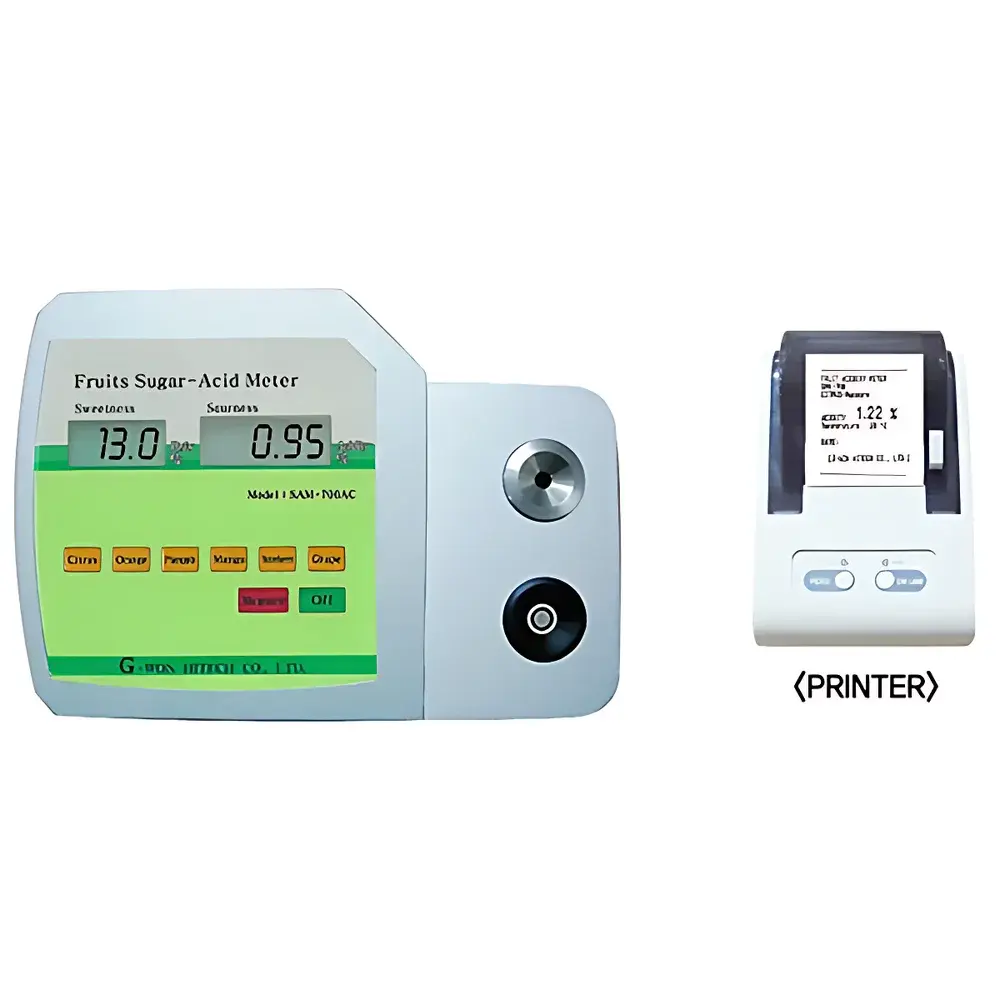
G-WON SAM-706AC Portable Fruit Acidity and Brix Analyzer
| Brand | G-WON |
|---|---|
| Origin | South Korea |
| Model | SAM-706AC |
| Measurement Principle | Conductivity (Acidity), Refractometry (Brix) |
| Brix Range | 0.0–45.0% |
| Acidity Range (as citric acid) | 0.00–3.50% |
| Accuracy | ±0.2% Brix, ±0.05% acidity |
| Resolution | 0.1% Brix, 0.01% acidity |
| Temperature Compensation | Automatic, 5–70 °C |
| Measurement Time | 3 s (Brix), 8 s (acidity) |
| Power Supply | 9 V alkaline battery or AC 220 V/60 Hz |
| Sample Compatibility | Citrus, grape, apple, strawberry, peach, kiwifruit, tomato, plum, cherry, raspberry, mulberry, pomegranate, pineapple, mango, pear, orange, etc. |
| Accessories | 30 mL syringe sampler, filtration unit, pipette with tips, diluent vial, shade hood, anti-theft lock, user manual, AC adapter |
Overview
The G-WON SAM-706AC is a dual-parameter portable analyzer engineered for simultaneous, field-deployable quantification of titratable acidity (expressed as % citric acid equivalent) and soluble solids content (°Brix) in fresh and processed fruit matrices. It integrates two orthogonal analytical principles—conductivity-based acid quantification and temperature-compensated refractometry—within a single handheld platform. Unlike benchtop titration systems or standalone refractometers, the SAM-706AC delivers traceable, repeatable results without reagent consumption or sample derivatization. Its microprocessor-controlled architecture ensures automatic thermal equilibration and real-time compensation across the full operational range (5–70 °C), eliminating manual correction factors common in ambient-temperature-only instruments. Designed for compliance with routine food quality control workflows, it supports rapid pass/fail screening at harvest, receiving docks, processing lines, and R&D laboratories—without requiring dedicated infrastructure or trained chemists.
Key Features
- Dual-mode measurement engine: Conductivity sensor calibrated for organic acid dissociation (citric, malic, tartaric) and Abbe-type optical prism for refractive index conversion to °Brix.
- Auto-ranging calibration: Preloaded species-specific algorithms for 18 fruit types—including citrus, grape, apple, kiwifruit, tomato, and tropical varieties—with user-selectable matrix adjustment to minimize matrix interference.
- Integrated temperature compensation: Thermistor-coupled measurement loop corrects both conductivity and refractive index readings in real time per ISO 2173 (fruit juice analysis) and AOAC 932.12 (Brix determination).
- Low-maintenance operation: No consumable electrodes, no buffer solutions, no optical solvent cleaning—only periodic calibration verification using certified sucrose and citric acid standards.
- Field-ready ergonomics: IP54-rated enclosure, shade hood for outdoor ambient light rejection, and dual power options (9 V battery for >2,000 measurements or AC adapter for continuous lab use).
- Regulatory-aligned data handling: Timestamped measurement logs with operator ID tagging, compatible with GLP-compliant audit trails when paired with optional thermal printer (G-WON PRT-01).
Sample Compatibility & Compliance
The SAM-706AC accepts homogenized, filtered fruit juices and pulps with suspended solids <50 µm (achieved via included filtration unit). It is validated per AOAC Official Method 985.25 for Brix and ASTM D1072–17 for total acidity estimation in high-water-content produce. The instrument meets IEC 61010-1 safety requirements for portable electrical equipment and complies with electromagnetic compatibility (EMC) standards EN 61326-1. While not a primary reference method, its performance aligns with QC acceptance criteria defined in Codex Alimentarius STAN 247–2005 (fruit juice specifications) and USP for analytical procedure verification under routine testing conditions.
Software & Data Management
Data output is supported via RS-232 serial interface (DB9 connector) to external PCs or printers. The embedded firmware stores up to 500 measurement records with date/time stamp, selected fruit type, Brix value, acidity value, and measured temperature. When connected to G-WON’s optional PC software (SAM-Link v3.2), users can export CSV-formatted datasets for statistical process control (SPC), generate batch reports compliant with ISO/IEC 17025 documentation requirements, and apply trend analysis across harvest seasons. All stored data includes immutable metadata required for FDA 21 CFR Part 11–aligned electronic records in regulated environments—provided system-level access controls and audit trail activation are configured externally.
Applications
- Harvest maturity assessment: Real-time Brix/acidity ratio evaluation for optimal picking windows in orchards and vineyards.
- Receiving inspection: Rapid verification of incoming fruit lots against contractual quality thresholds (e.g., ≥12.0°Brix + ≤0.85% acidity for dessert apples).
- Process monitoring: In-line tracking of juice concentration, blending consistency, and fermentation onset in juice and puree production.
- R&D formulation: Screening of cultivar-specific acid-sugar profiles during breeding programs or product development.
- Educational labs: Teaching quantitative food chemistry concepts including colligative properties (Brix) and electrolyte behavior (acidity).
FAQ
Does the SAM-706AC require daily calibration?
No—calibration is recommended before first use, after battery replacement, and at the start of each shift in high-volume settings. Two-point verification (zero and mid-range standard) satisfies ISO 8655-6 verification intervals.
Can it measure undiluted citrus juice?
Yes, but high-acid samples (>2.0% citric acid) must be pre-filtered through the supplied 0.45 µm membrane to prevent particulate fouling of the conductivity cell.
Is temperature compensation valid for frozen-thawed samples?
Only if the sample has fully equilibrated to the instrument’s internal sensor temperature (5–70 °C); rapid thermal gradients will transiently affect conductivity stability.
What is the shelf life of the included diluent solution?
The 100 mL diluent vial remains stable for 12 months unopened; once opened, use within 30 days under refrigerated, sealed conditions.
How does it handle pulp-rich fruits like mango or banana?
Homogenization followed by centrifugation (≥3,000 ×g, 5 min) or double-filtration is required to achieve acceptable turbidity levels (<10 NTU) for refractive index accuracy.






