
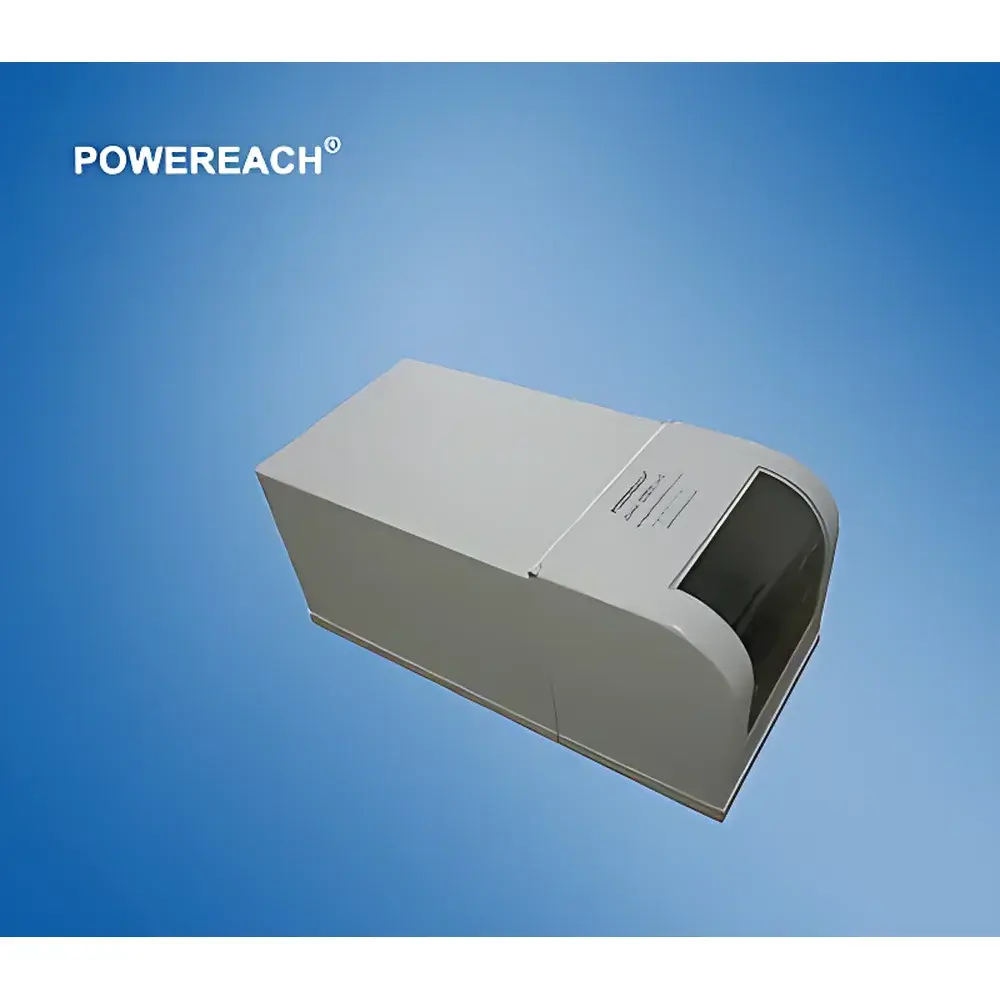
JS94K2M Zeta Potential Analyzer (Microelectrophoresis Instrument)
| Origin | Beijing, China |
|---|---|
| Manufacturer Type | Authorized Distributor |
| Origin Category | Domestic (China-made) |
| Model | JS94K2M |
| Price Range | USD 7,000–14,000 |
| Zeta Potential Range | ±3000 mV |
| pH Operating Range | 2.0–12.0 (extended range 1.6–13.0, resolution 0.1) |
| Temperature Operating Range | 5–35 °C (resolution 0.1 °C) |
| Accuracy | ≤5% |
| Repeatability | ≤5% |
| Sample Volume per Measurement | 0.5 mL |
| Optical Magnification | Up to 1200× |
| Particle Size Range | 0.2–50 µm (aqueous & non-aqueous dispersions) |
| Voltage Polarity Switching Time | Adjustable from 0.30–1.20 s |
| Power Supply | 220 V, 50 Hz, 150 W |
Overview
The JS94K2M Zeta Potential Analyzer is a microelectrophoresis-based instrument engineered for precise determination of electrophoretic mobility and subsequent calculation of zeta potential in colloidal dispersions and emulsions. It operates on the principle of laser-assisted microelectrophoresis: charged particles suspended in a liquid medium migrate under a controlled, low-frequency alternating electric field, and their velocity is optically tracked using a high-magnification (up to 1200×), semiconductor-emitted blue/green light optical system. This near-field illumination minimizes thermal perturbation (<50 µW output), preserving dispersion stability during measurement. The instrument is uniquely optimized for non-aqueous systems—where higher applied voltages are required to induce measurable particle motion—while maintaining full compatibility with aqueous media. Its design supports rigorous surface charge characterization critical to formulation development, stability prediction, and interfacial reaction mechanism studies across industrial and academic laboratories.
Key Features
- Integrated microelectrophoresis cell: 0.5 cm-thick borosilicate glass cuvette with embedded Ag/AgCl, Pt, and Ti electrodes—surface-treated for electrochemical stability and minimal polarization.
- Open-cup electrophoresis architecture: Precision-machined electrode holder ensures reproducible alignment and eliminates stagnant layer artifacts common in capillary-based systems.
- Real-time optical calibration: Motorized XYZ stage with crosshair reticle enables rapid, operator-independent positioning; magnification is validated in situ using a certified calibration scale before each run.
- Low-power, short-wavelength optical imaging: Dual-band (450 nm / 520 nm) LED illumination enhances contrast for sub-micron particles without inducing thermal convection or photodamage.
- Programmable AC field generation: Constant-voltage, low-frequency (0.1–5 Hz) bipolar power supply with adjustable polarity reversal timing (0.30–1.20 s); voltage amplitude is user-selectable to accommodate high-resistivity organic solvents.
- Automated environmental compensation: Integrated Pt100 temperature probe continuously feeds real-time thermal data to the analysis engine, correcting electrophoretic mobility for viscosity and dielectric permittivity variations.
Sample Compatibility & Compliance
The JS94K2M accommodates both aqueous and non-aqueous dispersions—including polar solvents (e.g., ethanol, DMF), apolar media (e.g., toluene, hexane), and mixed-phase emulsions—without requiring cell replacement or hardware modification. Its operational pH range spans 1.6–13.0 (standard use: 2.0–12.0), enabling characterization across extreme acid/base conditions relevant to catalyst synthesis, pharmaceutical nanosuspensions, and mineral flotation chemistry. While not certified to ISO 13099 or ASTM D7825 by default, the instrument’s measurement traceability aligns with core principles of those standards: calibrated pixel-to-distance mapping, temperature-stabilized electrophoretic mobility conversion, and documented uncertainty budgets (≤5% accuracy and repeatability). For regulated environments, raw image sequences and mobility time-series data are exportable in CSV/TIFF formats to support internal GLP audit trails and 21 CFR Part 11–compliant data archiving when integrated with validated LIMS platforms.
Software & Data Management
The native acquisition software runs on Windows OS and implements automated image capture at fixed intervals synchronized with field polarity switching. Four consecutive grayscale frames (two per polarity direction) are acquired per cycle, enabling bidirectional velocity averaging to suppress directional bias. All processing—including centroid tracking, mobility calculation via Henry’s equation (with Smoluchowski or Hückel correction selectable), and zeta potential derivation using the Helmholtz–Smoluchowski relation—is performed in real time. Raw images, intermediate mobility values, and final zeta distributions are stored with metadata (pH, T, voltage, date/time, operator ID). Export options include PDF reports with embedded calibration logs, Excel-compatible .csv datasets, and TIFF stacks for third-party validation. No cloud dependency: all data reside locally unless explicitly exported; no telemetry or remote access functionality is included.
Applications
- Colloidal stability assessment in cosmetic emulsions (e.g., silicone-in-water, oil-in-ethanol) and polymer dispersions.
- Surface charge profiling of nanocellulose, quantum dots, and metal–organic frameworks (MOFs) in organic processing media.
- Optimization of flocculant dosage in mineral ore beneficiation via zeta-potential titration curves.
- Characterization of liposomal and polymeric nanoparticle formulations under physiologically relevant pH gradients (e.g., gastric vs. intestinal conditions).
- Teaching laboratory implementation: quantitative demonstration of the Stern–Gouy–Chapman model, isoelectric point determination, and Debye length dependence on ionic strength.
- Environmental science: charge behavior of microplastics and engineered nanomaterials in seawater analogues and sediment pore water extracts.
FAQ
What sample volume is required per measurement?
0.5 mL per analysis. The compact electrophoresis cell design minimizes consumption while ensuring laminar flow conditions.
Can the instrument measure zeta potential in high-viscosity solvents like glycerol or ethylene glycol?
Yes—provided the solvent conductivity permits sufficient current density. Users must manually input viscosity and dielectric constant values into the software for accurate mobility-to-zeta conversion.
Is calibration required before every test?
Yes. A certified optical scale must be imaged prior to each session to verify magnification factor; this step is mandatory for traceable results.
Does the system comply with FDA or ISO regulatory requirements for quality control labs?
It meets foundational metrological requirements of ISO 13099 and ASTM D7825 but requires site-specific validation (e.g., IQ/OQ/PQ) and procedural documentation to satisfy GMP/GLP or 21 CFR Part 11 compliance.
How is temperature controlled during measurement?
The instrument monitors ambient temperature continuously via an internal Pt100 probe; however, active thermostating requires an external recirculating chiller or climate-controlled lab environment (recommended: ±0.5 °C stability).



