
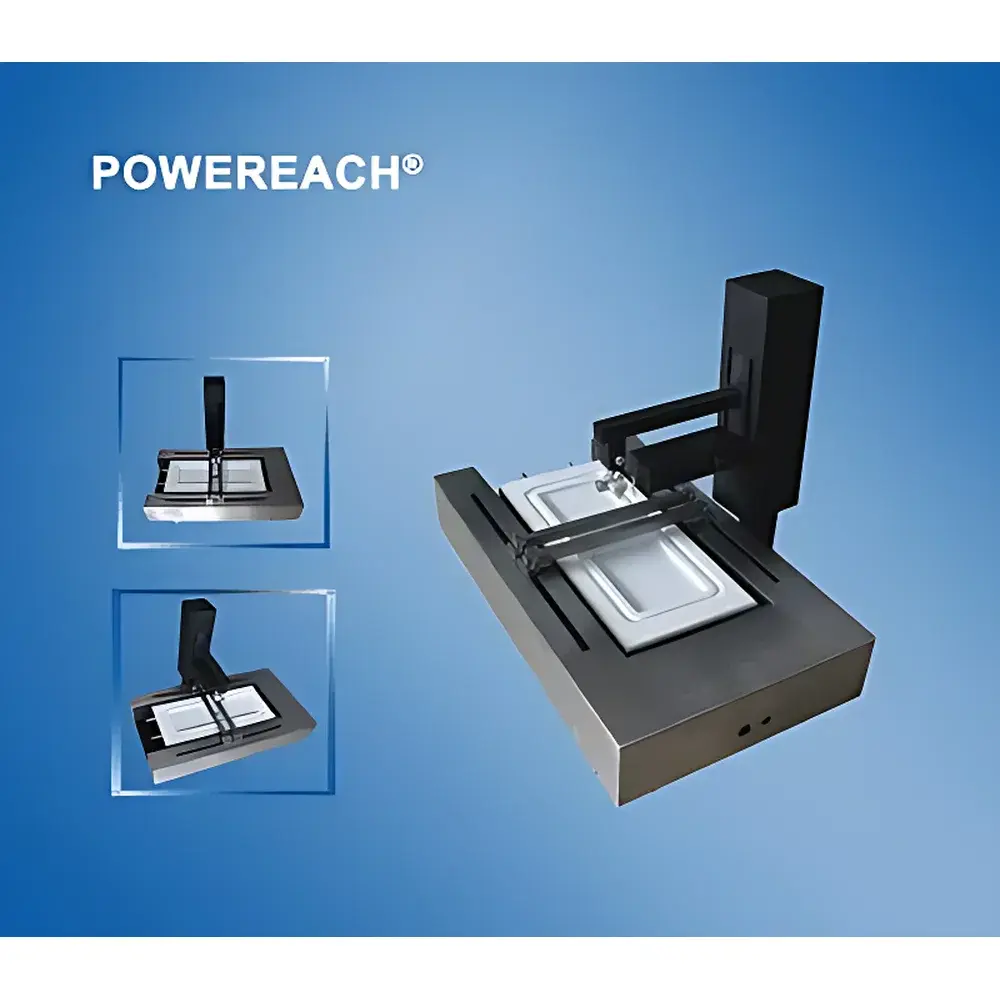
JML04C1 Langmuir-Blodgett Trough System with Wilhelmy Plate Surface Tensiometry
| Origin | Shanghai, China |
|---|---|
| Manufacturer Type | Authorized Distributor |
| Origin Category | Domestic (PRC) |
| Model | JML04C1 |
| Price Range | USD 14,000 – 28,500 |
| Surface Tension Range | 0–150 mN/m |
| Resolution | 0.05 mN/m |
| Measurement Method | Wilhelmy Plate (Wilhelmy-Type) |
| Trough Material | PTFE (Fully Fluorinated) |
| Trough Dimensions | 200 mm × 80 mm |
| Compression Ratio | Up to 90% |
| Barrier Type | Leakproof Movable Barrier |
| Barrier Speed | 0.48–97 mm/min |
| Deposition Speed | 0.22–45 mm/min |
| Deposition Modes | Upward & Downward |
| Power Supply | AC 220 V ±10%, 50 Hz |
| Max. Power Consumption | 150 W |
| Operating Temperature | Ambient (with optional external thermostatic bath support) |
| Relative Humidity | 30–85% RH |
| Software Interface | Windows-based GUI with real-time A–π and A–γ curve acquisition, exportable ASCII/CSV, post-processing capability |
| Compliance | Designed for GLP-aligned laboratory workflows |
Overview
The JML04C1 Langmuir-Blodgett Trough System is a precision-engineered platform for quantitative interfacial thermodynamics and monolayer engineering at the air–water interface. Based on the classical Langmuir trough architecture and integrated Wilhelmy plate tensiometry, it enables real-time, high-resolution measurement of surface pressure (π) and surface tension (γ) as a function of molecular area (A), generating fundamental π–A and γ–A isotherms. This system operates on the principle of controlled lateral compression of amphiphilic monolayers—such as phospholipids, surfactants, peptides, polymers, and synthetic lung surfactant analogs—on a purified aqueous subphase. Its design adheres to established physical chemistry conventions for monolayer characterization, supporting rigorous investigation into phase transitions, collapse pressure, compressibility modulus, and monolayer stability—parameters directly relevant to biomembrane biophysics, pulmonary surfactant dysfunction (e.g., in NRDS and ARDS), and functional thin-film fabrication.
Key Features
- Fully automated operation via embedded microcontroller and host PC, minimizing operator-induced variability and enabling reproducible monolayer compression/deposition cycles.
- High-precision Wilhelmy plate sensor with 0.05 mN/m resolution and 0–150 mN/m dynamic range, calibrated traceably to NIST-traceable standards.
- PTFE-coated Langmuir trough (200 mm × 80 mm active area) ensuring chemical inertness, ultra-low leakage (<0.1 mm²/min), and minimal edge effects during barrier movement.
- Leakproof, motorized barrier with programmable speed control (0.48–97 mm/min), capable of >90% area compression with sub-micron positional repeatability.
- Adjustable vertical deposition stage supporting both upward and downward LB transfer at speeds from 0.22 to 45 mm/min, compatible with hydrophilic/hydrophobic substrates (e.g., Si wafers, mica, glass, ITO).
- Real-time isotherm acquisition and visualization: simultaneous π–A and γ–A plots with automatic annotation of onset of condensation, phase transition points, and collapse pressure.
- Programmable deposition protocols—including constant-pressure mode, stepwise compression, and cyclic expansion–compression—enabling advanced monolayer rheology and hysteresis analysis.
- Low-noise mechanical architecture with vibration-damped base and thermal isolation, suitable for operation in standard ISO Class 7–8 laboratory environments without dedicated acoustic or thermal enclosures.
Sample Compatibility & Compliance
The JML04C1 accommodates a broad spectrum of amphiphilic systems: natural and synthetic phospholipids (DPPC, POPG), pulmonary surfactant extracts, block copolymers, dendrimers, peptide–lipid hybrids, and conjugated organic semiconductors. Subphase composition (e.g., Ca²⁺-doped buffers, pH-adjusted solutions, saline variants) is fully configurable. The system meets foundational requirements for regulatory-compliant research environments: raw data files include timestamps, operator IDs, instrument configuration metadata, and calibration logs—supporting GLP documentation practices. While not FDA 21 CFR Part 11-certified out-of-the-box, its software architecture permits integration with validated LIMS or ELN platforms for electronic signature and audit trail compliance where required.
Software & Data Management
The Windows-native application provides intuitive, menu-driven control of all hardware functions. Isotherm curves are rendered in real time with adjustable scaling, smoothing, and derivative overlays (e.g., dπ/dA for compressibility modulus). All datasets export natively to CSV and ASCII formats, preserving full precision for downstream statistical analysis (e.g., MATLAB, Python SciPy, OriginLab). Graphs support direct printing and PDF export with customizable legends, axis labels, and annotations. Batch processing tools allow alignment and normalization across multiple runs—critical for comparative studies of surfactant formulations or environmental organic matter isolates.
Applications
- Biophysical characterization of pulmonary surfactant monolayers in NRDS/ARDS pathophysiology modeling.
- Development and QC of synthetic surfactant therapeutics and lipid nanoparticle (LNP) delivery systems.
- Interfacial behavior of dissolved organic matter (DOM) in aquatic systems—relevant to water treatment fouling and coagulation efficiency.
- Preparation of ultrathin functional films for sensors, OFETs, and nonlinear optical devices via LB assembly.
- Thermodynamic profiling of peptide–membrane interactions and antimicrobial surfactant mechanisms.
- Education and training in colloid & interface science, soft matter physics, and pharmaceutical formulation science.
FAQ
What subphase temperature control options are available?
The JML04C1 operates at ambient temperature by default; an external recirculating chiller or thermostatic bath (e.g., Julabo F25) can be connected via inlet/outlet ports on the trough base.
Can the system perform multi-layer deposition?
Yes—sequential up-and-down transfers enable Y-type, X-type, or Z-type multilayer architectures, with layer count limited only by substrate compatibility and monolayer integrity.
Is the Wilhelmy plate sensor replaceable and recalibratable in-house?
The platinum-iridium Wilhelmy plate is field-replaceable; calibration uses standard ethanol/water mixtures per ASTM D971 and ISO 6295 protocols—no proprietary tools required.
Does the software support automated protocol sequencing across multiple samples?
Yes—scriptable method templates allow unattended execution of multi-step experiments (e.g., preconditioning → compression → hold → deposition → rinse), with error logging and pause/resume functionality.
Are custom trough geometries or dual-trough configurations supported?
Yes—custom PTFE troughs (including 300 mm × 100 mm, 300 mm × 200 mm, or dual independent troughs) are available under OEM engineering services with lead-time consultation.



