
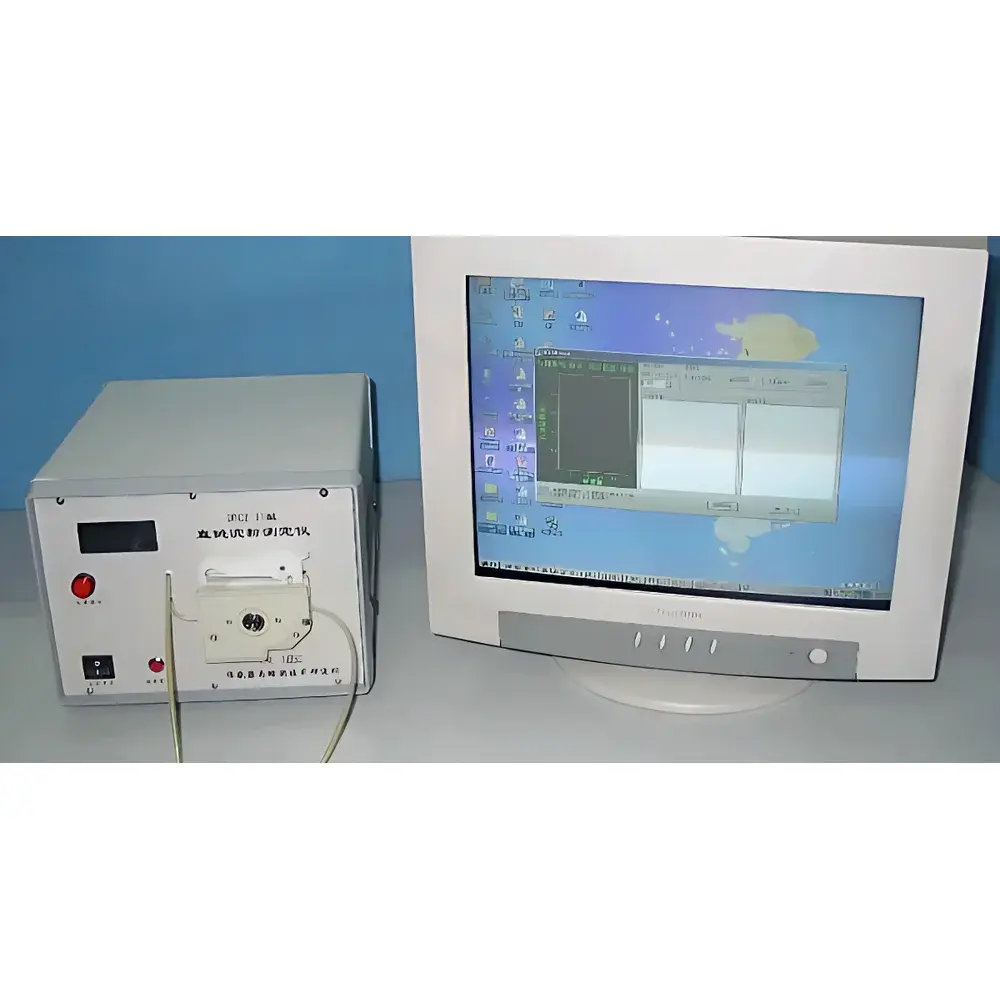
DPCZ Series Amylose Content Analyzer
| Origin | Beijing, China |
|---|---|
| Manufacturer Type | Authorized Distributor |
| Origin Category | Domestic (PRC) |
| Model | DPCZ |
| Price Range | USD 4,200 – 7,000 |
| Instrument Type | Manual Operation |
| Haze Range | 0–30% |
| Transmittance Range | 0–100% |
| Haze Repeatability | ±0.2% |
| Transmittance Repeatability | ±0.5% |
| Amylose Detection Range | 0–50% (w/w) |
| Accuracy | ±1% (absolute amylose content) |
| Measurement Time per Sample | ~60 s (excluding sample preparation) |
| Interface | RS-232 serial communication |
| Software Platform | Windows-based control and analysis suite |
Overview
The DPCZ Series Amylose Content Analyzer is a dedicated spectrophotometric instrument engineered for the quantitative determination of amylose concentration in cereal grains—including rice, wheat, maize, and millet—based on the iodine-binding colorimetric principle. Amylose forms a stable blue-colored complex with iodine in aqueous solution, with absorbance intensity at 620 nm directly proportional to amylose content. This method is standardized in multiple national and industry specifications, including GB/T 15683–2008 (China), AACC Method 38–12, and ISO 6647-1. The DPCZ system integrates a precision optical path, thermally stabilized cuvette holder, and high-stability tungsten-halogen light source to ensure consistent spectral output across repeated measurements. Unlike general-purpose spectrophotometers, the DPCZ is purpose-built: its optical design minimizes stray light, optimizes signal-to-noise ratio at the critical 620 nm band, and eliminates manual wavelength selection through fixed-bandpass filtering. The instrument operates as a turnkey solution comprising the analyzer unit and dedicated Windows-based software, enabling full assay workflow control—from reagent blanking and calibration curve generation to sample measurement and report export.
Key Features
- Fixed-wavelength photometric detection at 620 nm optimized for iodine–amylose complex quantification
- Thermally stabilized optical bench ensuring <0.002 AU/h baseline drift under ambient laboratory conditions (20–25°C)
- RS-232 serial interface compliant with standard COM port protocols for reliable host communication
- Pre-configured calibration routines supporting both single-point and multi-point (3–5 point) linear regression per batch
- Onboard memory buffer for up to 99 sample records; automatic timestamping and operator ID tagging
- Manual sample loading with 10-mm pathlength quartz cuvettes; compatible with standard 1-cm square cuvettes
- Integrated self-diagnostic routine verifying lamp intensity, detector response, and dark-current stability prior to each assay cycle
Sample Compatibility & Compliance
The DPCZ analyzer accepts homogenized, gelatinized, and iodine-reacted extracts from milled cereal grains prepared according to GB/T 15683–2008 or AACC 38–12 protocols. It supports both whole-grain flour and polished rice samples following standardized dispersion, alkaline dissolution, and iodine addition steps. All measurement outputs comply with metrological traceability requirements for food quality testing laboratories operating under ISO/IEC 17025:2017. The system meets electromagnetic compatibility (EMC) Class B limits per GB/T 18268.1–2010 and conforms to electrical safety standards GB 4793.1–2007 (equivalent to IEC 61010-1). While not FDA 21 CFR Part 11–validated out-of-the-box, audit trails, user access logs, and electronic signature support can be implemented via optional software configuration for GLP/GMP environments.
Software & Data Management
The bundled Windows application (v3.2+, compatible with Windows 10/11 64-bit) provides full assay lifecycle management. Users define sample batches, assign identifiers, import reference standards, and execute automated calibration. Raw absorbance values are converted to amylose % using pre-loaded polynomial or linear equations. Data are stored in encrypted SQLite databases with field-level audit logging—including parameter changes, recalibrations, and result overrides. Export options include CSV, PDF reports with embedded calibration curves, and XML for LIMS integration. The software supports configurable pass/fail thresholds per grain type and generates summary statistics (mean, SD, CV%) across replicates. All data files carry digital watermarks indicating instrument ID, firmware version, and measurement timestamp.
Applications
- Routine amylose screening in grain procurement centers for varietal classification (e.g., distinguishing waxy vs. non-waxy rice)
- Quality control in milling and parboiling facilities to monitor starch retrogradation behavior
- Research applications in cereal breeding programs evaluating amylose–amylopectin ratios as functional trait markers
- Food product development labs assessing starch functionality for texture, viscosity, and freeze–thaw stability
- Educational use in food science curricula for hands-on instruction in spectrophotometric assay validation and uncertainty estimation
FAQ
What sample preparation protocol is required prior to analysis?
Standardized extraction must follow GB/T 15683–2008: defatted flour is dispersed in NaOH, heated to complete gelatinization, cooled, and reacted with potassium iodide–iodine reagent. Filtration or centrifugation is required to remove particulates before measurement.
Can the DPCZ analyze raw, uncooked grain without milling?
No. Homogeneous fine flour (<100 µm particle size) is mandatory to ensure complete starch liberation and reproducible iodine complex formation.
Is the instrument suitable for amylopectin quantification?
No. The DPCZ is specifically calibrated for amylose. Amylopectin content is inferred by difference (100% − amylose % − moisture % − ash %) per standard cereal composition models.
Does the system support external printers or networked data transfer?
Direct USB or network printing is not natively supported; reports must be exported to file first. However, CSV exports can be ingested by enterprise MES or LIMS platforms via scheduled FTP or shared-folder polling.
What maintenance is required for long-term optical stability?
Annual verification of lamp output intensity and detector linearity is recommended using NIST-traceable neutral density filters. Cuvette pathlength verification with distilled water blank is advised before each daily session.




