
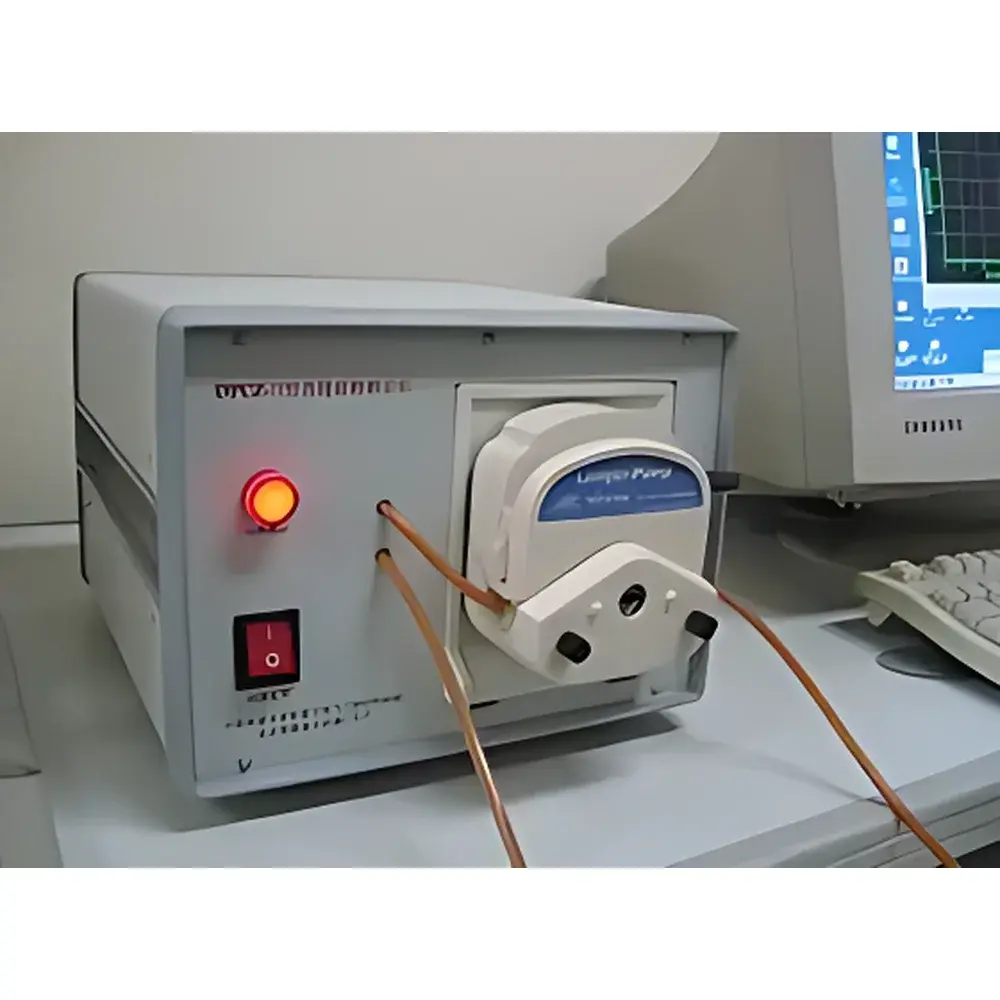
DPCZ-II Amylose Content Analyzer
| Origin | Beijing, China |
|---|---|
| Manufacturer Type | Authorized Distributor |
| Regional Origin | Domestic (China) |
| Model | DPCZ-II |
| Pricing | Available Upon Request |
| Detection Principle | Spectrophotometric Absorption (Iodine-Blue Complex Method) |
| Sample Types | Milled rice, wheat, maize (corn), millet |
| Measurement Range | 0–50% (w/w, amylose content) |
| Accuracy | ±1% (relative to reference method per GB/T 15683-2008 or ISO 6647-1) |
| Measurement Time | ~60 seconds per sample (post-extraction) |
| Interface | RS-232 serial communication with Windows-based control software |
| Compliance | Designed for alignment with Chinese national standard GB/T 15683 and international cereal quality testing protocols |
Overview
The DPCZ-II Amylose Content Analyzer is a dedicated spectrophotometric instrument engineered for rapid, reliable quantification of amylose concentration in milled cereal grains—including rice, wheat, maize, and millet. It operates on the well-established iodine-binding principle: amylose forms a stable blue-colored complex with iodine in aqueous solution, exhibiting characteristic absorbance at 620 nm. This optical signal is linearly correlated with amylose mass fraction within the validated 0–50% (w/w) range. Unlike general-purpose UV-Vis spectrophotometers, the DPCZ-II integrates optimized optical path design, temperature-stabilized cuvette holders, and pre-calibrated reagent delivery protocols to minimize inter-operator variability and matrix interference from amylopectin and soluble proteins. Its architecture reflects the industry shift toward application-specific instrumentation—prioritizing reproducibility, operational simplicity, and traceable calibration over broad spectral flexibility.
Key Features
- Optimized dual-beam photometric system with tungsten-halogen light source and narrow-band interference filter centered at 620 nm, ensuring high signal-to-noise ratio and minimal drift during sequential analysis.
- Dedicated sample handling workflow: integrated reagent mixing chamber, timed incubation stage (90 s at 25°C), and automated cuvette positioning—reducing manual steps and human error.
- RS-232 serial interface compliant with EIA/TIA-232-F standards, enabling deterministic handshake protocol and robust data transmission to host PC under Windows 7/10/11.
- Onboard microcontroller manages timing-critical operations (e.g., reaction initiation, measurement trigger, blank correction), decoupling hardware execution from host software latency.
- Calibration traceability: factory-default curves generated using NIST-traceable amylose reference materials (potato amylose, Sigma-Aldrich A0512) and verified against GB/T 15683-2008 procedural repeatability criteria.
Sample Compatibility & Compliance
The DPCZ-II accepts homogenized, defatted flour samples prepared per GB/T 5491–1985 (cereal grain sampling) and GB/T 5492–2008 (grain grinding specifications). It accommodates standard 10-mm pathlength quartz or high-transmission glass cuvettes (1.5 mL volume). The instrument’s measurement protocol aligns with the core analytical requirements of ISO 6647-1:2017 (rice—determination of amylose content), though final certification requires laboratory-specific validation per ISO/IEC 17025:2017. While not FDA 21 CFR Part 11–compliant out-of-the-box, its audit trail functionality (timestamped raw absorbance logs, operator ID input, version-stamped calibration files) supports GLP-aligned documentation when deployed in regulated QA/QC environments.
Software & Data Management
The Windows-based control software provides a deterministic, non-modal user interface with three functional layers: (1) Method Editor—configuring dilution factors, standard curve points (up to 6-point polynomial fit), and pass/fail thresholds; (2) Acquisition Module—real-time absorbance display, automatic baseline correction using solvent blank, and outlier detection via Grubbs’ test (α = 0.05); (3) Reporting Engine—generating PDF reports compliant with internal SOPs, including sample ID, operator, date/time stamp, raw A620, calculated % amylose, and uncertainty estimate (±1% as specified). All data files are stored in open CSV format with UTF-8 encoding, facilitating import into LIMS or statistical analysis platforms (e.g., JMP, R).
Applications
- Grain trading and procurement: Rapid screening of paddy rice lots for amylose classification (e.g., 25% = non-glutinous) prior to milling and blending.
- Food product development: Monitoring amylose variation across wheat cultivars for noodle texture optimization or maize hybrids for starch film-forming capacity.
- Seed breeding programs: High-throughput phenotyping of F2 or BC1 populations where amylose content serves as a marker trait linked to Waxy gene expression.
- Regulatory compliance testing: Supporting documentation for national grain quality grading systems (e.g., China’s GB 1354–2018 rice standard) and export certification dossiers requiring amylose specification.
FAQ
What reference standard is used for calibration?
The DPCZ-II is calibrated using certified potato amylose (CAS 9005-80-7) traceable to NIST SRM 1849a, with verification against in-house rice flour reference materials characterized by AOAC 975.20.
Can the instrument measure amylopectin directly?
No. Amylopectin is inferred by difference (100% – amylose % – moisture % – ash % – protein %), following standard proximate analysis protocols. Direct amylopectin quantification requires enzymatic hydrolysis (e.g., ISO 21527-1).
Is method validation required before routine use?
Yes. Per ISO/IEC 17025 Clause 7.2.2, laboratories must verify performance characteristics—including precision (RSD ≤ 2.5% for n=6 replicates), linearity (r² ≥ 0.999 over 5–45% range), and specificity—using locally sourced matrix-matched controls.
Does the system support networked deployment?
The base configuration uses point-to-point RS-232. For multi-instrument networks, optional USB-to-RS232 converters with virtual COM port drivers enable integration into centralized data acquisition systems.
How often must the optical system be recalibrated?
Photometric zero and gain calibration are performed automatically at startup. Annual verification of wavelength accuracy (using holmium oxide filter) and photometric linearity (neutral density filters) is recommended per manufacturer maintenance schedule.





