
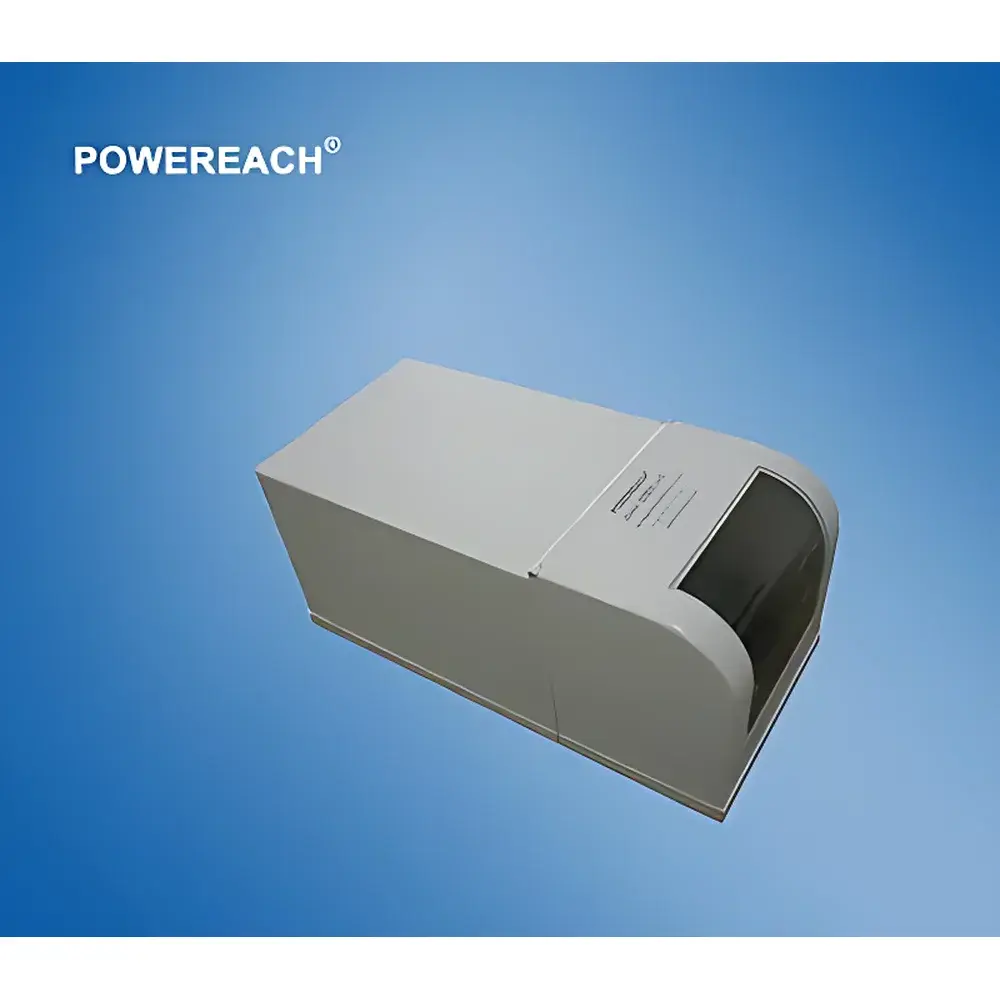
Zhongchen JS94H2M Zeta Potential Analyzer (Microelectrophoresis Instrument)
| Origin | Beijing, China |
|---|---|
| Manufacturer Type | Distributor |
| Origin Category | Domestic (China) |
| Model | JS94H2M Zeta |
| Price Range | USD 7,000–14,000 |
| Zeta Potential Range | ±3000 mV |
| pH Range | 0–14 |
| Operating Temperature Range | 5–35 °C |
| pH Resolution | 0.1 |
| Temperature Resolution | 0.1 °C |
| Accuracy | ≤5% |
| Repeatability | ≤5% |
| Particle Size Compatibility | 0.5–20 µm |
| Solvent Compatibility | Aqueous and non-aqueous dispersions |
| Optical System | Semiconductor-based blue/green LED illumination (low-power, <100 µW), 1200× digital magnification |
| Electrophoretic Cell | Integrated Ag/Pt/Ti electrodes in 0.5 cm-thick borosilicate glass cuvette |
| Voltage Control | Adjustable DC bias with polarity reversal (0.30–1.20 s interval) |
| Data Acquisition | Real-time temperature compensation |
Overview
The Zhongchen JS94H2M Zeta Potential Analyzer is a microelectrophoresis instrument engineered for precise determination of electrophoretic mobility and subsequent calculation of zeta potential (ζ) in colloidal dispersions and emulsions. Based on the principle of laser-assisted microelectrophoresis—where charged particles migrate under a controlled electric field while their velocity is optically tracked—the system delivers quantitative surface charge characterization at the solid–liquid or liquid–liquid interface. This measurement is critical for assessing colloidal stability, predicting aggregation behavior, identifying isoelectric points (IEP), and optimizing surface modification protocols across R&D and quality control environments. The JS94H2M is specifically designed to support both aqueous and non-aqueous systems, including organic solvents commonly used in pharmaceutical suspensions, pigment dispersions, and nanomaterial formulations—addressing a key limitation of conventional aqueous-only zeta analyzers.
Key Features
- Optimized electrophoretic cell architecture: 0.5 mm path-length borosilicate glass cuvette with integrated Ag/Pt/Ti electrodes—surface-treated for electrochemical stability and minimal Faradaic interference.
- Low-power semiconductor optical system: Blue/green LED illumination (λ ≈ 450–520 nm) enables high-contrast visualization of sub-micron particles without thermal perturbation of the dispersion medium.
- Precision motion tracking: Computer-controlled 1200× digital magnification with real-time bidirectional grayscale image acquisition (four frames per measurement cycle) ensures robust mobility quantification even for weakly scattering particles.
- Adaptive voltage control: Programmable polarity reversal timing (0.30–1.20 s) minimizes electrode polarization and improves signal-to-noise ratio; adjustable DC bias accommodates high-resistivity non-aqueous media.
- Integrated environmental monitoring: Onboard Pt100 temperature probe and high-resolution pH input (0.1 unit) enable automatic correction of electrophoretic mobility to standard conditions using Henry’s or Smoluchowski approximations.
- Economical sample usage: Requires only 0.5 mL per measurement; rapid cell rinsing protocol supports high-throughput screening of formulation variants.
Sample Compatibility & Compliance
The JS94H2M accommodates a broad range of dispersed phases—including inorganic nanoparticles (e.g., SiO₂, TiO₂, Fe₃O₄), polymeric microspheres, liposomes, protein aggregates, and pigment suspensions—in both water-based and organic media (e.g., ethanol, toluene, DMF). Its extended pH range (0–14) and temperature tolerance (5–35 °C) allow characterization under physiologically relevant, acidic catalyst, or alkaline processing conditions. While not pre-certified to ISO 13099 or ASTM D7826, the instrument’s operational methodology aligns with the foundational principles outlined in these standards for electrophoretic light scattering (ELS) and microelectrophoresis. For regulated environments, raw data export (CSV, TXT) supports traceability, and manual audit trails can be maintained per GLP requirements.
Software & Data Management
The proprietary acquisition software provides real-time visualization of particle trajectories, automated mobility histogram generation, and ζ-potential calculation using user-selectable models (Smoluchowski, Hückel, or Henry). All measurement parameters—including voltage, temperature, pH, frame rate, and reversal timing—are logged with timestamps. Exported datasets include mobility distributions, mean ζ-values, standard deviations, and confidence intervals. No cloud connectivity or remote access is embedded; all data reside locally, enabling full compliance with internal IT security policies and facilitating integration into validated LIMS or ELN platforms via standardized file I/O.
Applications
- Formulation development in cosmetics (emulsion stability prediction) and pharmaceuticals (nanocarrier surface charge optimization).
- Quality assurance of ceramic slurries, inkjet inks, and battery electrode dispersions.
- Environmental science: assessment of nanoparticle fate in soil leachates or wastewater matrices.
- Academic research: mechanistic studies of adsorption, ligand exchange, and interfacial protonation equilibria.
- Materials science: screening of surfactant efficacy, polymer grafting density, and pH-responsive behavior of smart colloids.
FAQ
What dispersion media are compatible with the JS94H2M?
Aqueous buffers, deionized water, and common organic solvents (e.g., ethanol, isopropanol, acetone, toluene, DMF) are supported. Conductivity should remain within 0.1–50 mS/m for reliable mobility detection.
Can the instrument measure zeta potential of aggregated or flocculated samples?
Yes—provided individual particles or primary aggregates remain electrophoretically active and resolvable optically. Highly viscous or opaque samples may require dilution or centrifugation prior to analysis.
Is calibration required before each measurement?
No routine calibration is needed; however, verification using NIST-traceable polystyrene latex standards (e.g., 100 nm, ζ ≈ −55 mV in 1 mM KCl) is recommended weekly or after major maintenance.
Does the system comply with FDA 21 CFR Part 11?
The standalone software does not include electronic signatures, audit trails, or role-based access control. However, exported data files and operator logs may be incorporated into a Part 11–compliant workflow when managed externally.
What maintenance is required for long-term reliability?
Annual inspection of electrode integrity, optical alignment verification, and cleaning of cuvette surfaces with appropriate solvents (e.g., ethanol for organics, dilute HNO₃ for metal oxides) are sufficient under normal use conditions.



