
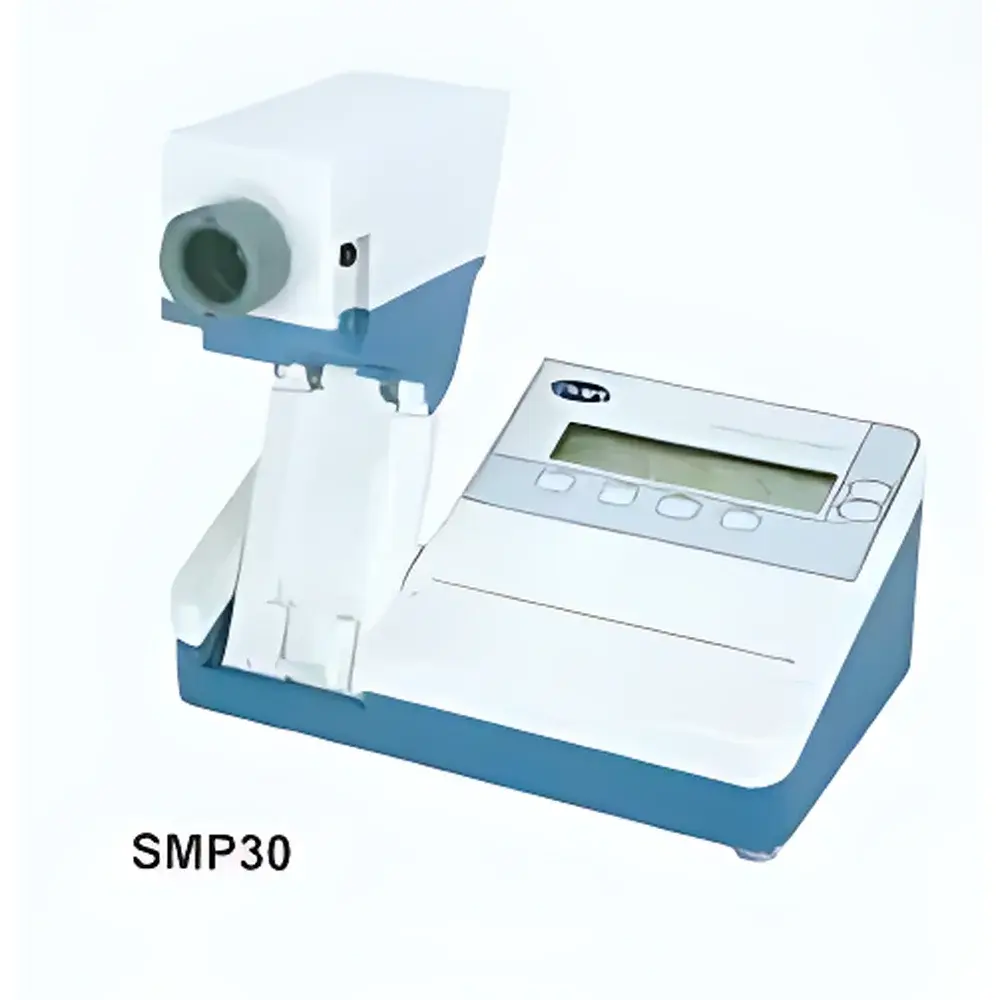
Stuart SMP30 Digital Melting Point Apparatus
| Origin | UK |
|---|---|
| Manufacturer Type | Authorized Distributor |
| Origin Category | Imported |
| Model | SMP30 |
| Price Range | USD 1,400–2,800 |
| Sample Capacity | 3 capillaries |
| Temperature Range | Ambient to 400 °C |
| Temperature Resolution | 0.1 °C |
| Temperature Accuracy | ±0.1 °C |
| Heating Rate | 0.5–10.0 °C/min (0.1 °C increments) |
| Temperature Memory | 8 readings per sample |
| Sensor | PT100 platinum resistance thermometer |
| Cooling | Integrated air pump |
| Dimensions | 325 × 200 × 170 mm |
| Net Weight | 3.6 kg |
| Power Supply | 230 V, 50/60 Hz, 60 W |
| Standard Accessories | Glass capillary tubes (SMP10/1) |
Overview
The Stuart SMP30 Digital Melting Point Apparatus is a precision thermal analysis instrument engineered for accurate, repeatable determination of solid-phase transition temperatures in pharmaceutical, chemical, and academic laboratories. It operates on the principle of controlled heating of crystalline samples sealed in standard capillary tubes, with real-time optical observation of melting onset and completion. The system employs a thermally stable aluminum heating block equipped with a calibrated PT100 platinum resistance sensor for closed-loop temperature feedback control. Unlike analog or manual instruments, the SMP30 integrates digital setpoint programming, programmable ramp rates, and automated post-cycle cooling—enabling high-throughput batch analysis while maintaining traceable metrological integrity. Its design conforms to core requirements of pharmacopoeial methods (e.g., USP , EP 2.2.14, JP 2.60), supporting GLP-compliant documentation when paired with validated procedures.
Key Features
- Triple-capillary capability: Simultaneous measurement of up to three independent samples per run, improving throughput without compromising inter-sample thermal uniformity.
- High-precision temperature control: ±0.1 °C accuracy across the full 20–400 °C operating range, achieved via PID-regulated heating and PT100 sensor integration with NIST-traceable calibration.
- Programmable heating profiles: Adjustable ramp rates from 0.5 to 10.0 °C/min in 0.1 °C/min increments—critical for method development, polymorph screening, and differentiation of close-melting compounds.
- Ergonomic optical viewing system: Dual-height adjustable observation chamber with integrated high-intensity LED illumination and 3× magnification lens, minimizing observer fatigue during extended qualification runs.
- Digital data retention: Stores eight discrete melting point values per sample (e.g., onset, clear point, range width), accessible via intuitive LCD interface without external software dependency.
- Rapid thermal recovery: Built-in centrifugal air pump reduces block cooldown time from 400 °C to 50 °C in under 8 minutes—significantly increasing daily assay capacity.
- Biocote® antimicrobial surface coating: Applied to all high-contact housing surfaces to inhibit microbial growth, supporting ISO 14644-1 cleanroom-adjacent workflows and routine lab hygiene protocols.
Sample Compatibility & Compliance
The SMP30 accepts standard 1.0 mm OD × 100 mm glass capillary tubes (supplied as SMP10/1), compatible with both organic small molecules and inorganic salts. Sample mass is optimized at 1–3 mg, ensuring reproducible packing density and minimal superheating artifacts. The instrument meets mechanical and electrical safety standards per IEC 61010-1:2010 and carries CE marking for use in EU-regulated environments. While the device itself does not generate electronic audit trails, its temperature logging function supports manual record-keeping aligned with FDA 21 CFR Part 11 Annex 11 principles when used within documented SOPs. Calibration certificates are supplied with each unit, traceable to UKAS-accredited reference standards.
Software & Data Management
The SMP30 operates as a standalone instrument with no mandatory PC connection. All configuration, execution, and retrieval functions are managed through its backlit monochrome LCD and membrane keypad interface. Temperature data is stored non-volatile memory; values persist after power cycling. No proprietary drivers or cloud services are required. For laboratories requiring electronic records, users may manually transcribe results into LIMS or ELN platforms. Optional RS-232 output (available via accessory kit) enables basic ASCII data streaming to serial terminals or legacy acquisition systems—though this interface does not support command-based control or real-time graphing.
Applications
- Pharmaceutical quality control: Identity verification and purity assessment of active pharmaceutical ingredients (APIs) per ICH Q5 and USP monographs.
- Chemical synthesis validation: Confirmation of product identity and detection of residual solvents or eutectic impurities in final reaction isolates.
- Polymorph characterization: Differentiation of crystalline forms based on distinct melting behavior under standardized ramp conditions.
- Academic research: Teaching fundamental thermal transitions in undergraduate chemistry and materials science curricula.
- Regulatory submissions: Generation of raw data packages supporting ANDA, DMF, or CMC sections where melting point is a critical quality attribute.
FAQ
What capillary tube dimensions are supported?
Standard 1.0 mm outer diameter × 100 mm length glass capillaries (SMP10/1); wall thickness 0.1–0.15 mm recommended.
Is the instrument suitable for measuring decomposition points?
No—the SMP30 is designed specifically for sharp, reversible melting transitions; decomposition or charring events require TGA or DSC instrumentation.
Can calibration be performed in-house?
Yes—users may verify performance using certified reference standards (e.g., indium, caffeine, potassium diphenylacetate); full recalibration requires authorized service technician intervention.
Does the device comply with ISO/IEC 17025 requirements?
The instrument provides metrologically sound measurements when operated per manufacturer instructions and maintained with scheduled verification; compliance depends on laboratory-specific quality system implementation.
What maintenance is required beyond routine cleaning?
Annual verification of sensor linearity and heating block thermal homogeneity is recommended; no consumable parts other than capillaries require replacement.



