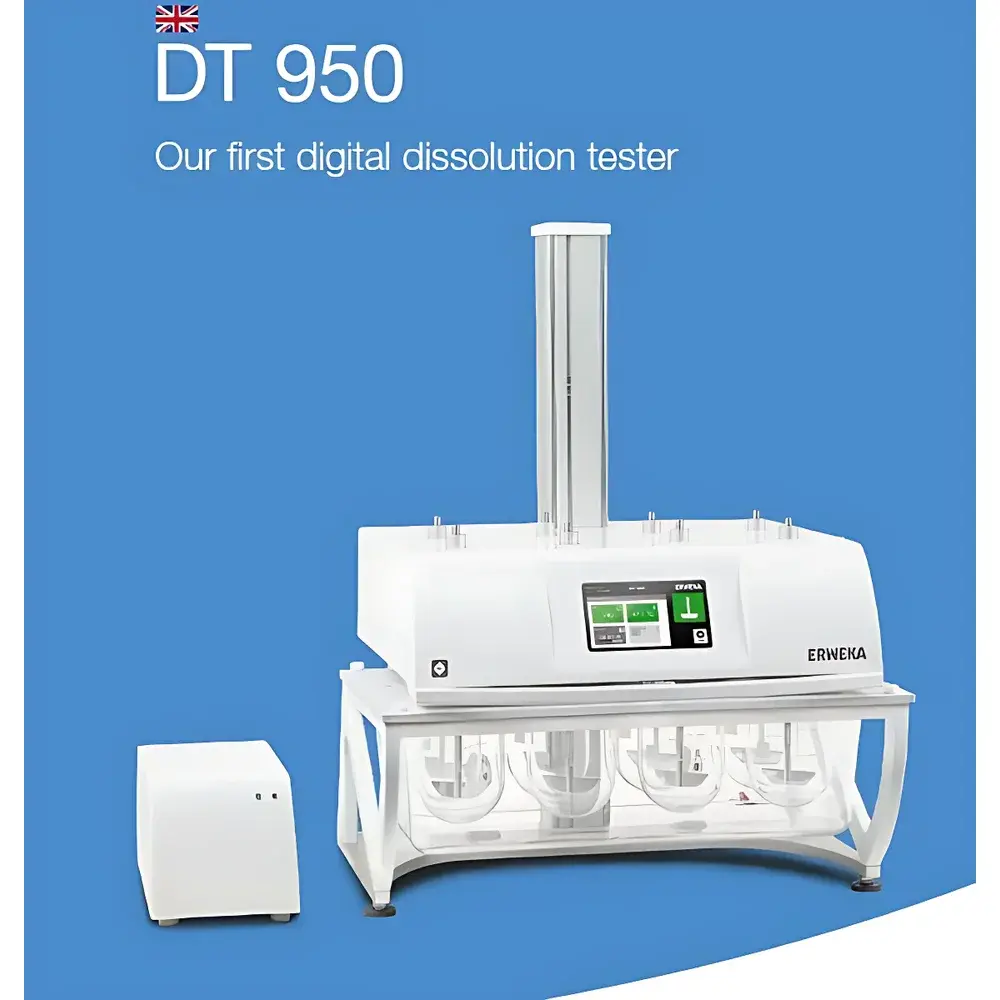
ERWEKA DT950 Digital Dissolution Tester
| Brand | ERWEKA |
|---|---|
| Origin | Germany |
| Model | DT950 |
| Instrument Type | Offline Dissolution Tester |
| Dissolution Vessels | Compliant with USP, JP, and EP Pharmacopoeias |
| Temperature Range | +5 °C to 40 °C |
| Temperature Accuracy | Compliant with USP/JP/EP |
| Rotational Speed Range | Compliant with USP/JP/EP |
| Paddle Wobble Amplitude | Compliant with USP/JP/EP |
| Basket Wobble Amplitude | Compliant with USP/JP/EP |
| Water Bath Temperature Control Range | +5 °C to 40 °C |
| Water Bath Temperature Resolution | ±1 °C |
| Water Bath Volume | Compliant with USP/JP/EP |
Overview
The ERWEKA DT950 Digital Dissolution Tester is a fully compliant, offline dissolution system engineered for precision, regulatory traceability, and long-term method adaptability in pharmaceutical quality control and development laboratories. Designed and manufactured in Langen, Germany, the DT950 implements the core hydrodynamic principles defined in USP <711>, JP XVII <2.05>, and EP 2.9.3 — utilizing calibrated paddle (USP Apparatus 2), basket (USP Apparatus 1), flow-through cell (USP Apparatus 4), and reciprocating cylinder (USP Apparatus 3) configurations. Its architecture integrates ISO 9001-certified mechanical manufacturing with pharmacopoeial validation requirements, ensuring reproducible fluid dynamics, consistent thermal equilibration, and minimal mechanical deviation across all 6–12 vessel positions. The system operates under strict adherence to dissolution hydrodynamics: laminar flow conditions, defined sinker geometry, standardized shaft alignment, and controlled vortex formation — all validated per ASTM E2503 and ICH Q5C guidelines.
Key Features
- 7-inch full-color capacitive touchscreen interface with intuitive workflow navigation, enabling step-by-step execution of dissolution protocols including method setup, parameter verification, run initiation, and manual or semi-automated sampling triggers.
- Fully integrated digital control architecture supporting future expansion via firmware updates — compatible with upcoming pharmacopoeial revisions (e.g., USP <724> extended release testing, EP Annex 8.26 dissolution modeling).
- Multi-language UI support: English, German, French, Spanish, Russian, and Simplified Chinese — each localized for technical terminology consistency and regulatory context accuracy.
- Real-time instrument status dashboard (TestAssist™) displaying active temperature setpoint and actual bath value, rotational speed and measured RPM, vessel-level wobble diagnostics, and time-synchronized run progression markers.
- Embedded versioning and serial code management enabling remote diagnostic access, secure over-the-air firmware patching, and audit-ready update logs aligned with FDA 21 CFR Part 11 electronic record requirements.
- System-level qualification tools: preconfigured IQ/OQ templates, automated calibration report generation, and built-in mechanical verification routines for paddle centering, basket concentricity, and shaft verticality per USP <711> Appendix A.
Sample Compatibility & Compliance
The DT950 accommodates standard USP-compliant 1000 mL dissolution vessels with interchangeable apparatus heads for immediate deployment of Apparatus 1 (basket), Apparatus 2 (paddle), Apparatus 3 (reciprocating cylinder), and Apparatus 4 (flow-through cell). All mechanical tolerances — including paddle wobble ≤0.5 mm, basket wobble ≤1.0 mm, shaft runout ≤0.2 mm, and vessel centering deviation ≤1.0 mm — are factory-verified and documented per EP 2.9.3 Annex II. Thermal performance meets USP <711> requirements for bath stability (±0.2 °C over 60 min) and uniformity (≤0.5 °C inter-vessel variation at 37 °C). The system supports GLP/GMP environments through configurable user roles, electronic signature enforcement, and full audit trail logging of all parameter changes and run events.
Software & Data Management
The embedded operating system features deterministic real-time scheduling for synchronized temperature ramping, rotation initiation, and timed sampling cues. All raw data — including temperature profiles, rotational speed traces, and operator annotations — are stored in vendor-neutral CSV and XML formats compliant with ALCOA+ principles. Optional integration with LIMS platforms is supported via ASTM E1482-compliant HL7 v2.5 messaging or direct ODBC connectivity. Software updates preserve historical method integrity and maintain backward compatibility with prior DT-series protocols. Full electronic record retention includes timestamps, user IDs, device signatures, and cryptographic hash verification for data immutability — satisfying FDA 21 CFR Part 11 Subpart C and EU Annex 11 requirements.
Applications
- Pharmaceutical QC release testing of immediate-release and modified-release solid oral dosage forms (tablets, capsules, pellets) per USP/EP/JP monographs.
- Biowaiver studies supporting BCS-based regulatory submissions (FDA, EMA, PMDA).
- Dissolution profile comparison for generic product equivalence assessment (f2 similarity factor calculation support).
- Stability-indicating method development for degradation-prone APIs under varied pH and surfactant conditions.
- Pre-formulation screening of excipient effects on drug release kinetics using programmable multi-stage temperature and agitation profiles.
- Regulatory submission dossier preparation with fully traceable, audit-ready validation documentation packages.
FAQ
Does the DT950 support USP Apparatus 5 and 6 configurations?
Yes — the system accepts optional modular hardware kits for reciprocating cylinder (Apparatus 3) and flow-through cell (Apparatus 4); Apparatus 5 (paddle-over-disc) and Apparatus 6 (cylindrical cell) require custom fixture integration verified per USP <711> mechanical calibration standards.
Is the water bath temperature resolution sufficient for accelerated stability studies?
The ±1 °C resolution applies to display and control feedback; actual thermal stability at setpoint (e.g., 37.0 °C) is maintained within ±0.2 °C over 60 minutes, meeting USP <711> requirements for routine QC use. For ICH Q1A(R3) accelerated conditions, external environmental chamber integration is recommended.
Can legacy DT-series methods be imported into the DT950 software?
Yes — the system includes a method migration utility that converts DT200/DT800 protocol files into native DT950 format while preserving all timing, temperature, rotation, and sampling logic.
How is mechanical compliance verified during installation qualification?
ERWEKA provides a certified IQ kit including laser alignment jigs, digital inclinometers, and calibrated wobble gauges — all traceable to DAkkS-accredited standards. Documentation templates align with ISO/IEC 17025 and ASTM E2503.
Is remote software support available outside EU/US time zones?
Yes — ERWEKA’s global service network offers 24/7 remote diagnostics via encrypted TLS 1.3 session handshaking, with regional response SLAs defined per distributor agreement and validated under ISO/IEC 20000-1 IT service management certification.