
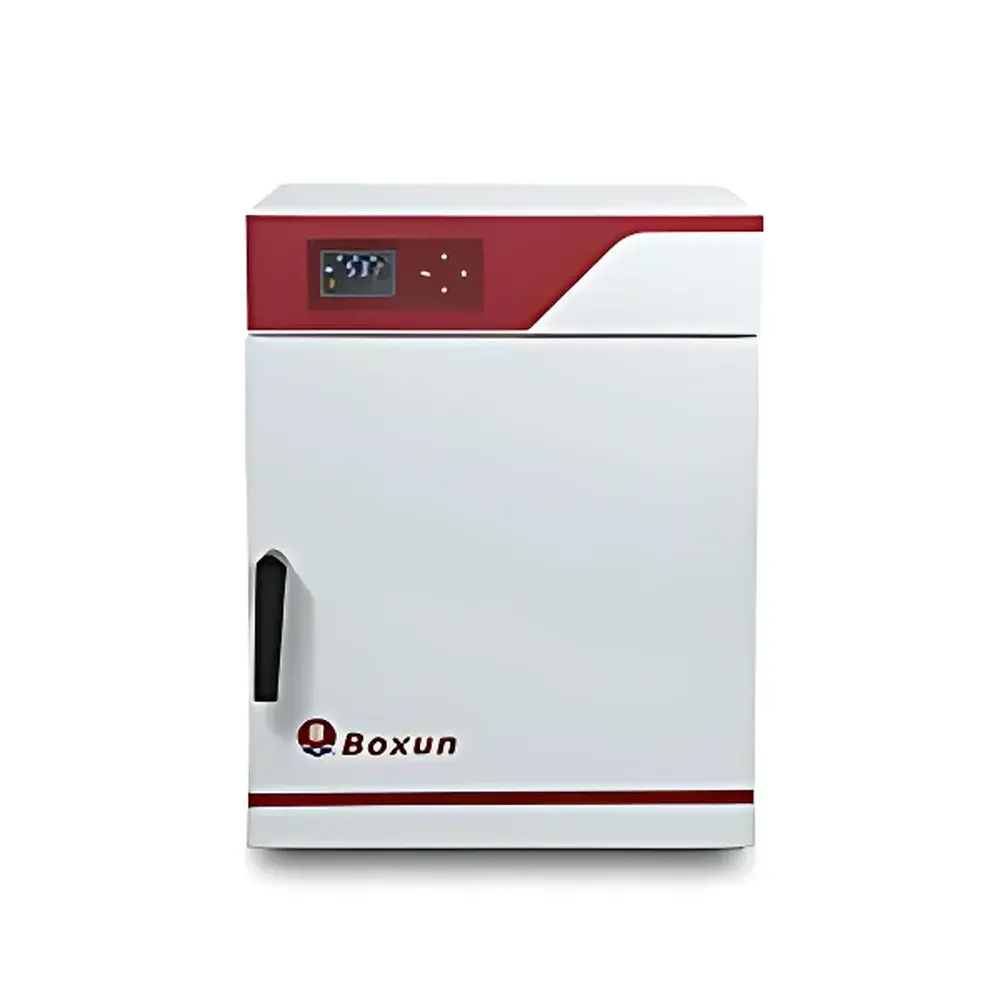
BOXUN BGZ-456 High-Temperature Forced-Air Drying Oven
| Brand | BOXUN |
|---|---|
| Origin | Shanghai, China |
| Manufacturer Type | Direct Manufacturer |
| Product Category | Domestic |
| Model | BGZ-456 |
| Instrument Type | High-Temperature Drying Oven |
| Temperature Range | Ambient + 5°C to 300°C |
| Temperature Uniformity | ±2% |
| External Dimensions (W×D×H) | 774 × 845 × 1704 mm |
| Internal Chamber Dimensions (W×D×H) | 600 × 580 × 1300 mm |
| Chamber Material | Mirror-Finish Stainless Steel (SUS304) |
| Heating Method | Forced-Air Circulation with Adjustable Fan Speed (6-step) |
| Temperature Resolution | 0.1°C |
| Temperature Fluctuation | ±0.8°C at 105°C |
| Rated Power | 3500 W |
| Chamber Volume | 452 L |
| Standard Shelves | 4 pcs (max. 18 pcs) |
| Shelf Load Capacity | 15 kg per shelf |
| Timer Range | 0–9999 min/h |
| Delay Start Range | 0–999 min |
| Programmable Control | 10 segments × 100 cycles |
| Interface | RS-485 (standard) |
| Power Supply | AC 220 V ±10%, 50 Hz ±2% |
| Recovery Function | Power-Failure Resume & System Auto-Restart |
Overview
The BOXUN BGZ-456 High-Temperature Forced-Air Drying Oven is an engineered laboratory-grade thermal processing system designed for precise, repeatable, and uniform heat treatment across demanding industrial, pharmaceutical, and academic applications. Utilizing a robust forced-air convection architecture, the oven ensures rapid thermal equilibration and exceptional temperature homogeneity—critical for drying hygroscopic materials, pre-conditioning polymer samples, sterilizing glassware, curing coatings, and conducting thermal stability assessments in compliance with ASTM D1654, ISO 17025, and USP . Its operational range from ambient +5°C up to 300°C supports both low-temperature desiccation and high-temperature post-processing workflows, while the stainless steel chamber (SUS304 mirror finish) resists corrosion, oxidation, and residue accumulation during extended exposure to aggressive solvents or alkaline residues.
Key Features
- Forced-air circulation system with six-step adjustable fan speed control—enabling optimization of airflow velocity to minimize particle displacement during drying of powders, granules, or filter membranes;
- PMMA II intelligent operating system featuring full-color LCD touchscreen interface, real-time parameter visualization, and intuitive navigation for setpoint entry, timer configuration, and program editing;
- Programmable temperature profile capability supporting up to 10 segments and 100 total cycles—ideal for multi-stage thermal protocols such as ramp-hold-cool sequences used in material aging studies;
- Preheated air duct design directs thermally conditioned air directly into the working chamber, reducing startup time by up to 35% compared to conventional static-heating ovens;
- Double-locking rotary door mechanism with high-compression silicone gasket ensures >95% sealing efficiency and minimizes thermal leakage at elevated temperatures;
- Chamber interior features radius-rounded corners and tool-free removable shelves—facilitating GMP-aligned cleaning validation and residue inspection;
- Integrated power-failure recovery function automatically restores previous settings and resumes operation upon grid restoration, preserving process integrity without manual reconfiguration.
Sample Compatibility & Compliance
The BGZ-456 accommodates a broad spectrum of sample formats—including Petri dishes, crucibles, beakers, aluminum weighing pans, and standard ISO/IEC 17025-certified calibration blocks—within its 452 L working volume. Its stainless steel construction meets FDA-recommended surface finish criteria (Ra ≤ 0.8 µm), supporting routine cleaning validation under cGMP Annex 1 and EU GMP guidelines. The oven is compatible with IQ/OQ/PQ qualification protocols and includes audit-trail-capable event logging via RS-485 interface for integration into LabVantage or Thermo Fisher SampleManager LIMS environments. Temperature uniformity (±2%) and stability (±0.8°C at 105°C) are verified per IEC 60068-3-5 and validated using NIST-traceable Class A PT100 sensors.
Software & Data Management
The PMMA II control system embeds non-volatile memory for persistent storage of up to 20 user-defined programs and 100 historical run logs—including start/end timestamps, actual vs. setpoint temperature curves, alarm events, and fan-speed profiles. All data exports via RS-485 to external SCADA or MES platforms in Modbus RTU format. Optional BOXUN DataBridge software (v3.2+) provides remote monitoring, CSV report generation, and electronic signature support compliant with FDA 21 CFR Part 11 requirements for audit-ready documentation.
Applications
- Drying of moisture-sensitive pharmaceutical excipients (e.g., microcrystalline cellulose, lactose monohydrate) prior to tablet compression;
- Thermal decontamination of reusable labware in microbiology and cell culture facilities;
- Accelerated aging studies of packaging materials per ASTM F1980;
- Curing of epoxy-based adhesives and conformal coatings in electronics manufacturing;
- Residue ashing preparation for gravimetric analysis in environmental testing labs (EPA Method 1664);
- Pre-baking of silicon wafers and ceramic substrates in semiconductor R&D;
- Stability testing of active pharmaceutical ingredients (APIs) per ICH Q1A(R2).
FAQ
What is the maximum allowable operating temperature and how is thermal safety ensured?
The BGZ-456 is rated for continuous operation up to 300°C. Dual independent over-temperature protection circuits—mechanical cut-off (280°C) and digital PID limiter (310°C)—trigger immediate power disconnection and audible alarm activation.
Can the oven be integrated into a centralized laboratory automation network?
Yes. The standard RS-485 port supports Modbus RTU communication for bidirectional command exchange with PLCs, BMS systems, or enterprise LIMS platforms.
Is validation documentation available for GxP-regulated environments?
BOXUN provides Factory Acceptance Test (FAT) reports, IQ/OQ templates, and calibration certificates traceable to CNAS-accredited laboratories upon request.
How does the airflow adjustment affect temperature uniformity at high setpoints?
At temperatures above 200°C, selecting lower fan speeds (Levels 1–3) reduces convective heat loss at the chamber walls and improves axial uniformity—verified per ISO 15504 Annex D test methodology.
What maintenance intervals are recommended for long-term reliability?
Fan motor lubrication and gasket integrity inspection are advised every 12 months; temperature sensor recalibration is recommended biannually or after 500 operational hours at ≥250°C.



