
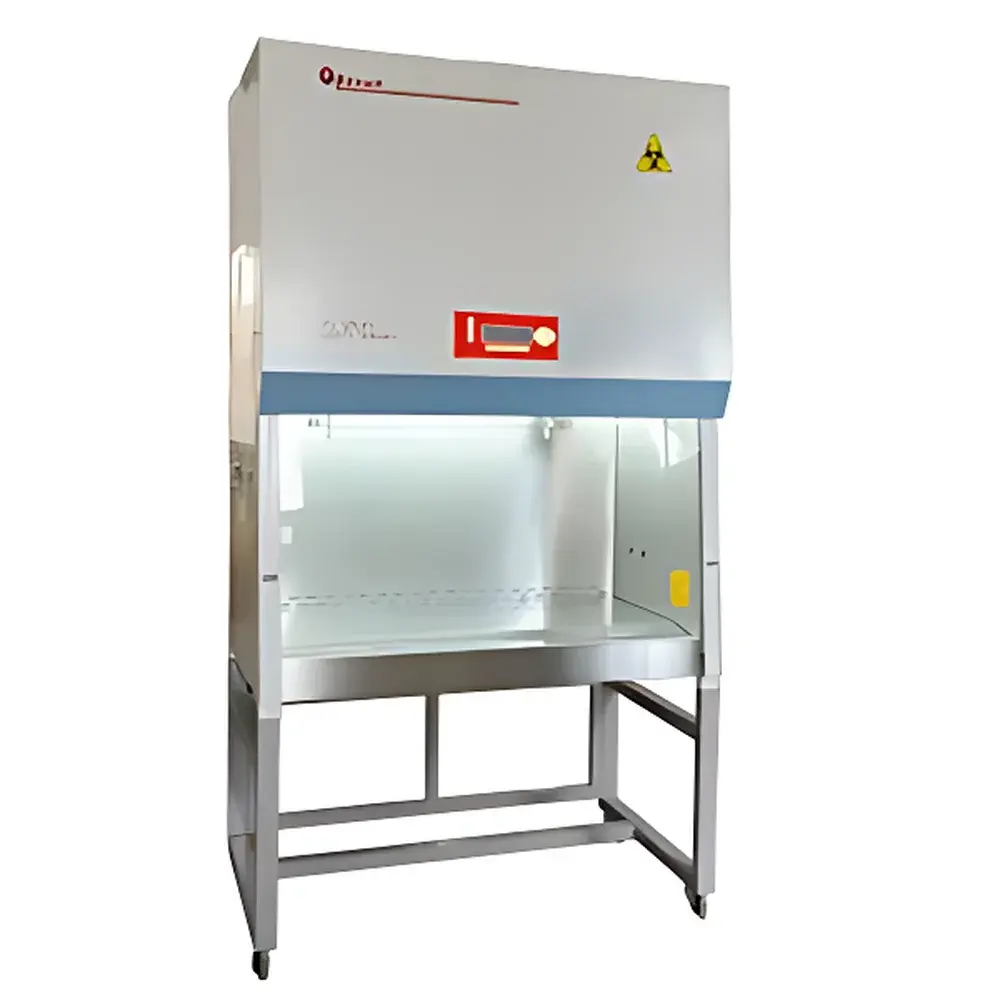
BOXUN BSC-1000B2 Class II Type B2 Biological Safety Cabinet
| Brand | BOXUN |
|---|---|
| Origin | Shanghai, China |
| Manufacturer Type | Direct Manufacturer |
| Product Category | Domestic |
| Model | BSC-1000B2 |
| Price Range | USD 2,800 – 7,200 (FOB) |
| Cabinet Class | Class II, Type B2 (Total Exhaust) |
| External Dimensions (L×W×H) | 1120 × 895 × 2340 mm |
| Internal Work Area Dimensions (L×W×H) | 1000 × 500 × 640 mm |
| HEPA Filter Efficiency | ≥99.99% @ 0.3 µm |
| Inflow Velocity | 0.55 m/s (avg.) |
| Downflow Velocity | 0.35 m/s (avg.) |
| Downflow Control Accuracy | ±0.015 m/s |
| Differential Pressure Range | 0–500 Pa |
| Noise Level | ≤67 dB(A) |
| Vibration Half-Peak | ≤5 µm |
| Average Illuminance | ≥650 lx |
| Operating Temperature | 10–30 °C |
| Relative Humidity | ≤70% @ 25 °C |
| Atmospheric Pressure Range | 80–105 kPa |
| Supply Filter Size | 1026 × 606 × 70 mm |
| Exhaust Filter Size | 482 × 515 × 90 mm |
| Lighting | 2 × 30 W LED daylight lamps |
| UV Lamp | 1 × 18 W |
| Total Power Consumption | 2.1 kW |
| Electrical Supply | AC 220 V ±10%, 50/60 Hz |
Overview
The BOXUN BSC-1000B2 is a certified Class II, Type B2 biological safety cabinet engineered for full-exhaust (total exhaust) operation in biosafety level 2 (BSL-2) and select BSL-3 applications. It operates on the principle of inward airflow containment combined with downward laminar flow—both streams fully exhausted via dedicated ducting to the outside environment—eliminating recirculation entirely. This configuration ensures simultaneous protection of personnel, product, and environment against aerosolized biohazards, including viruses, bacteria, recombinant DNA constructs, and low-to-moderate risk human pathogens. Designed in strict accordance with NSF/ANSI 49-2022 and EN 12469:2000 standards, the BSC-1000B2 integrates aerodynamic integrity testing, real-time airflow velocity monitoring, and redundant safety interlocks to meet GLP-compliant laboratory infrastructure requirements.
Key Features
- Robust structural design with modular stainless steel frame (SUS304 brushed finish), seamless one-piece curved work chamber walls, and radius-corner welds to prevent microbial accumulation and facilitate decontamination.
- Ergonomically optimized sash window angled at 5° to minimize visual fatigue and glare; constructed from tempered, UV-resistant, shatterproof glass meeting EN 12600 P2A impact classification.
- Dual-sensor airflow control system featuring calibrated U.S.-sourced hot-wire anemometers for independent, continuous monitoring of inflow and downflow velocities—with automatic fan speed adjustment to maintain setpoints within ±0.015 m/s tolerance.
- Integrated alarm architecture: audible/visual alerts triggered by HEPA filter degradation (pressure differential threshold), sash height violation (>200 mm), UV lamp failure, lighting circuit fault, or loss of negative pressure integrity.
- German-manufactured ebm-papst centrifugal blowers delivering stable, low-vibration performance with extended service life and energy-efficient operation under variable static pressure conditions.
- Front-accessible liquid collection trough with bottom-mounted drain valve, pre-wired dual AC outlets (one splash-proof), and standardized utility ports for optional water/gas line integration.
Sample Compatibility & Compliance
The BSC-1000B2 supports open-vessel manipulations involving cell cultures, primary tissue isolates, viral transduction protocols, and diagnostic specimen processing where operator exposure risk and cross-contamination must be minimized. Its Type B2 configuration is mandatory when working with volatile toxic chemicals (e.g., ethidium bromide, chloroform) alongside biological agents. All internal surfaces comply with ISO 14644-1 Class 5 (Fed Std 209E Class 100) cleanroom requirements for particulate concentration (≤3.5 particles ≥0.5 µm per liter). The unit undergoes factory-certified containment validation per NSF/ANSI 49 Annex D (KI-Discus test) and airflow visualization per Annex E, with full documentation provided for regulatory audits (FDA 21 CFR Part 11-ready log files available via optional software package).
Software & Data Management
Equipped with an embedded microcontroller-based LCD interface supporting real-time display of inflow/downflow velocity, cabinet differential pressure, UV usage hours, and filter lifetime estimation. All operational parameters—including sash position events, alarm triggers, and fan runtime—are timestamped and stored locally for ≥12 months. Optional BOXUN BioSafeLink™ software enables remote monitoring, CSV export, and automated report generation aligned with ISO/IEC 17025 quality management frameworks. Audit trails include user ID logging, parameter change history, and electronic signature support for GxP environments.
Applications
- Primary cell culture maintenance and passaging under sterile conditions
- Recombinant protein expression workflows involving plasmid transfection and lentiviral packaging
- Clinical microbiology specimen handling (e.g., sputum, CSF, blood cultures)
- Vaccine production support activities requiring chemical-biological co-handling
- Regulatory QC testing of biologics per USP , EP 5.1.3, and ICH Q5A guidelines
- Teaching laboratories conducting BSL-2-level genetic engineering experiments
FAQ
Does the BSC-1000B2 require external ductwork for safe operation?
Yes. As a Type B2 cabinet, it must be hard-ducted to an exterior exhaust system with dedicated makeup air supply to maintain room balance and prevent negative pressure buildup.
Can this unit be installed in a non-ducted configuration?
No. Unlike Type A2 cabinets, the BSC-1000B2 does not permit recirculation and cannot operate safely without full exhaust ducting.
What certification documentation is supplied with shipment?
Each unit ships with a Factory Performance Certificate, NSF/ANSI 49 compliance statement, CE Declaration of Conformity, and full test reports covering airflow uniformity, containment, and motor performance.
Is the UV lamp intensity monitored or validated?
UV irradiance is verified during commissioning per ISO 15190 Annex C; routine user verification using a calibrated radiometer is recommended every 6 months or after lamp replacement.
How often should the HEPA filters be replaced?
Filter service life depends on usage intensity and ambient particulate load; typical replacement intervals range from 3–5 years, with pressure drop trending enabled via the onboard monitoring system.





