
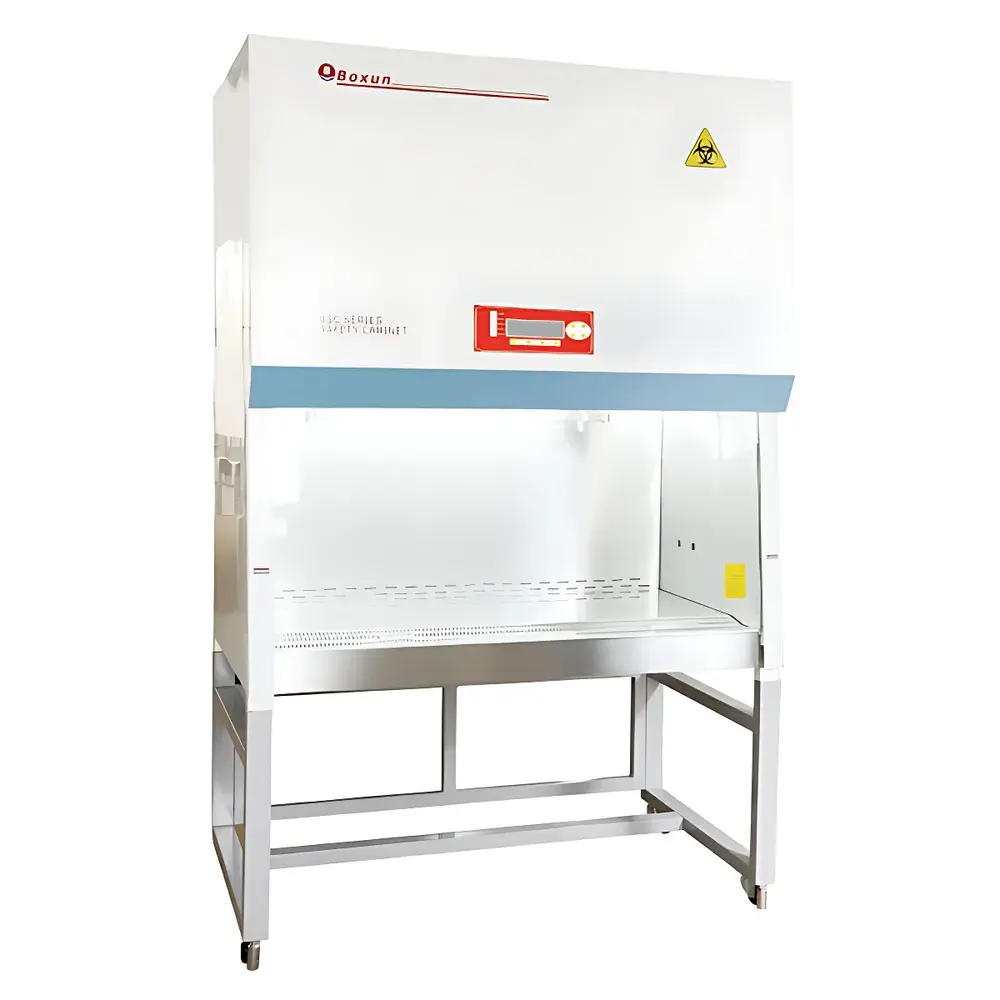
BOXUN BSC-1360B2 Class II Biological Safety Cabinet
| Brand | BOXUN |
|---|---|
| Origin | Shanghai, China |
| Manufacturer Type | Direct Manufacturer |
| Product Category | Domestic (China-made) |
| Model | BSC-1360B2 |
| Instrument Class | Class II Biological Safety Cabinet |
| External Dimensions (L×W×H) | 1420 × 895 × 2340 mm |
| Internal Work Area Dimensions (L×W×H) | 1300 × 500 × 640 mm |
| HEPA Filter Efficiency | ≥99.99% @ 0.3 µm |
| Inflow Velocity | 0.55 m/s |
| Downflow Velocity | 0.33 m/s |
| Downflow Control Accuracy | ±0.015 m/s |
| Pressure Differential Range | 0–500 Pa |
| Noise Level | ≤67 dB(A) |
| Vibration Peak-to-Peak | ≤5 µm |
| Average Illuminance | ≥650 lx |
| Operating Temperature | 10–30 °C |
| Relative Humidity | ≤70% RH (at 25 °C) |
| Atmospheric Pressure Range | 80–105 kPa |
| Supply Voltage | AC 220 V ±10%, 50/60 Hz |
| Total Power Consumption | 2.2 kW |
| Lighting | 2 × 40 W fluorescent lamps + 1 × 30 W UV lamp |
| Electrical Outlet | 1 × splash-proof AC socket (220 V) with reserved water/gas interface |
Overview
The BOXUN BSC-1360B2 is a certified Class II, Type A2 biological safety cabinet engineered for reliable personnel, product, and environmental protection in biosafety level 1–2 laboratories. It operates on the principle of laminar airflow management—drawing ambient air through a front intake grille (inflow), passing it over the work surface via a vertically downward HEPA-filtered downflow, and recirculating ~70% of the air back into the work area after filtration while exhausting ~30% externally via a dedicated ducted system or optional canopy-mounted exhaust blower. This dual-airflow architecture complies with NSF/ANSI 49–2022 and EN 12469:2000 standards for Class II cabinets, ensuring containment of low-to-moderate risk biological agents during routine microbiological manipulation, cell culture, and molecular diagnostics workflows.
Key Features
- Robust structural design featuring modular, tool-free disassembly with castor-mounted base and adjustable leveling screws for rapid repositioning and facility integration.
- Intuitive 7-inch LCD control panel displaying real-time inflow velocity, downflow velocity, pressure differential, UV lamp status, and filter service indicators in English-language interface.
- Microprocessor-controlled constant-velocity regulation using calibrated U.S.-sourced hot-wire anemometry, maintaining ±0.015 m/s downflow stability across filter loading cycles.
- Dual HEPA filtration system: supply air passes through a 1326 × 606 × 70 mm pre-filtered primary HEPA; exhaust air undergoes secondary filtration via a 782 × 515 × 90 mm HEPA module, both certified to retain ≥99.99% of 0.3 µm particles (DOP-tested).
- Safety interlocks include UV–lighting mutual exclusion, audible/visual alarm for sash height deviation (>200 mm), automatic fan shutdown upon sash closure, and predictive filter life monitoring with preemptive failure alerts.
- Ergonomic 5° inclined tempered glass sash with anti-UV, shatter-resistant coating; seamless SUS304 stainless steel interior with radius-curved corners and removable, autoclavable work surface.
- Integrated liquid collection trough with bottom-mounted drain valve and IP54-rated splash-proof AC outlet (220 V, 10 A); provisioned for optional water/gas line routing beneath the work surface.
Sample Compatibility & Compliance
The BSC-1360B2 supports open-vessel handling of non-volatile, low-to-moderate risk biological materials—including bacterial cultures, mammalian cell lines, plasmid transfections, and diagnostic reagents—under BSL-2 conditions. It is not intended for use with volatile radioactive compounds, toxic chemicals requiring full containment (e.g., Class III applications), or high-risk aerosol-generating procedures without supplementary engineering controls. Certification documentation includes conformity to ISO 14644-1 Class 5 (Fed Std 209E Class 100) cleanroom performance for the work area, validated airflow uniformity per IEC 61010-1, and electromagnetic compatibility per EN 61326-1. Optional third-party NSF 49 validation reports are available upon request for GLP/GMP-aligned facilities.
Software & Data Management
While the BSC-1360B2 operates via embedded firmware without cloud connectivity, its control system logs operational history—including cumulative runtime, alarm events, filter usage hours, and calibration timestamps—in non-volatile memory. Audit trail data can be exported via USB interface in CSV format for integration into laboratory quality management systems (QMS). The unit supports 21 CFR Part 11-compliant access control when deployed with external authentication modules (e.g., RFID badge readers), enabling user-specific parameter locking and electronic signature capture for critical SOP adherence in regulated environments.
Applications
This cabinet serves as a primary containment platform for routine aseptic techniques in academic research labs, clinical microbiology departments, biopharmaceutical QC units, and vaccine production support areas. Typical use cases include: inoculation of agar plates and broth cultures; passaging of adherent and suspension cell lines; preparation of sterile media and reagents; handling of recombinant DNA constructs; and processing of patient-derived specimens prior to nucleic acid extraction. Its 1300 mm work width accommodates dual-user operation without compromising airflow integrity, making it suitable for shared-core facilities requiring high-throughput sample preparation under consistent biosafety conditions.
FAQ
Does the BSC-1360B2 require external ducting for safe operation?
Yes—when operated in Type A2 mode, it must be connected to a dedicated exhaust system or equipped with an optional canopy-mounted exhaust blower to safely discharge contaminated air outdoors.
Can the unit be validated for ISO Class 5 compliance?
Yes—the internal work area is factory-verified to maintain ≤3.5 particles ≥0.5 µm per cubic foot (ISO 14644-1 Class 5), with optional on-site certification services available.
What maintenance intervals are recommended for HEPA filters?
Supply and exhaust HEPA filters should be integrity-tested semiannually per NSF 49; replacement frequency depends on usage intensity but typically ranges from 5–7 years under standard BSL-2 conditions.
Is the control system compatible with building management systems (BMS)?
It provides dry-contact relay outputs for fan status, alarm conditions, and sash position, enabling integration with facility-wide BMS via Modbus RTU (optional add-on module).
Does the cabinet meet FDA requirements for pharmaceutical manufacturing environments?
While not inherently GMP-certified, its design, documentation traceability, and audit-log functionality align with Annex 1 and USP expectations for aseptic processing support equipment when implemented within a validated facility infrastructure.






