
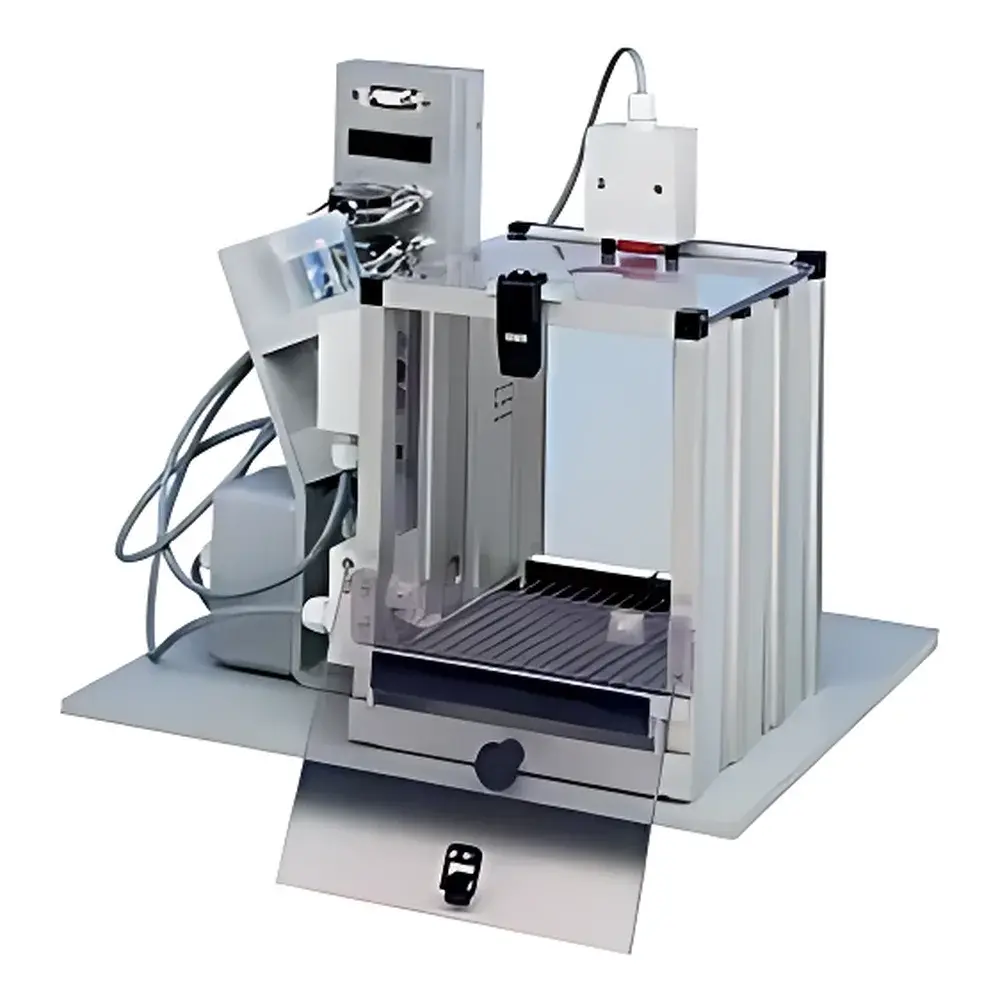
TSE Systems Operant Behavior Systems (OBS) for Rodent Behavioral Neuroscience
| Brand | TSE Systems |
|---|---|
| Origin | Germany |
| Model | Operant Behavior Systems (OBS) |
| Cage Compatibility | Mouse and Rat |
| Modular Design | Fully Integrated Skinner Box Platform |
| Environmental Control | Acoustically and optically shielded chambers with active ventilation |
| Control & Data Acquisition | Unified TSE OBS Software Suite |
| Scheduling Engine | Predefined and user-programmable schedules (FR, VR, PR, FI, VI, PI, DRH, DRL, Geller Conflict, Drug Discrimination) |
| Response Modules | Adjustable lever, retractable lever, nose-poke, single- and tri-color cue lights |
| Reinforcement Delivery | Pellet dispensers (14 mg for mice |
| Custom Protocol Development | Built-in graphical schedule editor and free scripting language (TSE Script) |
| Cross-Platform Integration | Compatible with TSE PhenoMaster® home-cage phenotyping system |
| Regulatory Alignment | Designed to support GLP-compliant behavioral data acquisition with audit-trail-capable software logging |
Overview
The TSE Systems Operant Behavior Systems (OBS) is a fully computerized, modular platform engineered for precise, reproducible operant conditioning experiments in rodents. Based on the foundational principles of Skinnerian learning theory, the system implements discrete-trial and continuous-schedule paradigms through real-time control of environmental stimuli, response detection, and reinforcement delivery. Each unit functions as an independent, acoustically isolated and optically shielded operant chamber—equipped with active ventilation to maintain thermal and CO₂ stability during extended sessions. The architecture supports both classical discrete-chamber assays and longitudinal, low-stress home-cage–integrated protocols via interoperability with the TSE PhenoMaster® platform. This dual-mode capability enables researchers to bridge translational gaps between controlled laboratory paradigms and ethologically relevant behavioral monitoring.
Key Features
- Modular, standardized cage frames compatible with both mouse and rat subjects—designed for rapid reconfiguration across experimental cohorts.
- Configurable response interfaces: precision-engineered levers (weight-adjustable, retractable), capacitive nose-poke detectors, and programmable cue-light arrays (single- or tri-color LED configurations).
- Reinforcement delivery systems optimized for behavioral fidelity: calibrated pellet dispensers offering 14 mg (mouse), 20 mg, and 45 mg pellets; liquid reward ports with volumetric precision; and dedicated IV catheter interfaces for intravenous self-administration studies.
- Preloaded schedule library compliant with established behavioral neuroscience standards—including fixed ratio (FR), variable ratio (VR), progressive ratio (PR), fixed interval (FI), variable interval (VI), peak interval (PI), differential reinforcement of high/low rates (DRH/DRL), Geller conflict, and drug discrimination protocols.
- Integrated schedule development environment: TSE Script—a freely available, syntax-light programming language—and a drag-and-drop graphical editor enabling full protocol customization without external coding dependencies.
- Real-time data streaming and timestamped event logging at sub-millisecond resolution, synchronized across hardware modules and software layers.
Sample Compatibility & Compliance
The OBS platform accommodates C57BL/6, BALB/c, Sprague-Dawley, Wistar, and other commonly used rodent strains. Cage dimensions and response module ergonomics adhere to NIH and FELASA guidelines for animal welfare in behavioral testing. All electronic components meet CE and RoHS directives. The TSE OBS software suite is designed to support regulatory compliance workflows, including ALARA-aligned session duration controls, operator-level access permissions, and optional 21 CFR Part 11–ready audit trails (with electronic signature configuration). Experimental metadata—including subject ID, protocol version, calibration timestamps, and environmental logs—is embedded directly into raw data files to facilitate GLP/GCP audit readiness.
Software & Data Management
Control, scheduling, and data acquisition are unified under the TSE OBS Software Suite—a Windows-based application built on a deterministic real-time kernel. The interface provides live visualization of response rates, reinforcement latency, session progress, and error-state diagnostics. All behavioral events are stored in HDF5 format, ensuring cross-platform compatibility and long-term archival integrity. Export modules support direct conversion to CSV, MATLAB (.mat), and Neurodata Without Borders (NWB) schema for integration with downstream analysis pipelines (e.g., Python-based ethomics toolchains or commercial platforms such as EthoVision XT or MATLAB’s Behavioral Toolbox). Software updates are delivered via secure, version-controlled repositories with documented change logs and backward-compatible file format support.
Applications
The OBS platform serves core applications across preclinical neuroscience, psychopharmacology, and translational psychiatry research. It is routinely deployed in studies of motivation and reward processing (e.g., effort-based decision making using PR schedules), cognitive flexibility (attentional set-shifting, reversal learning), compulsive behavior (schedule-induced polydipsia, DRL performance), addiction mechanisms (IV cocaine/heroin self-administration, cue-induced reinstatement), and affective dysregulation (learned helplessness paradigms via inescapable shock protocols). Its compatibility with PhenoMaster® further extends utility to circadian-modulated operant tasks, social operant conditioning, and longitudinal behavioral phenotyping across disease models—including neurodegenerative, metabolic, and neurodevelopmental disorders.
FAQ
Is the system compatible with existing TSE PhenoMaster® installations?
Yes—OBS modules integrate natively with PhenoMaster® via shared communication protocols and synchronized timebase architecture, enabling seamless transition from discrete-session to home-cage operant paradigms.
Can custom reinforcement schedules be validated for reproducibility across laboratories?
All user-defined schedules are saved as portable, versioned script files with embedded parameter metadata; TSE provides inter-laboratory validation templates aligned with SOPs recommended by the International Behavioral Neuroscience Society (IBNS).
Does the software support automated calibration logging for audit purposes?
Yes—lever force thresholds, pellet drop timing, light intensity outputs, and nose-poke capacitance baselines are automatically recorded during system startup and can be exported as PDF reports with digital signatures.
What level of technical support is provided for protocol development?
TSE offers remote protocol co-development sessions with certified behavioral neuroscientists, including assistance with schedule logic design, statistical power estimation for operant endpoints, and alignment with journal-specific reporting standards (e.g., ARRIVE 2.0).



