
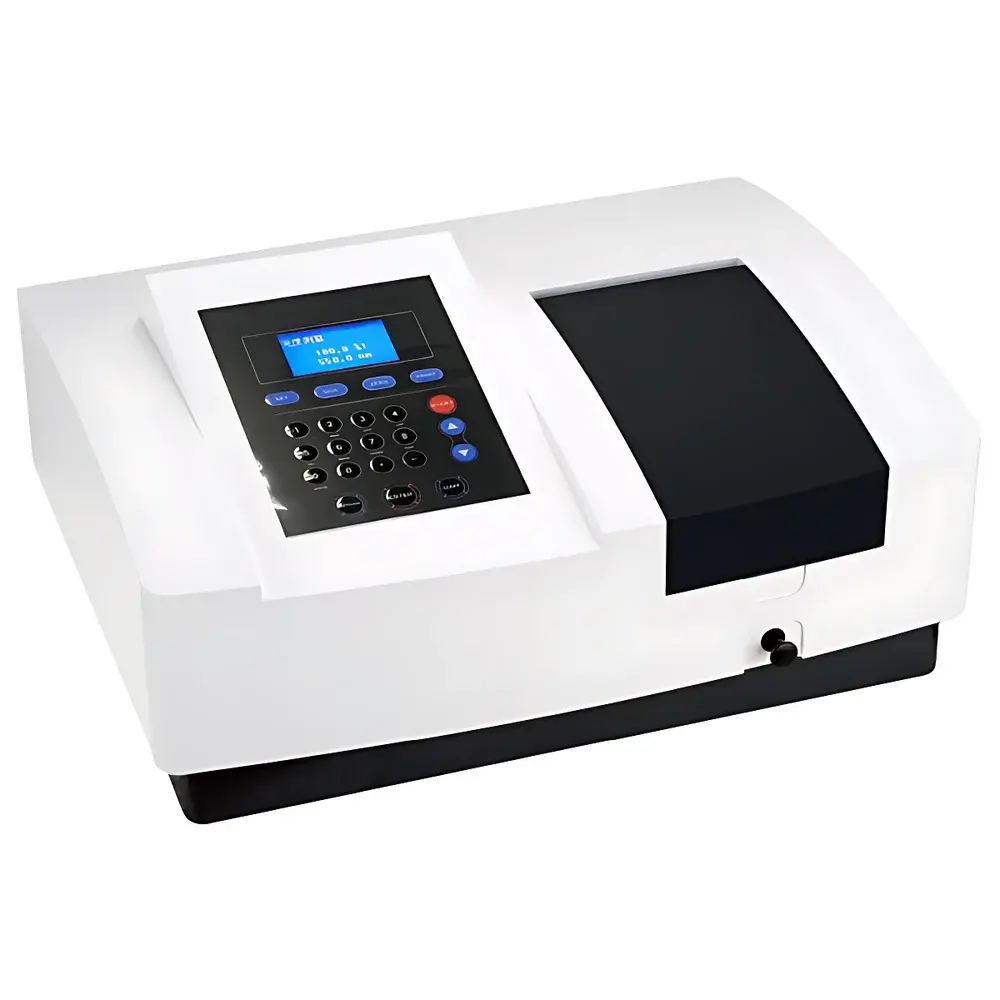
Yoke 723(N/S) Dual-Beam Visible Spectrophotometer
| Brand | Yoke |
|---|---|
| Origin | Shanghai, China |
| Manufacturer Type | Manufacturer |
| Model | 723(N/S) |
| Instrument Architecture | Dual-Beam |
| Detector Type | Photocell |
| Wavelength Range | 320–1100 nm |
| Wavelength Accuracy | ±0.5 nm |
| Spectral Bandwidth | 2 nm |
| Stray Light | ≤0.05%T @ 360 nm |
| Photometric Accuracy | ±0.3%T |
| Photometric Repeatability | ±0.15%T |
| Wavelength Repeatability | ±0.2 nm |
| Baseline Linearity | ±0.002 A |
| Stability | ±0.001 A/h @ 500 nm |
| Photometric Range | 0–200%T, −0.301–3.000 A |
| Display | 128×64 dot-matrix LCD |
| Light Source | Imported Tungsten Lamp |
| Net Weight | 12 kg |
Overview
The Yoke 723(N/S) Dual-Beam Visible Spectrophotometer is a precision optical instrument engineered for quantitative and qualitative analysis in the visible spectral region (320–1100 nm). Based on dual-beam ratio measurement architecture, it continuously compares sample and reference beam intensities in real time—minimizing errors induced by source drift, detector instability, or environmental fluctuations. This design ensures high photometric reproducibility and long-term baseline stability, making it suitable for routine quality control, educational laboratories, and research applications where robustness and traceable performance are required. The system employs a high-efficiency 1200 lines/mm holographic grating and a sealed monochromator housing with SiO₂-coated optical surfaces to maintain optical integrity over extended operation. Its wavelength calibration and positioning are fully automated via stepper motor-driven mechanisms, eliminating manual alignment and reducing operator dependency.
Key Features
- Dual-beam optical path with real-time reference compensation for enhanced photometric stability and reduced baseline drift
- Automated wavelength scanning and calibration—no manual adjustment required for routine use
- High-resolution 128×64 dot-matrix LCD display supporting direct visualization of absorbance/transmittance spectra, standard curves, and stored data
- Onboard memory capacity for up to 200 sample measurements and 100 user-named calibration curves, enabling rapid method recall and cross-sample comparison
- Sealed monochromator assembly with SiO₂-protected mirrors and gratings to prevent oxidation and contamination in ambient lab environments
- Optimized optical bench accommodating cuvettes from 5 mm to 100 mm pathlength, including standard 10 mm quartz or glass cells
- 32-bit ARM11 microcontroller (533 MHz) delivering deterministic response time, low-latency data acquisition, and stable firmware execution
- USB 2.0 interface compliant with USB CDC class protocols for seamless integration with Windows-based host systems
Sample Compatibility & Compliance
The Yoke 723(N/S) supports liquid, suspension, and transparent solid samples in standard spectrophotometric cuvettes (10 mm, 20 mm, 50 mm, and 100 mm pathlengths). It complies with core optical metrology principles defined in ISO 6581:2022 (Spectrophotometers — Performance verification) and meets essential requirements for routine UV-Vis instrumentation under GLP-aligned laboratory practices. While not certified for regulated GMP environments without additional validation documentation, its photometric accuracy (±0.3%T), stray light performance (≤0.05%T at 360 nm), and wavelength repeatability (±0.2 nm) align with ASTM E275–21 specifications for visible spectrophotometer verification. The instrument’s sealed optical train and stable tungsten lamp source support consistent operation across varying humidity and temperature conditions typical of general-purpose chemistry labs.
Software & Data Management
The Yoke 723(N/S) is compatible with YOKE3.0 Spectroscopy Software—a Windows-native application supporting full remote control, kinetic scan acquisition, multi-wavelength quantitation, and Beer-Lambert curve fitting. YOKE3.0 implements audit-trail-capable session logging, user-defined method templates, and CSV/Excel export with metadata tagging (timestamp, operator ID, instrument serial number). Though not natively 21 CFR Part 11 compliant, the software architecture permits integration with third-party electronic lab notebook (ELN) systems via standardized data exchange protocols. All onboard data—including absorbance values, transmittance readings, and concentration results—are timestamped and stored in non-volatile memory with checksum validation to ensure data integrity during power cycling.
Applications
- Quantitative determination of analyte concentrations in pharmaceutical excipients, food dyes, and water quality parameters (e.g., nitrate, phosphate, iron)
- Enzyme kinetics monitoring via time-resolved absorbance at fixed wavelengths (e.g., NADH at 340 nm)
- Validation of colorimetric assay kits used in clinical chemistry and environmental testing
- Verification of optical density in microbiological culture growth studies
- Teaching fundamental spectroscopic concepts—including Beer-Lambert law derivation, spectral deconvolution, and baseline correction techniques
- Raw material identification through spectral fingerprinting in polymer and pigment characterization
FAQ
Does the Yoke 723(N/S) support UV-range measurements below 320 nm?
No—the instrument is optimized for the visible and near-NIR spectrum (320–1100 nm) and does not incorporate a deuterium lamp or UV-grade optics required for sub-320 nm operation.
Can the onboard memory be expanded via external storage?
No—data storage is limited to internal flash memory; however, all measurements can be exported in real time via USB to external hosts running YOKE3.0.
Is the tungsten lamp user-replaceable?
Yes—the lamp module is designed for field replacement using standard tools and requires no optical recalibration post-installation.
What cuvette materials are recommended for 320–1100 nm measurements?
Optical glass or fused silica cuvettes are suitable; plastic cuvettes may exhibit absorption above 800 nm and are not recommended for high-accuracy NIR work.
Does the instrument support GLP-compliant electronic signatures?
Not out-of-the-box—electronic signature functionality requires integration with validated ELN or LIMS platforms that provide role-based access control and digital audit trails.





