
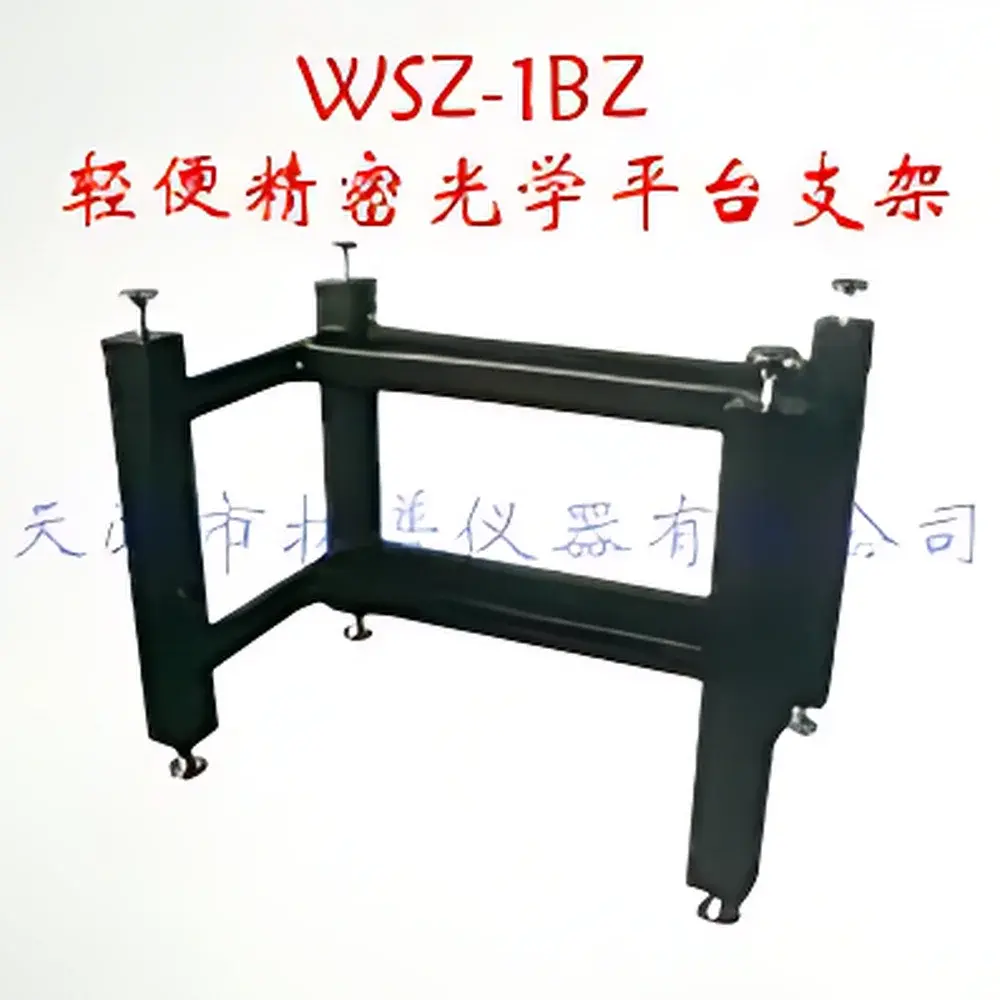
Topo WSZ-1BZ Portable Precision Optical Table Support System
| Brand | Topo |
|---|---|
| Model | WSZ-1BZ |
| Origin | Tianjin, China |
| Manufacturer Type | Direct Manufacturer |
| Country of Origin | China |
| Height | 700 mm |
| Vertical Adjustment Range | −10 mm to +30 mm |
| Base Interface | High-Elasticity Rubber Isolation Pads |
| Structural Design | Rigid Welded Steel Frame |
| Variant Options | Fixed-Foot (Type 1) and Castor-Mounted (Type 2) Configurations |
| Compatible Table Sizes | 600 × 600 mm to 1800 × 900 mm |
| Compliance | Designed for ISO 10360-compliant optical metrology environments |
Overview
The Topo WSZ-1BZ Portable Precision Optical Table Support System is an engineered mechanical foundation solution designed specifically for laboratory-grade optical measurement setups requiring stable, vibration-isolated elevation. Unlike generic lab stands or adjustable shelving, the WSZ-1BZ employs a purpose-built rigid steel frame architecture grounded in principles of static load distribution and low-frequency mechanical isolation. Its core function is to elevate optical tables—ranging from compact 600 × 600 mm breadboard platforms to full-size 1800 × 900 mm interferometric work surfaces—to a standardized working height of 700 mm while maintaining sub-millimeter planarity across the entire support footprint. The system operates on passive vibration mitigation rather than active cancellation: high-elasticity rubber isolation pads at both the table–support interface and floor–support interface attenuate broadband environmental disturbances (e.g., footfall, HVAC-induced floor resonance, and low-amplitude building sway) within the 5–50 Hz range typical of conventional laboratory environments. This makes it suitable for applications where optical path stability, beam alignment repeatability, and long-exposure imaging integrity are critical—notably in laser interferometry, collimation testing, spectrometer calibration, and optical coherence tomography (OCT) benchtop integration.
Key Features
- Rigid welded steel frame construction ensures structural integrity under static loads up to 150 kg per support unit, minimizing flexural deformation during instrument mounting and thermal cycling.
- Two distinct configuration families: Type 1 (fixed-foot) for permanent or semi-permanent installations requiring maximum rigidity; Type 2 (castor-mounted) with dual-braked 75 mm polyurethane swivel castors enabling controlled repositioning without disassembly.
- Precision height and leveling adjustment via four independent M12 threaded leveling feet, each offering a total travel range of 40 mm (−10 mm to +30 mm relative to nominal height), allowing fine-tuned horizontal alignment even on uneven floors.
- Optimized interface geometry accommodates standard optical table thicknesses (6–12 mm) and clamping patterns, with recessed mounting zones to prevent interference with table-threaded holes or vacuum ports.
- Surface-treated carbon steel components meet ASTM B117 salt-spray resistance standards (>72 hr), ensuring durability in controlled-humidity lab environments.
Sample Compatibility & Compliance
The WSZ-1BZ supports optical tables conforming to common industry dimensions—including ISO-standard 600 × 600 mm, 900 × 600 mm, 900 × 900 mm, 1200 × 600 mm, 1200 × 900 mm, 1500 × 900 mm, and 1800 × 900 mm formats—with consistent 700 mm elevation and uniform load-bearing distribution. It is compatible with aluminum breadboards (e.g., Thorlabs, Newport), steel-core laminated tables, and composite honeycomb optical platforms. While not certified to ISO 14000 or ISO 9001 as a standalone product, its design adheres to mechanical tolerances referenced in ISO 10360-7 (geometrical product specifications for coordinate measuring systems) and supports GLP-compliant optical alignment workflows by enabling traceable, repeatable platform positioning. No electrical or pneumatic interfaces are included; all operation is purely mechanical and non-intrusive to sensitive instrumentation.
Software & Data Management
The WSZ-1BZ is a fully mechanical support system with no embedded electronics, firmware, or digital connectivity. Consequently, it requires no software drivers, configuration utilities, or data logging capabilities. Its operational parameters—height, leveling status, and load position—are manually verified using standard metrology tools (e.g., digital levels, dial indicators, or laser trackers). Documentation includes dimensional drawings (PDF/DXF), assembly instructions, and torque specifications for leveling foot installation—all provided in English and aligned with ANSI/ASME Y14.5 geometric dimensioning conventions. For laboratories operating under FDA 21 CFR Part 11 or EU Annex 11 requirements, the absence of electronic records simplifies audit readiness: physical installation logs, leveling verification records, and maintenance checklists may be maintained in paper-based or validated electronic lab notebook (ELN) systems without validation overhead.
Applications
- Laser alignment stations requiring fixed-height beam paths across multiple optical elements.
- Modular optical test benches where rapid reconfiguration between interferometric, spectroscopic, and imaging subsystems is routine.
- Calibration labs performing ISO/IEC 17025-accredited measurements of lens focal length, wavefront error, or surface flatness.
- University teaching labs deploying shared optical tables across undergraduate physics and photonics courses.
- QC/QA environments supporting vision-based inspection systems, structured-light 3D scanners, and automated optical inspection (AOI) rigs.
FAQ
Does the WSZ-1BZ include vibration isolation beyond rubber pads?
No. It relies solely on passive isolation via high-damping rubber interfaces. Active or pneumatic isolation requires separate external systems.
Can it support dynamic loads, such as motorized translation stages?
Yes—within its rated static capacity—but dynamic acceleration forces must be evaluated separately; resonance coupling between moving components and the support frame should be assessed via modal analysis.
Is custom sizing available for non-standard table dimensions?
Standard configurations cover the listed sizes; bespoke variants (e.g., asymmetric foot spacing or extended height ranges) are available under OEM agreement with engineering review.
What maintenance is required?
Annual visual inspection of rubber pad compression set and leveling foot thread integrity; castor wheels require periodic cleaning and lubrication per manufacturer guidelines.
Are mounting hardware and torque specifications included?
Yes—M6 and M8 socket-head cap screws, washers, and calibrated torque values (4.5 ± 0.3 N·m for leveling feet) are supplied with each unit.




