
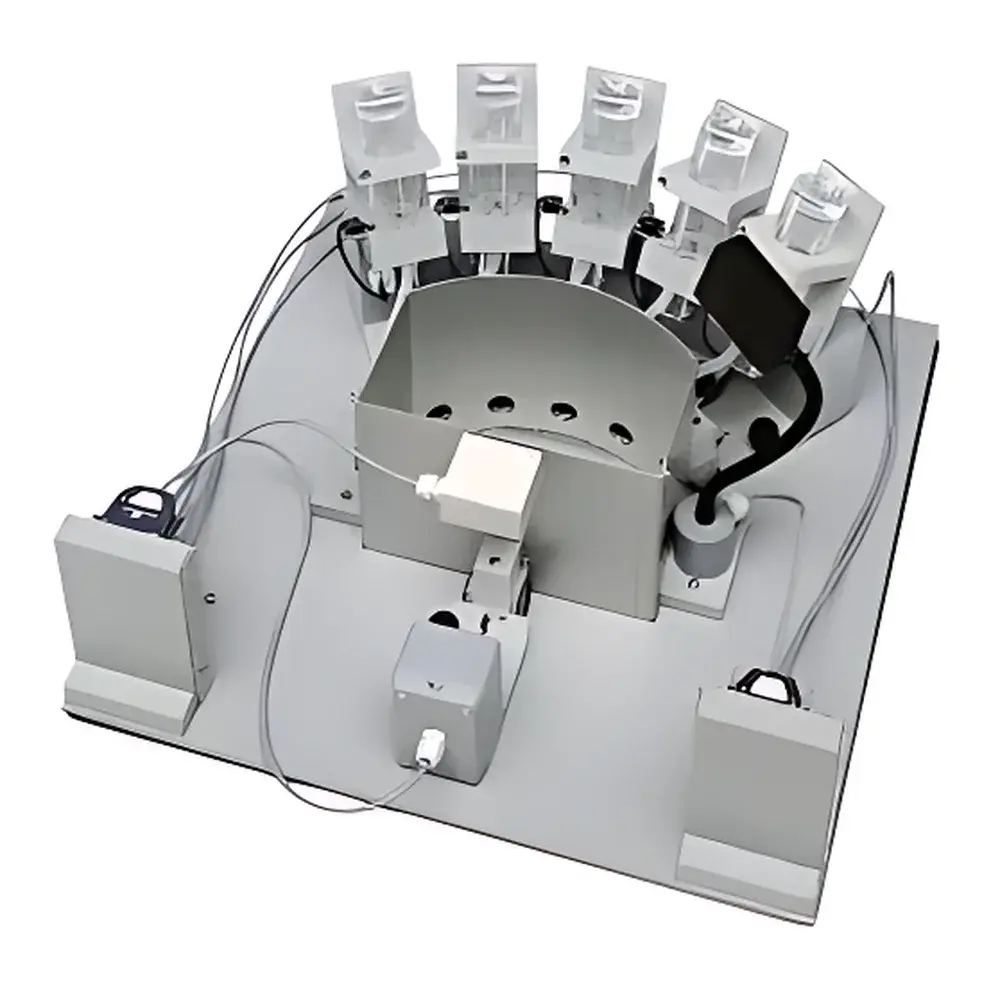
TSE Systems 5-Hole-Box System for Rodent Attention and Impulse Control Assessment
| Brand | TSE Systems |
|---|---|
| Origin | Germany |
| Model | 5-Hole-Box System |
| Application | Operant Behavioral Testing in Mice and Rats |
| Stimulus Modality | Visual (LED), Auditory (White Noise, Sine Tones) |
| Reward Delivery | Pellet (14/20/45 mg) or Liquid via Solenoid-Actuated Dispensers |
| Detection Method | Infrared Beam Break |
| Programmability | Built-in Protocol Editor (Customizable Trial Logic, Stimulus Timing, Reinforcement Schedules) |
| Compliance | Designed for GLP-aligned behavioral phenotyping workflows |
Overview
The TSE Systems 5-Hole-Box System is a fully integrated, computer-controlled operant chamber designed for standardized assessment of attentional performance, response inhibition, and impulsive action in rodents—primarily mice and rats. Grounded in the validated 5-Choice Serial Reaction Time Task (5-CSRTT) paradigm, the system implements a sustained visual attention assay wherein brief, spatially distributed light stimuli are presented pseudorandomly across five apertures mounted on an illuminated front wall. Each aperture is equipped with an infrared photobeam to detect nose-poke responses with millisecond temporal resolution. Correct responses—defined as nose pokes into the illuminated aperture within a user-defined limited-hold window—trigger immediate reinforcement delivery, either directly into the same aperture or into a centrally located reward magazine on the opposite wall. The system supports both pellet-based (14 mg for mice; 20 mg or 45 mg for rats) and liquid reward delivery, enabling precise control over reinforcement magnitude and schedule. Its modular architecture allows integration of auditory modulators—including broadband white noise bursts for selective attention priming and programmable sine-wave tones delivered via up to two independently addressable speakers—to introduce cross-modal distractors or cue-specific contingencies.
Key Features
- Five identical, IR beam-equipped stimulus apertures arranged horizontally on a backlit panel, engineered for uniform luminance and minimal glare.
- High-precision solenoid-driven pellet dispensers with calibrated drop detection; compatible with standard 14 mg, 20 mg, and 45 mg sucrose or grain-based pellets.
- Dual-mode reward delivery: intra-aperture reinforcement for spatial contiguity or centralized magazine delivery for response generalization studies.
- Integrated audio subsystem supporting white noise bursts (broadband, 50–20,000 Hz) and two independent sine-tone generators (frequency range: 1–20 kHz, amplitude adjustable in 1 dB steps).
- Real-time behavioral event logging with timestamp resolution ≤1 ms, capturing all nose pokes, stimulus onset/offset, reward delivery, timeout entries, and premature responses.
- Built-in protocol editor enabling full customization of trial structure—including variable inter-trial intervals, stimulus duration gradients, omission criteria, punishment contingencies (e.g., timeout following premature responses), and multi-stage task sequencing.
Sample Compatibility & Compliance
The 5-Hole-Box System is validated for use with C57BL/6, BALB/c, Sprague-Dawley, and Wistar strains under standard vivarium conditions (22 ± 2°C, 12:12 h light:dark cycle). Chamber dimensions (L × W × H: 25 × 25 × 30 cm) accommodate adult mice (≥20 g) and rats (≥250 g) without restraint. All hardware components comply with IEC 61000-6-3 (EMC emission standards) and IEC 61000-6-2 (immunity). Software-generated data files adhere to FAIR principles (Findable, Accessible, Interoperable, Reusable) and support export in CSV, HDF5, and Neurodata Without Borders (NWB) format. The system supports audit trail functionality and user-access controls aligned with GLP documentation requirements, including electronic signature capability for protocol approval and data export logs traceable to individual operators.
Software & Data Management
TSE’s proprietary BehaviorStudio software provides real-time visualization of ongoing sessions, dynamic parameter adjustment during acquisition, and automated calculation of core behavioral metrics: accuracy (% correct), omissions (% trials with no response), premature responses (% trials with nose poke before stimulus onset), correct latency (mean RT for hits), and perseverative responses (repeated pokes post-reinforcement). Frequency distribution histograms quantify aperture preference bias. All raw event timestamps and derived metrics are stored in a relational database with version-controlled protocol metadata. Export modules support direct integration with MATLAB, Python (via PyTSE), and commercial statistical platforms (SPSS, GraphPad Prism). Optional FDA 21 CFR Part 11 compliance package includes role-based access control, electronic signatures, and immutable audit trails for regulated preclinical studies.
Applications
- Pharmacological validation of pro-cognitive or impulsivity-modulating compounds (e.g., noradrenergic agents, dopamine D1/D2 modulators, cholinesterase inhibitors).
- Genetic phenotyping of transgenic/knockout models exhibiting attentional deficits (e.g., Dlg2, Grid2, Nr1n1 mutants).
- Longitudinal assessment of cognitive decline in aging or neurodegenerative models (e.g., APP/PS1, tauopathy lines).
- Neurodevelopmental disorder modeling, including ADHD-relevant endophenotypes (e.g., increased premature responding, reduced accuracy under high-demand conditions).
- Cross-species translational validation using homologous task structures between rodent 5-CSRTT and human Continuous Performance Tests (CPT).
FAQ
What species and strain types are supported?
The system is optimized for mice (C57BL/6, BALB/c, FVB) and rats (Sprague-Dawley, Wistar), with adjustable pellet sizes and chamber lighting intensity calibrated for species-specific visual acuity.
Can the system be used for longitudinal studies across multiple weeks?
Yes—hardware is constructed from autoclavable, non-porous polycarbonate; software supports session scheduling, progressive difficulty ramping, and cohort-level performance trending with automatic outlier detection.
Is remote monitoring or multi-chamber synchronization possible?
Up to 16 chambers can be synchronized via Ethernet-connected master controller; live video streaming (optional camera module) and real-time metric dashboards are accessible via secure web interface.
Does the system meet regulatory requirements for IND-enabling toxicology studies?
With optional 21 CFR Part 11 add-on, it satisfies audit readiness for GCP/GLP-compliant behavioral endpoints in safety pharmacology packages.
How is calibration and maintenance performed?
Daily automated self-test verifies IR beam integrity, LED luminance stability (±3% tolerance), and dispenser actuation timing; annual NIST-traceable photometric and timing calibration is available through TSE-certified service engineers.




