
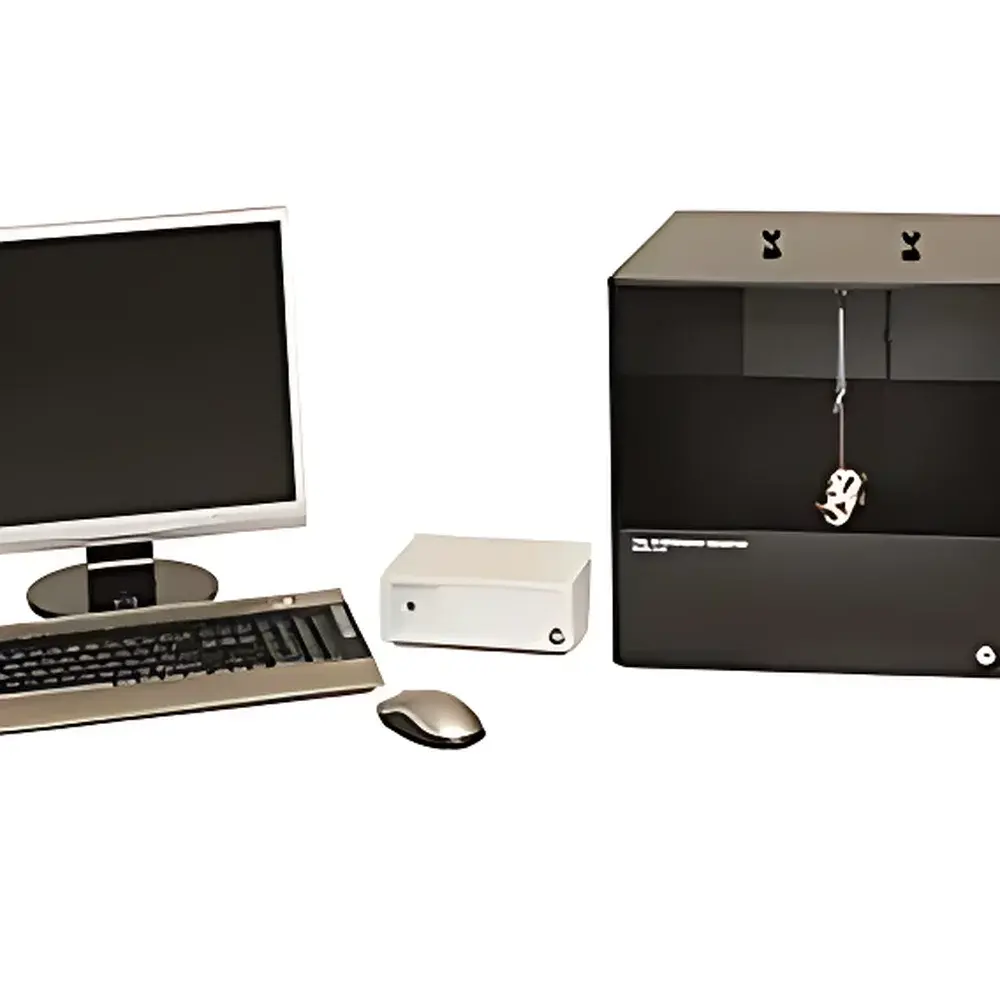
Tail Suspension Monitor by TSE Systems
| Brand | TSE Systems |
|---|---|
| Origin | Germany |
| Model | Tail Suspension Monitor |
| Configuration | Computerized, up to 16-channel |
| Regulatory Compliance | Designed for GLP-compliant behavioral phenotyping in preclinical neuroscience research |
Overview
The Tail Suspension Monitor by TSE Systems is a standardized, computer-controlled behavioral assessment instrument engineered for objective quantification of immobility in murine models during tail suspension testing—a widely accepted paradigm in preclinical depression research. Based on the principle that mice suspended by the tail exhibit alternating phases of active struggling and passive immobility, the system precisely detects motion dynamics using high-sensitivity optical or capacitive sensing (depending on configuration), enabling reliable discrimination between movement and immobility states. Unlike subjective manual scoring, this system delivers time-stamped, threshold-based event detection with temporal resolution sufficient to meet NIH- and ICMR-endorsed behavioral assay standards. The assay itself is pharmacologically validated: immobility duration correlates inversely with serotonergic and noradrenergic activity and is significantly reduced by clinically effective antidepressants—including SSRIs, SNRIs, and tricyclics—making it a core component of early-stage CNS drug discovery pipelines.
Key Features
- Configurable multi-channel architecture supporting simultaneous monitoring of up to 16 independent test subjects, enabling efficient throughput in longitudinal or dose-response studies.
- User-defined motion threshold adjustment (in arbitrary motion units) to accommodate strain-specific baseline activity levels (e.g., C57BL/6 vs. BALB/c) and experimental conditions (e.g., circadian phase, prior handling).
- Real-time data streaming to TSE Tail Suspension Software (Windows-based), with synchronized timestamping, event logging, and automatic generation of .csv and .xlsx result files compatible with GraphPad Prism, R, and Python pandas workflows.
- Hardware-integrated calibration routine ensuring inter-session reproducibility; system stability verified across ≥100 consecutive 6-min trials under controlled environmental conditions (22 ± 1°C, 40–60% RH, low ambient light).
- Optional standalone semi-automated unit available with LED digital display, push-button start/stop, and internal memory for single-channel field use where IT infrastructure is limited—ideal for satellite labs or teaching environments.
Sample Compatibility & Compliance
The system is validated for use with adult male and female mice (typically 8–12 weeks, 18–30 g), including common inbred (C57BL/6J, DBA/2J), outbred (CD-1), and transgenic lines (e.g., BDNF-KO, 5-HTT−/−). It accommodates standard tail suspension protocols aligned with published guidelines from the European College of Neuropsychopharmacology (ECNP) and the Society for Neuroscience (SfN). All hardware components comply with CE marking requirements (2014/30/EU EMC Directive and 2014/35/EU Low Voltage Directive). Data acquisition and storage support audit trails and electronic signatures per FDA 21 CFR Part 11 when deployed with validated software versioning and networked server backup—facilitating regulatory submissions under ICH S7A and nonclinical study compliance frameworks.
Software & Data Management
TSE Tail Suspension Software provides a dedicated, intuitive interface for protocol definition (trial duration, sampling interval, motion threshold), real-time visualization of activity traces per channel, and batch export of primary metrics: total immobility time (s), latency to first immobility (s), number of mobility bouts, and mean amplitude of detected motion events. Raw sensor output is archived at 10 Hz sampling rate, allowing retrospective re-analysis with modified thresholds. Exported datasets include metadata headers (subject ID, date/time, operator, protocol ID) to ensure FAIR (Findable, Accessible, Interoperable, Reusable) data principles. Integration with LIMS platforms via ODBC drivers is supported upon request for enterprise-level deployment.
Applications
- Primary screening of novel antidepressant candidates in academic and industrial pharmacology laboratories.
- Phenotypic characterization of genetically modified mouse models relevant to mood disorders, stress resilience, and neurodevelopmental pathways.
- Investigation of chronic stress paradigms (e.g., social defeat, restraint) and their modulation by pharmacological or environmental interventions.
- Validation of biomarker correlations—for instance, linking plasma corticosterone levels or hippocampal BDNF expression to behavioral immobility profiles.
- Training and standardization of behavioral technicians across multi-site preclinical consortia (e.g., IMI EU-AIMS, ENIGMA-MDD).
FAQ
What is the recommended suspension duration for mice in the tail suspension test?
Standard protocol specifies 6 minutes of suspension, with the last 4 minutes used for immobility scoring—consistent with OECD Test Guideline 426 and peer-reviewed methodology in Psychopharmacology and Behavioural Brain Research.
Can the system differentiate between fine tremor and gross locomotion?
Yes—the motion detection algorithm is calibrated to respond to displacement exceeding user-defined amplitude thresholds; fine tremor (sub-millimeter oscillations) falls below default sensitivity unless explicitly adjusted for specific neurodegenerative models.
Is validation documentation available for GxP-regulated studies?
Yes—TSE provides IQ/OQ/PQ templates, system suitability test procedures, and software validation reports compliant with ISO/IEC 17025 and ASTM E2500-15 for instrument qualification in regulated environments.
Does the system require external calibration weights or reference standards?
No—motion sensitivity is factory-calibrated using traceable dynamic reference signals; annual performance verification is conducted via built-in diagnostic routines and optional NIST-traceable motion simulators.
How is animal welfare addressed during testing?
The system includes automatic trial termination if excessive struggling (>90 s cumulative mobility within first 60 s) or tail injury indicators are detected; all protocols adhere to Directive 2010/63/EU Annex VIII and AAALAC International standards for humane endpoints.




