IntelliCage Add-On SocialBox by TSE Systems
| Brand | TSE Systems |
|---|---|
| Origin | Germany |
| Model | IntelliCage Add-On SocialBox |
| Type | RFID-Based Automated Social Behavior Monitoring Module for Mouse Ethology |
| Compatibility | Designed exclusively for IntelliCage Plus and IntelliCage Pro systems |
| Max Expansion | Up to 4 SocialBoxes per IntelliCage unit (5 total zones) |
| System Scalability | Up to 8 IntelliCage units or 32 SocialBoxes (128 mice) |
| Software Control | IntelliCage Plus v5.0+ with audit-trail-enabled experimental protocol scheduling |
| Regulatory Alignment | Compliant with GLP-compliant data integrity requirements |
Overview
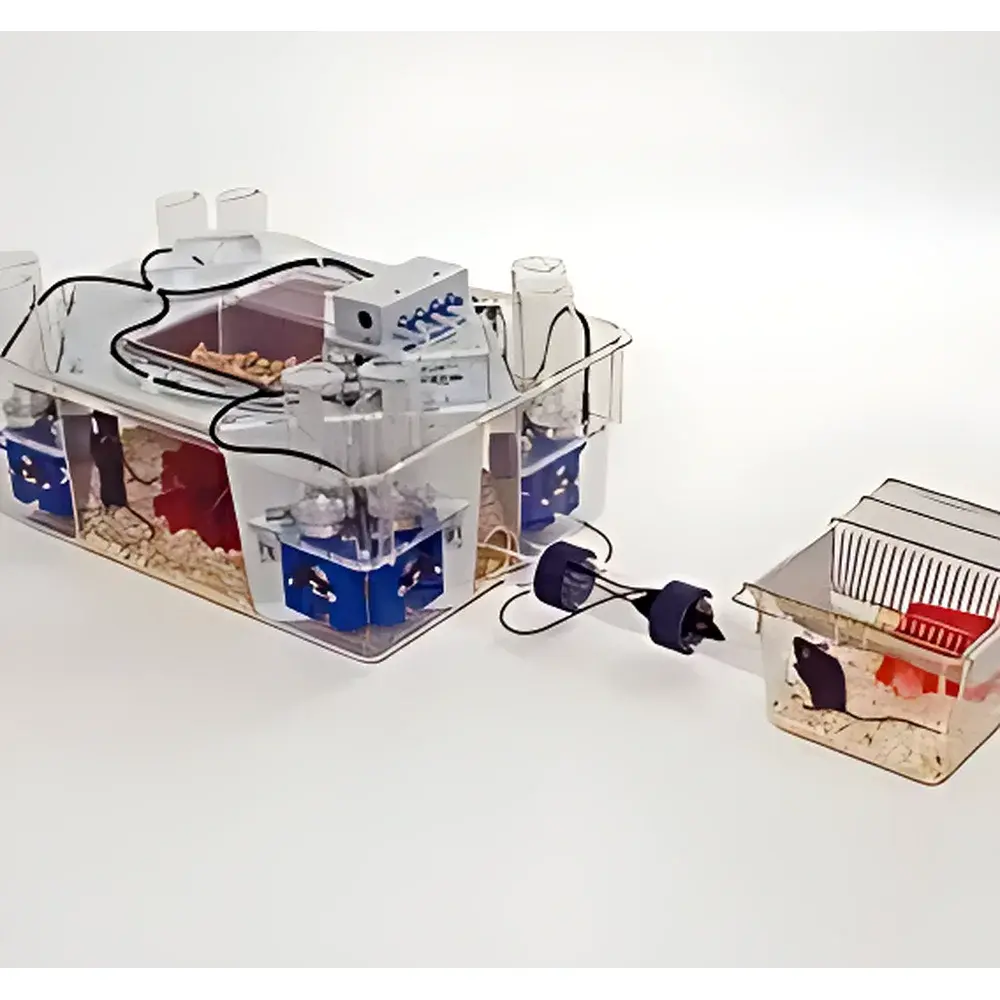
The IntelliCage Add-On SocialBox is a modular, RFID-based behavioral extension module engineered by TSE Systems (Germany) to transform the standard IntelliCage into a multi-compartment ethological platform for longitudinal, non-invasive monitoring of murine social dynamics and spatial decision-making. Built upon the same 13.56 MHz ISO/IEC 15693-compliant RFID transponder architecture as the core IntelliCage system, the SocialBox enables precise, individual-level tracking of mouse movement, zone occupancy, inter-animal proximity events, and temporal interaction sequences without manual intervention or physical restraint. Each SocialBox functions as an autonomous behavioral arena—equipped with integrated IR beam arrays, programmable LED lighting, temperature sensors, and optional environmental stimulus ports—allowing researchers to introduce controlled, time-stamped contextual variables (e.g., light spectra shifts, olfactory cues via odorized air streams, acoustic stimuli, or novel object placement) across discrete zones. When connected to an IntelliCage base unit, up to four SocialBoxes expand the system into a five-zone configuration, supporting hierarchical analysis of territoriality, dominance hierarchies, social clustering, and conditioned place preference/avoidance at cohort scale.
Key Features
- Modular expansion: Adds up to four independent behavioral compartments per IntelliCage unit, enabling scalable multi-zone experimental designs.
- Individual identification: Leverages implanted or subcutaneous RFID transponders (ISO 11784/11785 compliant) for continuous, unambiguous animal ID with <100 ms read latency.
- Synchronized behavioral logging: Time-stamped event records (entry/exit, nose-poke, beam break, door actuation) are synchronized across all zones with microsecond-level precision via shared system clock.
- Environmental controllability: Each SocialBox supports independent control of ambient illumination (white + RGB LEDs), surface temperature (±0.5°C resolution), and integration with external stimulus delivery hardware (e.g., ultrasonic emitters, odor vaporizers).
- Standardized hardware interface: Uses identical power, data, and communication protocols as the IntelliCage base—ensuring mechanical, electrical, and software interoperability without firmware modification.
- GLP-aligned data architecture: Raw binary event logs are stored in encrypted, tamper-evident HDF5 files with embedded metadata (user, timestamp, protocol ID, calibration flags) to support regulatory audits.
Sample Compatibility & Compliance
The SocialBox is validated for use with C57BL/6, BALB/c, DBA/2, and other common inbred and outbred mouse strains (18–35 g). Cage dimensions (W × D × H: 320 × 220 × 155 mm) conform to EU Directive 2010/63/EU and NIH Guide for Care and Use of Laboratory Animals space requirements for group-housed mice (up to 5 animals per SocialBox under standard conditions). All electronics meet IEC 61000-6-3 EMC emission standards and IEC 61000-6-2 immunity specifications. The system complies with ISO/IEC 17025 documentation practices for instrument qualification and supports IQ/OQ/PQ validation packages upon request.
Software & Data Management
Controlled exclusively via IntelliCage Plus v5.0 or later, the SocialBox integrates natively into the platform’s centralized experiment scheduler, real-time dashboard, and post-hoc analytics engine. Experimental protocols—including zone-specific reward contingencies, stimulus timing windows, and access restrictions—are defined using a drag-and-drop visual editor with version-controlled saving. Behavioral metrics (e.g., inter-animal proximity duration, zone transition matrices, social bout frequency, latency to first interaction) are computed automatically from raw event streams using open-source Python-based analysis modules (included). Audit trails record all user actions (login/logout, parameter edits, data exports) with SHA-256 hashing and UTC timestamps—meeting FDA 21 CFR Part 11 requirements for electronic records when deployed with validated Windows Server environments.
Applications
- Quantification of dominance hierarchies via chase-follow sequences and resource monopolization patterns.
- Longitudinal mapping of social network topology using weighted, time-resolved adjacency matrices.
- Assessment of sociability deficits in neurodevelopmental disorder models (e.g., BTBR, Shank3 KO) under variable environmental enrichment conditions.
- Evaluation of pharmacological modulation of social motivation via real-time reinforcement schedules in specific zones.
- Context-dependent place preference testing using multimodal cue combinations (light + odor + texture) across adjacent SocialBoxes.
- Chronic stress modeling through controlled social instability paradigms (e.g., dynamic cage-mate rotation with RFID-verified exposure history).
FAQ
Can the SocialBox operate independently of an IntelliCage base unit?
No. The SocialBox has no standalone controller or power supply—it draws power and synchronization signals exclusively from the host IntelliCage via standardized ribbon cable interface.
Is it possible to mix SocialBoxes with different environmental configurations within one IntelliCage system?
Yes. Each SocialBox retains independent configuration for lighting, temperature, and stimulus routing, enabling heterogeneous zone design within a single experiment.
What level of temporal resolution is achieved for social interaction detection?
Beam-break and RFID read events are timestamped with ≤10 ms precision; proximity inference (e.g., co-occupancy in same zone) is calculated at 100 Hz sampling rate.
Does the system support automatic detection of aggressive behaviors such as biting or tail rattling?
No. The SocialBox detects spatial co-occupancy and directed movement but does not perform video-based behavioral classification; complementary video tracking (e.g., EthoVision XT integration) is recommended for fine-grained ethogram annotation.
How is data integrity ensured during extended multi-week experiments?
All event logs are written continuously to redundant internal SSD storage with journaling file system (ext4); automatic daily checksum verification and failover to secondary storage prevent data loss during unexpected power interruption.
Related Products