
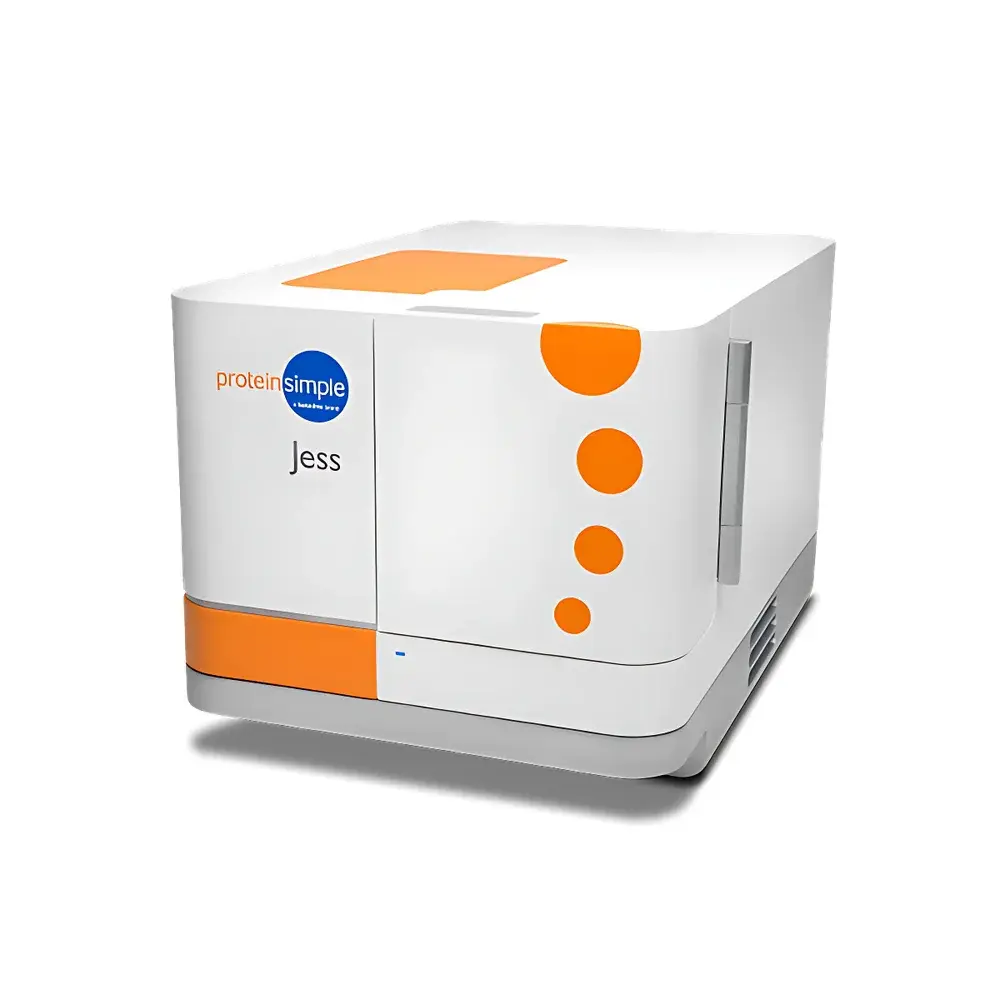
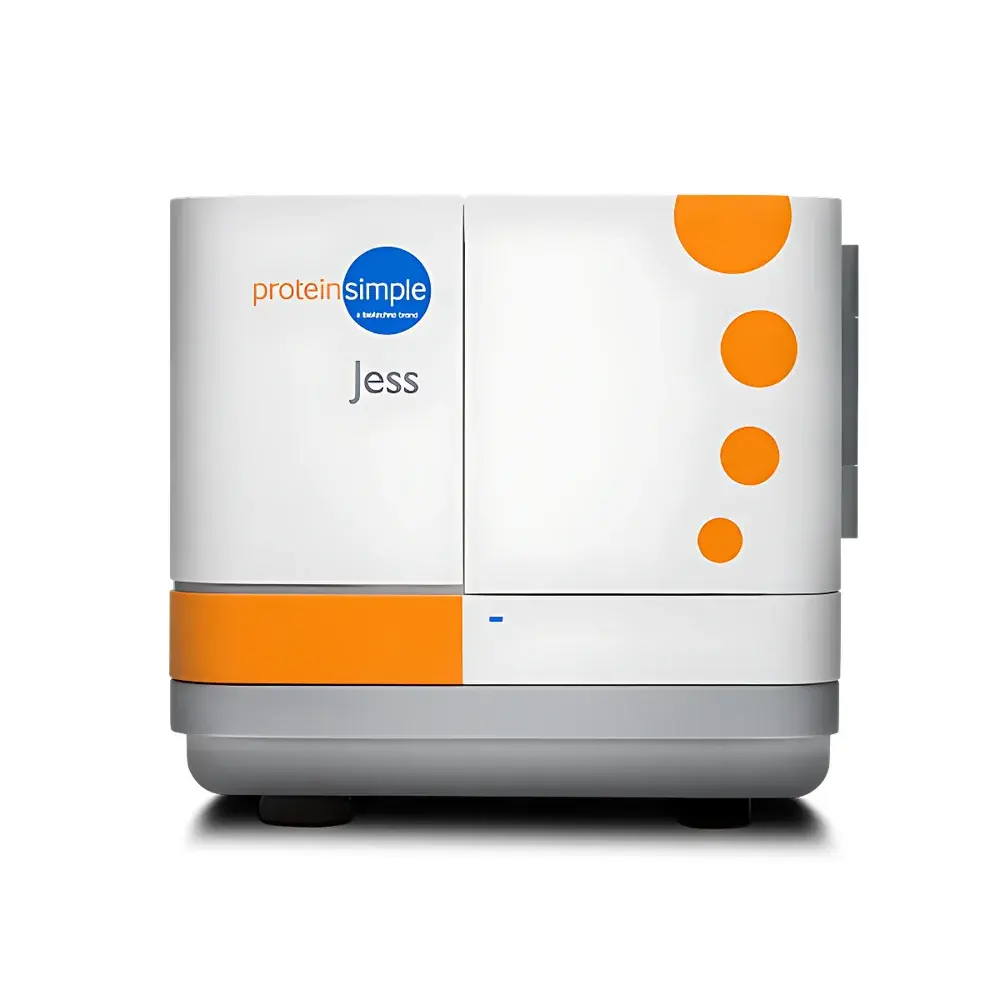
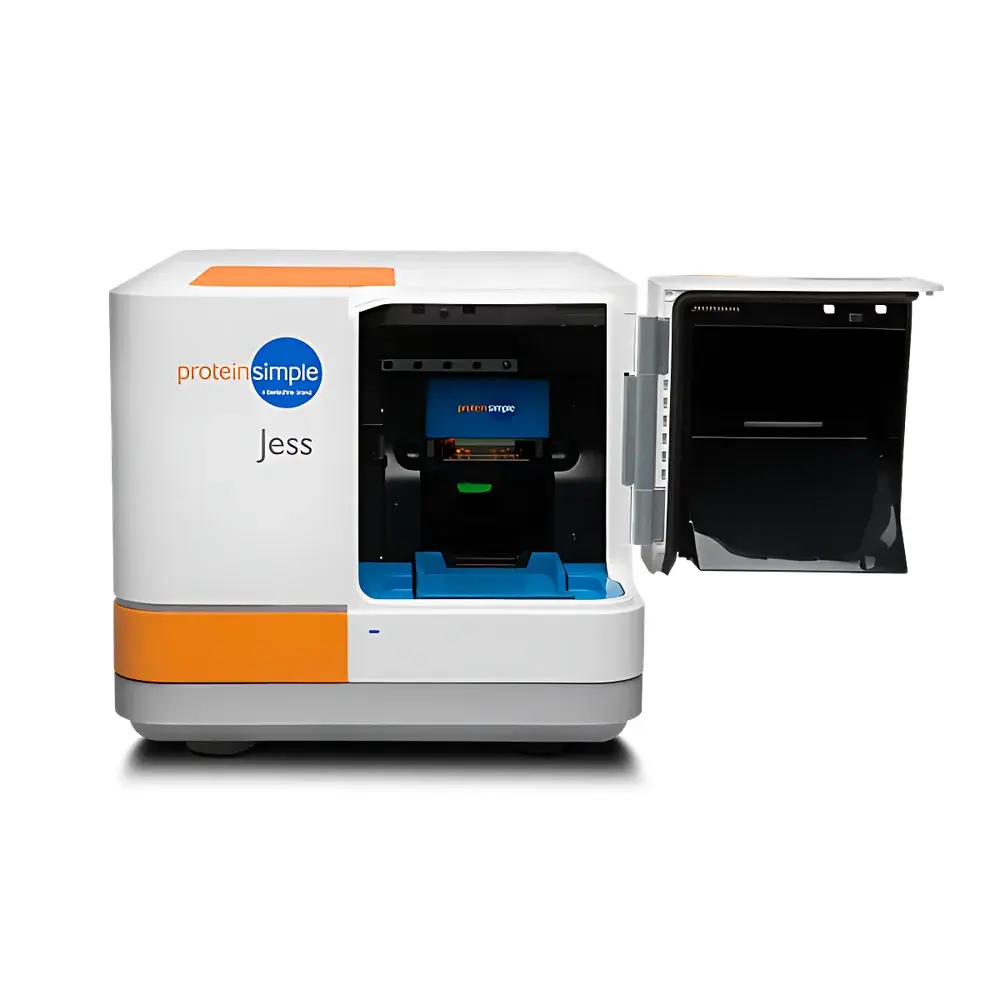
ProteinSimple Jess Automated Digital Western Blotting System
| Brand | ProteinSimple |
|---|---|
| Origin | USA |
| Manufacturer Type | Authorized Distributor |
| Product Category | Imported Instrument |
| Model | Jess |
| Instrument Type | Fully Automated Digital Western Blotting System |
| Automation Level | Fully Automated |
| Sample Volume | 3 µL per assay |
| Detection Modes | Chemiluminescence, Dual-Color Fluorescence |
| Quantification | Absolute (via standard curve) and Relative (total protein normalization or internal control) |
| Molecular Weight Range | 2–440 kDa |
| Throughput | Up to 25 samples per run |
| Run Time | ~3 hours |
| RePlex Capability | Yes — automated antibody stripping and re-probing on same capillary |
Overview
The ProteinSimple Jess Automated Digital Western Blotting System is an integrated, capillary-based digital immunoassay platform engineered for precision, reproducibility, and workflow efficiency in quantitative protein analysis. Unlike conventional slab-gel Western blotting—which relies on electrophoretic separation in polyacrylamide gels followed by membrane transfer, manual blocking, antibody incubation, and film-based detection—the Jess system performs all core steps—sample loading, electrophoretic separation, immunoprobing, and signal detection—within a single, sealed 25-µm inner-diameter capillary. This microfluidic architecture leverages electrokinetic transport and proprietary capillary surface chemistry to achieve high-resolution protein separation under native or denaturing conditions, followed by on-capillary immunocapture and digital chemiluminescent or fluorescence readout. The system eliminates gel casting, membrane handling, and film development, reducing hands-on time by >80% while delivering quantitative data with inter-run CVs typically <15%—a critical improvement over traditional semi-quantitative blotting.
Key Features
- Fully Automated Workflow: Integrated fluidics and temperature-controlled modules execute sample loading, electrophoresis, antibody incubation (primary and secondary), washing, substrate addition, and imaging without user intervention.
- Ultra-Low Sample Consumption: Requires only 3 µL of lysate per assay—approximately 1/10 to 1/20 the volume needed for conventional Western blotting—enabling analysis of precious clinical or primary cell samples.
- Dual-Mode Detection: Supports both high-sensitivity chemiluminescence (HRP- or AP-conjugated secondaries) and dual-color fluorescence (e.g., 680/800 nm channels), allowing multiplexed target detection within a single run.
- Total Protein Normalization (TPN): Built-in fluorescent total protein staining (e.g., using Ponceau S analogues or proprietary dyes) enables lane-to-lane normalization without reliance on housekeeping proteins—reducing bias from variable expression of traditional loading controls.
- RePlex Technology: Patented on-capillary antibody stripping and re-probing allows sequential detection of multiple targets on the same capillary, eliminating inter-capillary variability and conserving sample integrity.
- Validated Molecular Weight Range: Capable of resolving and quantifying proteins across a broad dynamic range—from 2 kDa peptides to 440 kDa multimeric complexes—without gel optimization or transfer inefficiency.
Sample Compatibility & Compliance
The Jess system accepts clarified cell/tissue lysates, purified recombinant proteins, serum, plasma, CSF, and exosome-enriched fractions—provided samples are compatible with SDS-PAGE denaturation or native electrophoresis buffers. All reagents, including separation matrices, antibodies, and detection substrates, are validated for use under Good Laboratory Practice (GLP) and Good Manufacturing Practice (GMP)-aligned workflows. Data acquisition and analysis comply with FDA 21 CFR Part 11 requirements when deployed with audit-trail-enabled software configurations. The platform supports ISO/IEC 17025 traceability frameworks for method validation, and assay protocols align with relevant sections of USP , CLSI EP17-A2, and ASTM E2500-19 for analytical instrument qualification.
Software & Data Management
Acquisition and analysis are managed via Compass Software (v5.x or later), a Windows-based application offering intuitive protocol builder, real-time run monitoring, and automated band identification. Quantitative outputs include peak area, relative intensity, % of total signal, and normalized fold-change versus controls. Calibration curves generated from serial dilutions support absolute quantification (ng/mL or fmol/µL). Raw data files (.jess) are stored in vendor-neutral HDF5 format, enabling third-party integration via Python or MATLAB APIs. Audit trails record user actions, parameter changes, and instrument events; electronic signatures and role-based access control support regulated environments. Export options include CSV, PDF reports, and publication-ready TIFF/PNG figures with embedded metadata.
Applications
The Jess system is routinely deployed in translational research laboratories for biomarker verification, pharmacodynamic monitoring, and mechanism-of-action studies. Key use cases include: quantification of phosphorylated signaling nodes (e.g., p-ERK, p-AKT) in tumor biopsies and patient-derived organoids; longitudinal profiling of immune checkpoint proteins (PD-1, CTLA-4, LAG-3) in PBMC subsets isolated by FACS; characterization of extracellular vesicle cargo (e.g., tetraspanins, oncoproteins) from liquid biopsies; validation of CRISPR/Cas9 knockout efficiency at the protein level; and assessment of protein degradation kinetics following PROTAC treatment. Its compatibility with laser-capture microdissected tissue and low-input stem cell lysates makes it especially valuable in developmental biology and rare disease research.
FAQ
How does Jess differ from traditional Western blotting in terms of reproducibility?
Jess eliminates inter-gel and inter-membrane variability through standardized capillary cartridges and automated fluidic handling—resulting in intra-assay CVs <10% and inter-assay CVs <15% across independent runs.
Can Jess perform total protein normalization without housekeeping proteins?
Yes—Compass Software includes built-in algorithms for total protein stain-based normalization using fluorescent dyes applied directly in-capillary, providing unbiased loading correction independent of reference gene or protein stability.
Is RePlex compatible with both chemiluminescent and fluorescent detection?
RePlex is fully supported for both modalities; however, fluorophore photostability must be verified for multi-cycle probing—recommended dyes include IRDye 680RD and IRDye 800CW.
What regulatory documentation is available for method validation?
ProteinSimple provides IQ/OQ/PQ protocols, system suitability test templates, and validation guides aligned with ICH Q5E and FDA Bioanalytical Method Validation Guidance.
Does the system support custom antibody validation?
Yes—users may define custom antibody titration curves, optimize incubation times, and validate specificity using positive/negative controls within the Compass Software assay editor.




