
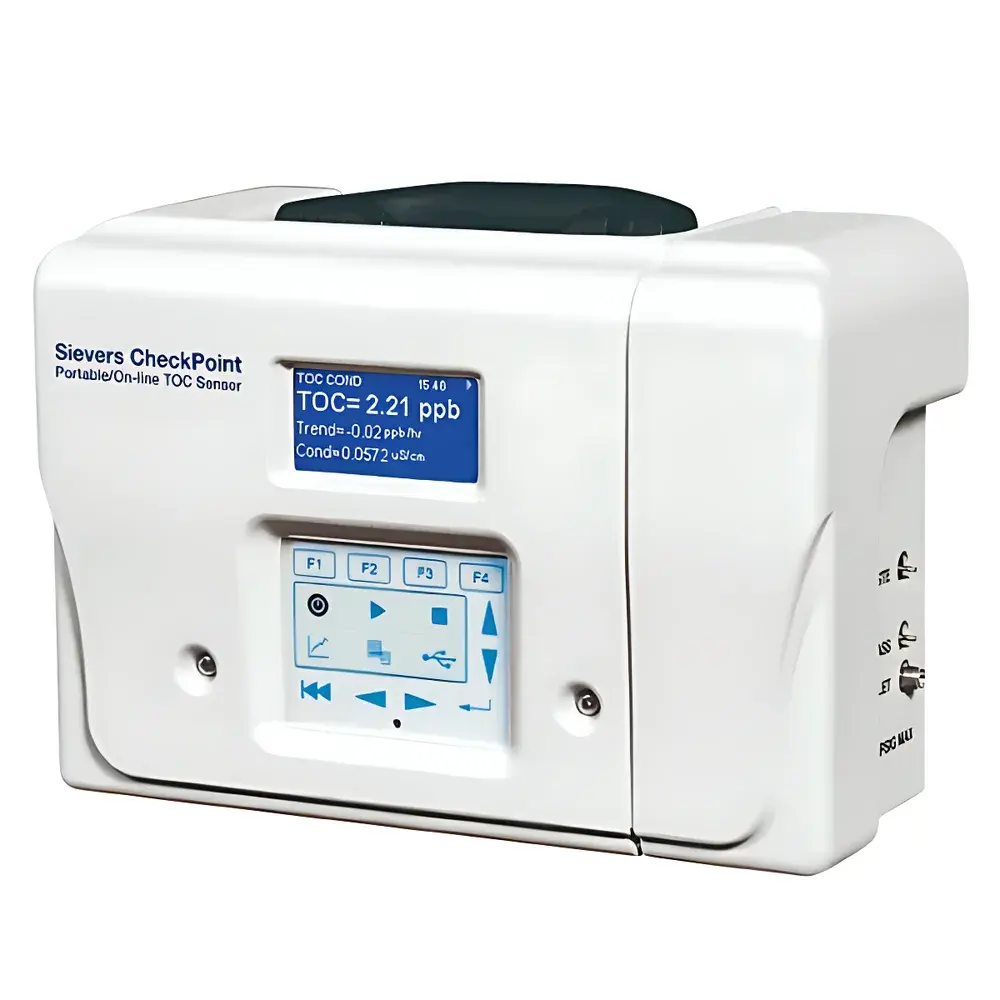
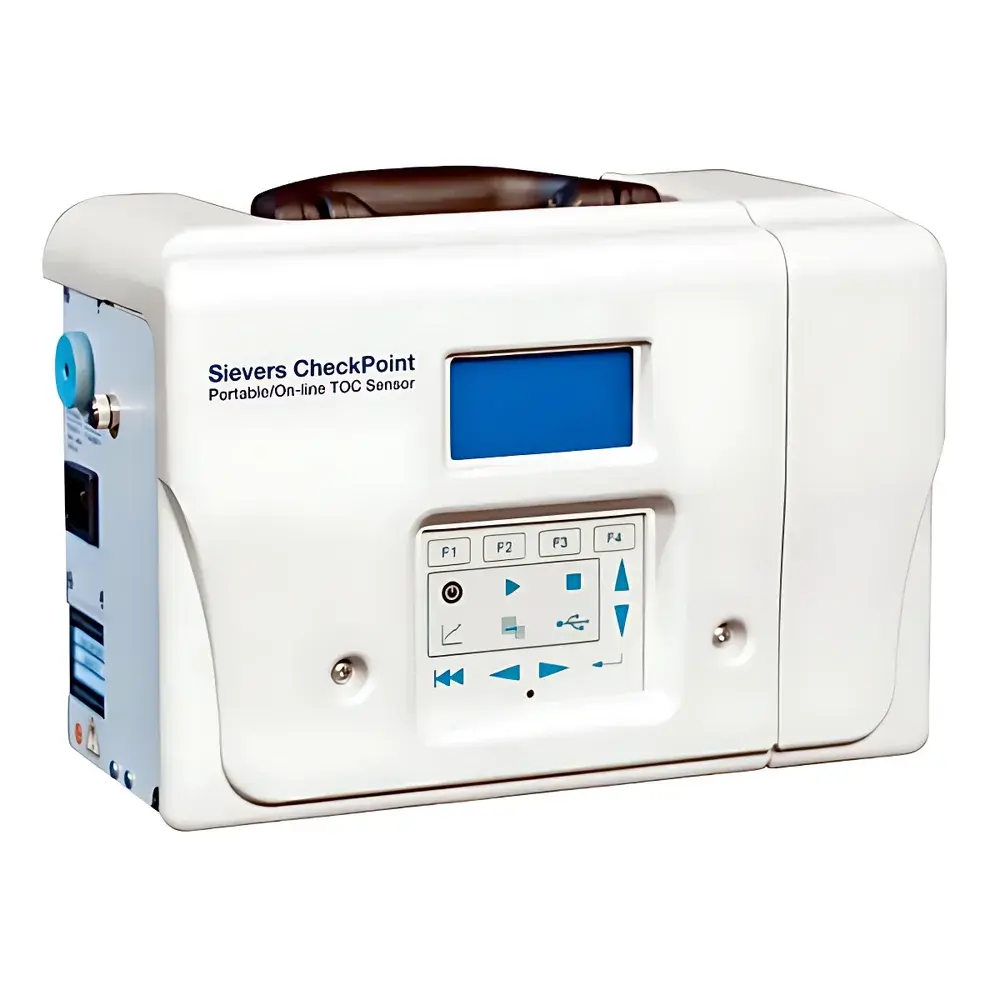
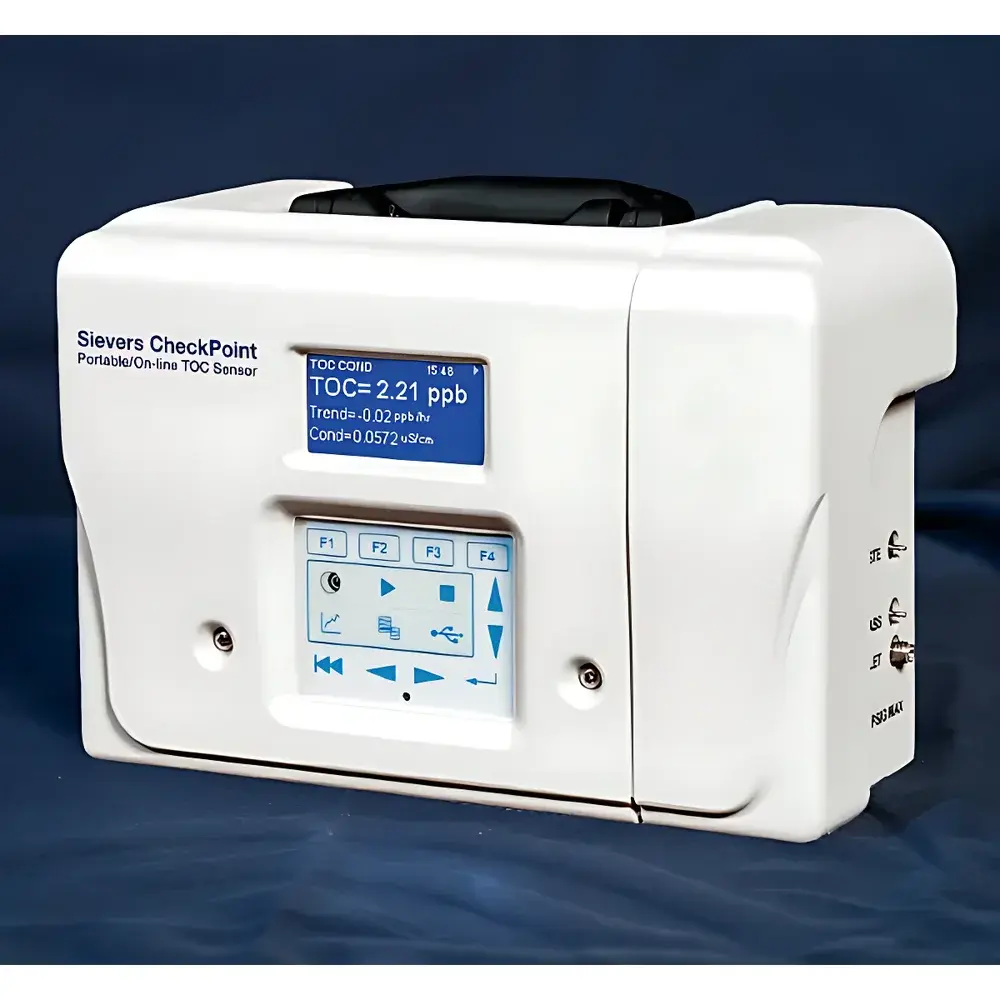
Sievers CheckPoint Online and Portable Total Organic Carbon (TOC) Sensor
| Brand | Sievers (Veolia) |
|---|---|
| Origin | USA |
| Manufacturer Type | Original Equipment Manufacturer (OEM) |
| Product Category | Imported Instrument |
| Model | CheckPoint |
| Instrument Type | Portable & Online TOC Analyzer |
| Measurement Principle | Direct Conductivity (DC) Detection |
| Oxidation Method | UV Photolysis (185/254 nm) |
| Measurement Range | 0.05–1000 ppb C (CheckPointe) |
| Accuracy | ±5% (at 500 ppb C sucrose) |
| Resolution | 0.001 ppb C |
| Detection Limit | 0.05 ppb C |
| Precision (Online Mode) | RSD <1% or 0.05 ppb (whichever is greater, CheckPointe) |
| Data Output Interval | Adjustable from 15 seconds to 8 hours |
| Sample Temperature Range | 10–90 °C (CheckPoint Pharma) |
| Ambient Operating Temperature | 10–55 °C (Pharma) |
| Pressure Rating | 103–690 kPa (15–100 psig) |
| Power Supply | 100–240 VAC ±10%, 50/60 Hz, 60 W |
| Certifications | CE, ETL listed |
| Regulatory Compliance | FDA 21 CFR Part 11 ready (via USB printer support), GLP/GMP-aligned IQ/OQ/PQ protocols |
Overview
The Sievers CheckPoint Online and Portable Total Organic Carbon (TOC) Sensor is an engineered solution for real-time, low-level organic carbon monitoring in ultra-pure water systems across regulated and high-sensitivity industrial environments. Based on Sievers’ proprietary Direct Conductivity (DC) detection technology, the CheckPoint measures CO2 generated from UV photolysis (185/254 nm) of oxidized organic compounds—eliminating reagent dependency and minimizing maintenance overhead. Unlike catalytic combustion or NDIR-based TOC analyzers, DC detection provides superior sensitivity below 1 ppb while maintaining robustness in variable conductivity matrices typical of pharmaceutical PW, WFI, and semiconductor UPW streams. The dual-mode architecture—supporting both continuous online flow-through analysis and discrete grab-sample measurement—enables seamless integration into permanent monitoring points as well as rapid field diagnostics without infrastructure modification.
Key Features
- Battery-powered operation: First and only TOC sensor capable of fully autonomous portable use, enabling point-of-use verification without AC power or external gas supply.
- Dual-model configuration: CheckPoint Pharma optimized for high-temperature (up to 90 °C), ozone-tolerant (up to 200 ppb O3 for 2 hrs/day) pharmaceutical water systems; CheckPointe engineered for ultra-low detection (0.05 ppb C LOD) in microelectronics and power generation applications where thermal stability and ozone exposure are not primary concerns.
- FDA 21 CFR Part 11 compliance support: Integrated USB printer interface enables audit-trail–capable report generation; onboard memory stores all calibration logs, measurement data, and system events with user-definable date-range export.
- Regulatory-ready validation framework: Predefined IQ/OQ/PQ protocols aligned with ASTM D5905, USP , and EP 2.2.44 facilitate rapid qualification under GMP/GLP environments.
- Multi-parameter synchronous output: Simultaneous reporting of TOC, specific conductivity (0–1.4 μS/cm), and temperature via three analog outputs—ensuring full traceability per ISO 9001 and ICH Q5C requirements.
- Flexible connectivity: Standard Ethernet (Modbus TCP/IP), USB host/device, and optional I/O expansion board with dual 4–20 mA outputs, two relay alarms, and binary inputs for SCADA or DCS integration.
Sample Compatibility & Compliance
The CheckPoint operates within defined physicochemical boundaries to ensure metrological integrity. For CheckPoint Pharma, sample compatibility includes PW, WFI, and purified steam condensate at temperatures up to 90 °C and residual ozone concentrations ≤200 ppb (limited daily exposure). CheckPointe supports ambient-temperature UPW, rinse water, and boiler feedwater with conductivity <1.4 μS/cm—exceeding this threshold may reduce TOC accuracy due to ionic interference in DC detection. Both models meet CE marking requirements and are ETL-listed to UL 61010-1 and CSA C22.2 No. 61010-1 safety standards. UV lamp components contain mercury and must be disposed of in accordance with local, state, and federal hazardous waste regulations (e.g., U.S. EPA 40 CFR Part 273).
Software & Data Management
Data acquisition and archival follow ALCOA+ principles (Attributable, Legible, Contemporaneous, Original, Accurate, Complete, Consistent, Enduring, Available). All measurements—including raw conductivity, temperature-compensated TOC values, calibration timestamps, and system diagnostics—are stored in non-volatile memory with time-stamped metadata. USB mass storage mode allows direct download of CSV-formatted datasets; Ethernet connectivity supports remote configuration and firmware updates via standard web interface or Modbus register mapping. The built-in 21 CFR Part 11 toolkit includes electronic signature capture, role-based access control (admin/operator), and immutable audit trails for all critical operations—fully supporting inspection readiness for FDA, EMA, and PMDA audits.
Applications
- Pharmaceutical manufacturing: Continuous TOC verification of WFI distribution loops, PW storage tanks, and clean-in-place (CIP) final rinse water per USP and EU Annex 1.
- Semiconductor fabrication: Monitoring UPW polishing loop effluent and tool inlet points where sub-ppb organic contamination risks defect formation on 5nm node wafers.
- Power generation: Feedwater and condensate monitoring in supercritical boiler systems to prevent organic acid corrosion and turbine deposit accumulation.
- Research & development labs: Rapid troubleshooting of purification system leaks, membrane fouling, or resin exhaustion using handheld grab-sampling capability.
- Contract manufacturing organizations (CMOs): Portable validation of TOC performance across multiple client sites without instrument relocation or recalibration delays.
FAQ
What oxidation method does the CheckPoint use, and why is it suitable for low-concentration TOC measurement?
The CheckPoint employs dual-wavelength UV photolysis (185 nm + 254 nm), which achieves >95% oxidation efficiency for small-molecule organics (e.g., methanol, acetone, formaldehyde) without catalysts or persulfate. This method minimizes blank contribution and preserves detector linearity down to 0.05 ppb C.
How often does the sensor require calibration, and what standards are recommended?
Calibration stability is typically six months under normal operating conditions. Certified sucrose standards (e.g., NIST-traceable 500 ppb C) are recommended for initial calibration and periodic verification per ASTM D5905.
Can the CheckPoint be used in ozone-sanitized pharmaceutical water systems?
Yes—CheckPoint Pharma is specifically validated for continuous operation in ozone-treated WFI loops with up to 200 ppb residual ozone for limited daily durations. CheckPointe is not ozone-rated.
Does the instrument comply with data integrity requirements for regulated industries?
Yes. With its embedded 21 CFR Part 11-compliant audit trail, electronic signatures, and secure data export, the CheckPoint meets FDA, EMA, and PIC/S expectations for computerized system validation in GxP environments.
What is the minimum sample flow rate required for online operation?
60 mL/min for standard high-pressure configurations; 1 mL/min when used with the optional low-pressure sampling kit—enabling deployment in low-flow recirculation branches or point-of-use locations.
Related Products







