
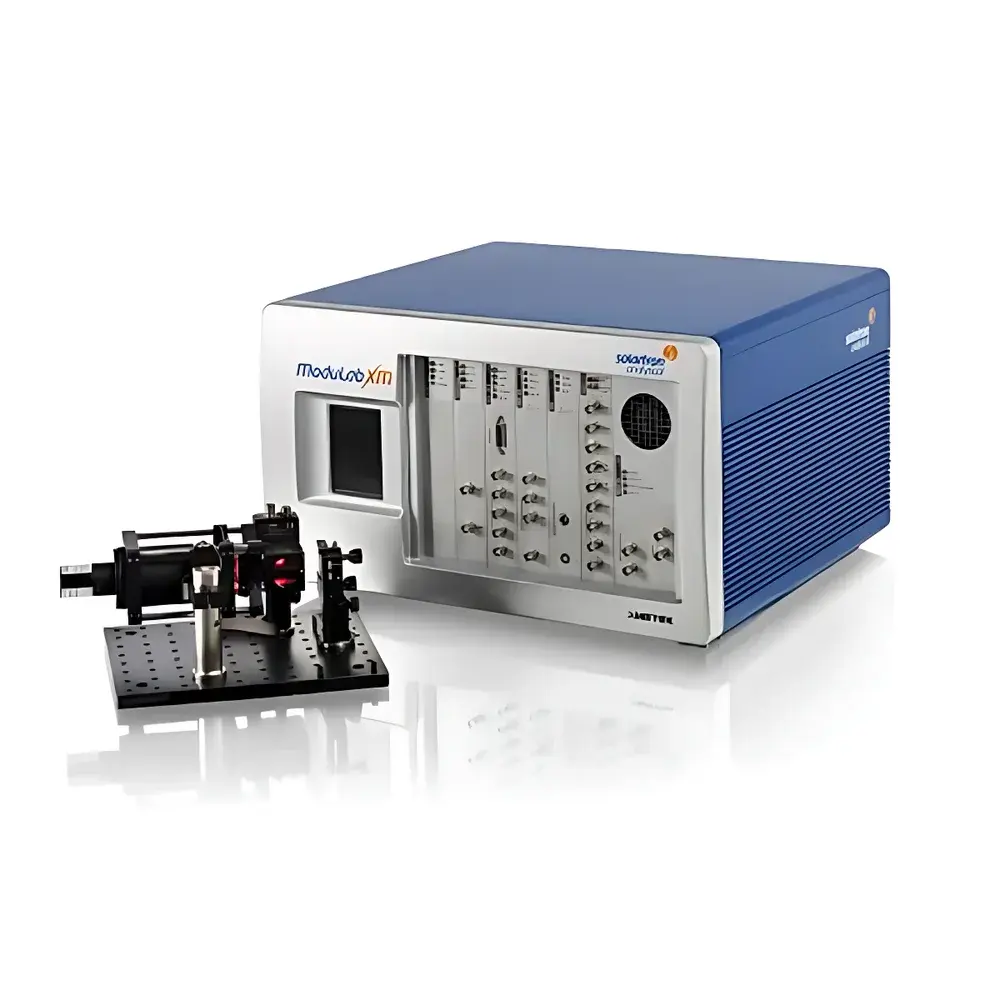
Solartron Analytical ModuLab XM PhotoChem IPCE Electrochemical Workstation
| Brand | Solartron Analytical |
|---|---|
| Origin | United Kingdom |
| Model | ModuLab XM PhotoChem IPCE |
| Instrument Type | Electrochemical Workstation |
| Channel Count | Single-Channel |
| Current Range | ±2 A |
| Current Accuracy | ±0.2% of reading |
| Potential Accuracy | ±0.2% of reading |
| Potentiostatic Range | ±8 V to ±100 V (high-voltage option) |
| AC Impedance Frequency Range | 10 µHz – 1 MHz |
| Light Source Calibration | NIST-traceable |
| Software Platform | ModuLab XM Suite with PhotoElectroChem module |
Overview
The Solartron Analytical ModuLab XM PhotoChem IPCE Electrochemical Workstation is a purpose-engineered, integrated optical-electrochemical measurement platform designed for quantitative characterization of photoactive materials and devices under controlled illumination. Built upon Solartron’s industry-proven ModuLab XM architecture, this system combines high-fidelity potentiostat/galvanostat functionality with synchronized, spectrally resolved light modulation and detection—enabling rigorous investigation of charge generation, separation, transport, and recombination dynamics in photoelectrochemical (PEC) systems. Its core operational principle integrates time-domain transient techniques (e.g., photocurrent decay, charge extraction) with frequency-domain methods (e.g., IMPS, IMVS, EIS) under programmable light bias, making it particularly suited for dye-sensitized solar cells (DSSCs), metal oxide photoanodes (e.g., α-Fe2O3 for water splitting), perovskite photovoltaics, and emerging photoelectrocatalytic interfaces.
Key Features
- Single-channel electrochemical workstation with ±2 A current compliance and ±100 V high-voltage capability—optimized for both low-current photoresponse measurements and high-bias photoelectrolysis studies.
- NIST-traceable, thermally stabilized broadband and monochromatic LED light sources, supporting intensity-modulated spectroscopy (IMPS/IMVS) and incident photon-to-current efficiency (IPCE) quantification across 350–900 nm.
- Integrated optical bench with motorized filter wheels, calibrated irradiance sensors, and shutter control—fully synchronized with electrochemical stimulus via ModuLab XM timing engine.
- Dual-potential monitoring with auxiliary voltage divider capability for simultaneous anode/cathode potential resolution during impedance or transient measurements.
- Solartron’s proprietary Frequency Response Analysis (FRA) engine—including single-sine, multi-sine, and swept-frequency modes—delivering high signal-to-noise ratio impedance data down to 10 µHz for slow interfacial processes.
- “One-click” automated analysis workflows for electron lifetime (τn), effective diffusion coefficient (Deff), and surface recombination resistance—validated against standard PEC modeling frameworks (e.g., equivalent circuit fitting, transmission line models).
Sample Compatibility & Compliance
The ModuLab XM PhotoChem IPCE supports three-electrode photoelectrochemical cells (quartz or borosilicate electrochemical cells with optical windows), custom-built gas-tight PEC reactors, and solid-state thin-film devices mounted on optically transparent conductive substrates (e.g., FTO, ITO). All hardware and firmware comply with IEC 61010-1 for electrical safety in laboratory environments. The system supports audit-ready operation under GLP and GMP-aligned workflows, including full experimental metadata logging, user-access controls, and electronic signature compatibility. Calibration records—including NIST-traceable irradiance verification—are stored within the software database and exportable as PDF reports compliant with ISO/IEC 17025 documentation requirements.
Software & Data Management
Controlled by the modular ModuLab XM software suite, the system provides two operational tiers: (1) guided experiment wizards for routine IPCE, IMPS, and charge extraction protocols—ideal for graduate researchers and core facility users; and (2) advanced scripting interface (via Python API and LabVIEW drivers) enabling custom sequence development, real-time data streaming, and integration with external equipment (e.g., temperature controllers, gas flow meters). All raw and processed data are saved in open-format .mld files (ModuLab Data Format), compatible with MATLAB, Python (pandas, SciPy), and Origin for secondary analysis. Full audit trail functionality logs operator ID, timestamp, parameter set, calibration status, and instrument configuration—meeting FDA 21 CFR Part 11 requirements for regulated research environments.
Applications
- Quantitative IPCE mapping of photoanode/cathode quantum efficiency across UV-Vis-NIR spectral ranges.
- Dynamic characterization of charge carrier lifetimes in hematite (α-Fe2O3) and BiVO4 photoelectrodes under simulated solar illumination.
- Interface-resolved kinetic analysis of DSSC components using IMVS/IMPS deconvolution and distributed element modeling.
- In situ monitoring of photocorrosion onset via time-resolved open-circuit voltage decay under constant illumination.
- Development and validation of multi-step photoelectrocatalytic reaction mechanisms (e.g., CO2 reduction, nitrogen fixation) requiring coupled potentiostatic control and optical triggering.
FAQ
Is the ModuLab XM PhotoChem IPCE compatible with existing ModuLab XM systems?
Yes—previously installed ModuLab XM potentiostats can be upgraded to full PhotoChem IPCE capability via optional optical bench modules, FRA firmware license, and PhotoElectroChem software package.
What light source options are available beyond standard LEDs?
Optional xenon arc lamps with monochromators (300–1100 nm), tunable laser diodes (405–850 nm), and calibrated solar simulators (AM1.5G, Class AAA) are supported through third-party integration kits.
Does the system support simultaneous dual-working-electrode measurements?
No—the base configuration is single-channel; however, dual-channel operation is achievable using two synchronized ModuLab XM units controlled via shared timing master clock and unified software interface.
How is light intensity calibrated and maintained over time?
Each LED source ships with a NIST-traceable calibration certificate; built-in reference photodiode enables daily in-situ irradiance verification without disassembly or external equipment.
Can the software generate ASTM-compliant test reports?
Yes—templates for ASTM E2527 (IPCE measurement), ASTM G173 (solar spectral irradiance), and ISO 15387 (photoelectrochemical cell testing) are embedded and customizable for institutional reporting standards.
Related Products





