
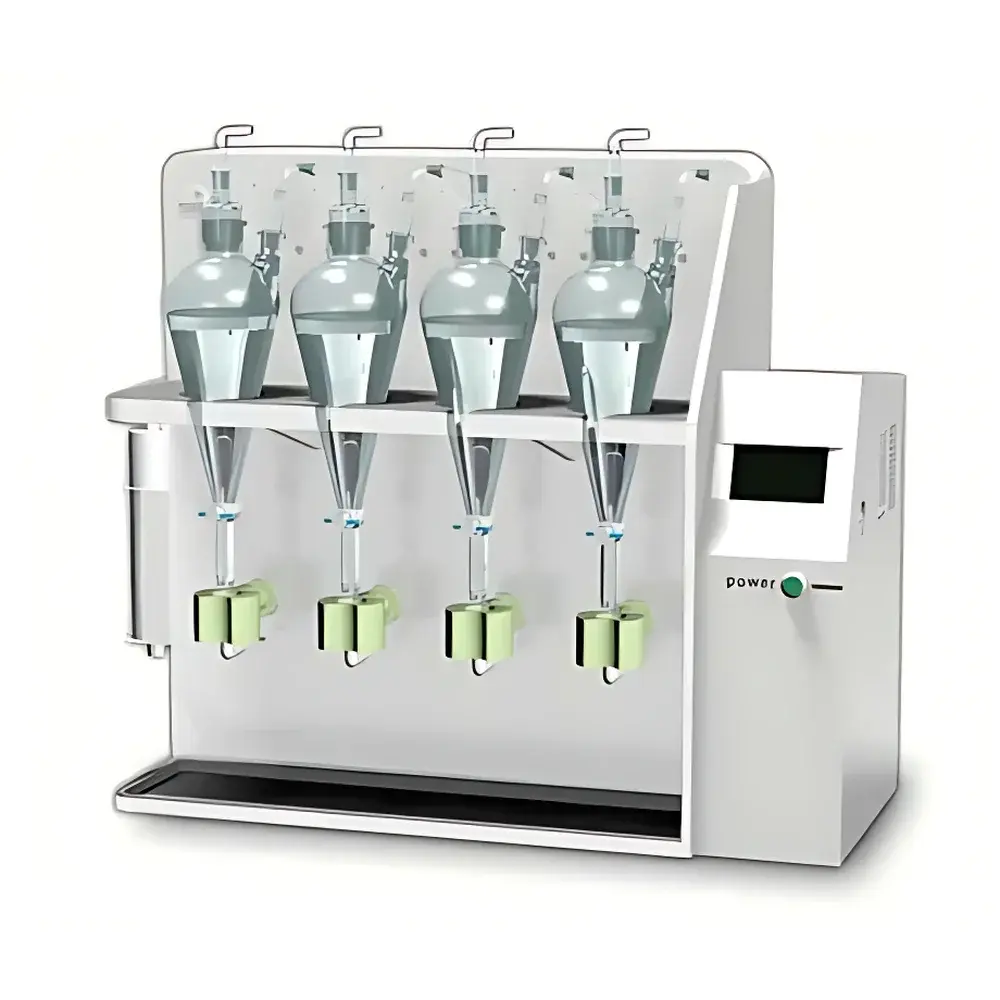
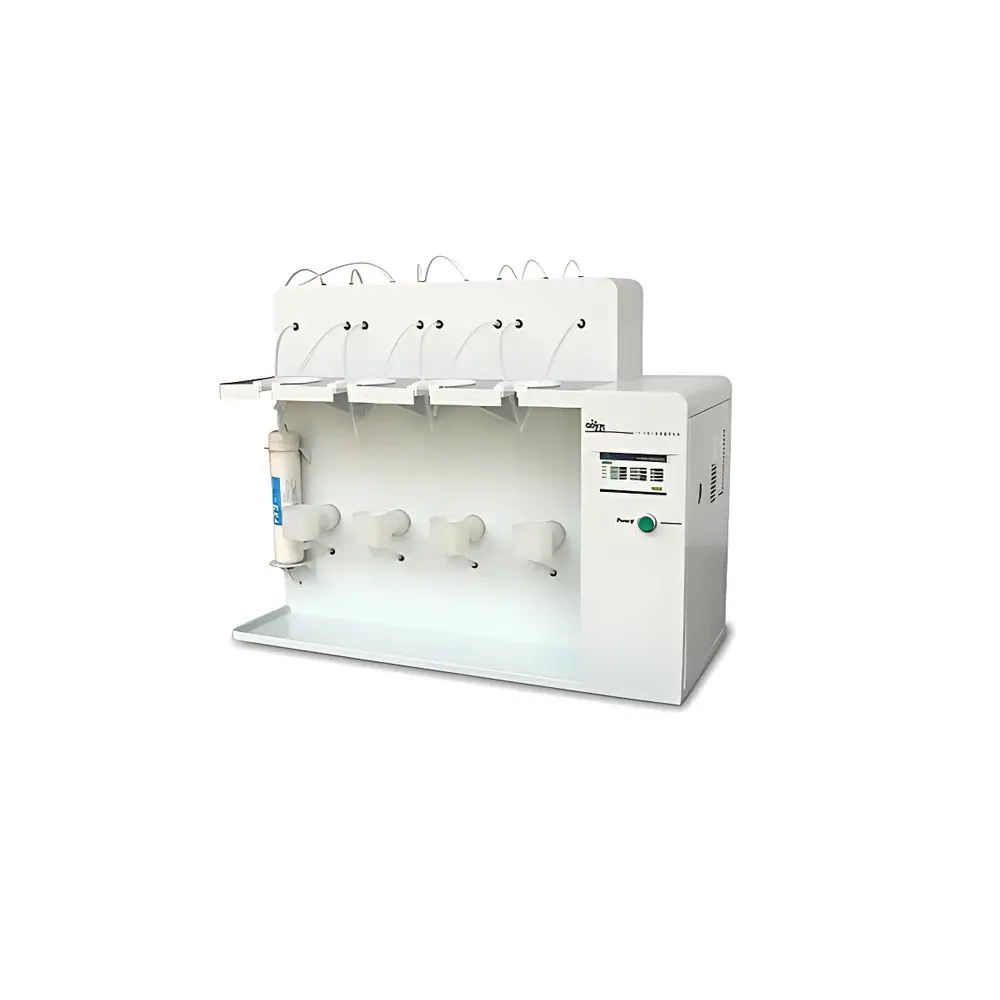
Sentte STC-302 Automated Liquid-Liquid Extractor
| Brand | Sentte |
|---|---|
| Origin | Shandong, China |
| Manufacturer Type | Direct Manufacturer |
| Country of Origin | China |
| Model | STC-302 |
| Price Range | USD 1,400 – 7,000 (FOB) |
| Extraction Efficiency | 0–100% |
| Extraction Duration | 0–200 min |
| Agitation Method | Closed-loop Pneumatic Gas-Liquid Mixing |
| Simultaneous Extraction Capacity | 4 Samples |
Overview
The Sentte STC-302 Automated Liquid-Liquid Extractor is an engineered solution for high-throughput, operator-safe sample preparation in environmental water analysis laboratories. It implements a closed-loop pneumatic agitation principle—distinct from conventional mechanical shaking, inversion, stirring, or jet-based systems—to induce controlled gas-liquid mixing within sealed extraction vessels. This method eliminates headspace pressure buildup, thereby removing the need for manual venting during extraction—a critical safety and procedural advantage when handling volatile organic solvents such as n-hexane, tetrachloroethylene, or petroleum ether. Designed specifically to support regulatory-compliant analysis of petroleum hydrocarbons in aqueous matrices, the STC-302 aligns with U.S. EPA Method 1664 (for oil and grease), ASTM D7066, and Chinese national standards HJ 637–2018 (Infrared Spectrophotometric Determination of Petroleum and Animal/Vegetable Oils in Water) and HJ 970–2018 (UV Spectrophotometric Determination of Petroleum in Water). Its architecture supports fully unattended operation across all stages: solvent addition, pneumatic agitation, phase separation, aqueous phase removal, vessel washing, and waste effluent treatment.
Key Features
- Four independent extraction channels operate in parallel, enabling simultaneous processing of up to four samples without cross-contamination.
- Closed-loop pneumatic agitation system ensures consistent, reproducible mass transfer between immiscible phases while preventing solvent evaporation and operator exposure to vapors.
- Integrated automatic venting-free cycle: no manual intervention required during agitation or phase equilibration.
- Onboard programmable washing module utilizes dedicated detergent reservoir and precision fluid delivery to perform post-extraction bottle cleaning—based on principles adapted from industrial bottle washer design—without disassembly.
- Activated carbon adsorption cartridge integrated into the waste discharge path captures residual organic compounds prior to effluent release, supporting laboratory environmental compliance.
- 7-inch capacitive touchscreen interface with intuitive icon-driven navigation; stores up to 50 user-defined method protocols with timestamped execution logs.
- All fluid pathways constructed from chemically resistant materials (PTFE tubing, borosilicate glass vials, EPDM seals) compatible with common extraction solvents.
Sample Compatibility & Compliance
The STC-302 accommodates standard 500 mL or 1 L separatory funnels or cylindrical extraction vessels (custom adapters available). It is validated for use with water samples containing low-to-moderate concentrations of petroleum hydrocarbons, diesel-range organics, polycyclic aromatic hydrocarbons (PAHs), and other non-polar analytes extractable via liquid-liquid partitioning. Instrument performance meets ISO/IEC 17025 requirements for method validation traceability when operated under documented SOPs. Data integrity features—including audit-trail-enabled parameter logging and user-access control levels—support alignment with GLP and GMP environments where regulatory documentation is required. While not FDA 21 CFR Part 11 certified out-of-the-box, the system’s digital log structure permits integration with validated LIMS or ELN platforms for electronic record retention.
Software & Data Management
The embedded firmware provides real-time monitoring of agitation duration, rest time, wash cycles, and waste volume status. Each run generates a CSV-formatted report containing method ID, start/end timestamps, solvent type, agitation parameters, and operator ID (if logged in). Reports are exportable via USB port or optional Ethernet/Wi-Fi module. No proprietary software installation is required on host PCs; exported files are compatible with Microsoft Excel, LabArchives, and most laboratory informatics systems. Firmware updates are delivered via secure HTTPS download and applied locally through the touchscreen interface.
Applications
- Quantitative determination of total petroleum hydrocarbons (TPH) in surface water, groundwater, wastewater, and seawater per HJ 637–2018 and EPA 1664.
- Pre-concentration of hydrophobic contaminants (e.g., PCBs, organochlorine pesticides) prior to GC-ECD or GC-MS analysis.
- Routine QC/QA workflows in municipal water testing labs requiring high repeatability and minimal analyst involvement.
- Research applications involving solvent optimization studies or kinetic evaluation of extraction efficiency under varying pH, salinity, or temperature conditions (when paired with external environmental chambers).
- Teaching laboratories seeking a safe, visual, and repeatable platform for demonstrating liquid-liquid equilibrium principles.
FAQ
Does the STC-302 require manual venting during extraction?
No. Its closed-loop pneumatic agitation mechanism prevents internal overpressure, eliminating the need for manual venting at any stage.
Can it be used with solvents other than n-hexane?
Yes—compatible with tetrachloroethylene, chloroform, dichloromethane, and other low-viscosity immiscible solvents, provided material compatibility is verified.
Is the activated carbon filter replaceable, and what is its service life?
Yes; the cartridge is user-replaceable and rated for approximately 200 extraction cycles under typical wastewater matrix conditions.
What maintenance is required beyond routine cleaning?
Annual calibration verification of timer accuracy and pressure regulation; biannual inspection of tubing elasticity and seal integrity.
Does the instrument support remote monitoring or network connectivity?
Standard configuration includes USB data export; optional Ethernet or Wi-Fi modules enable networked status polling and scheduled report push to designated servers.



