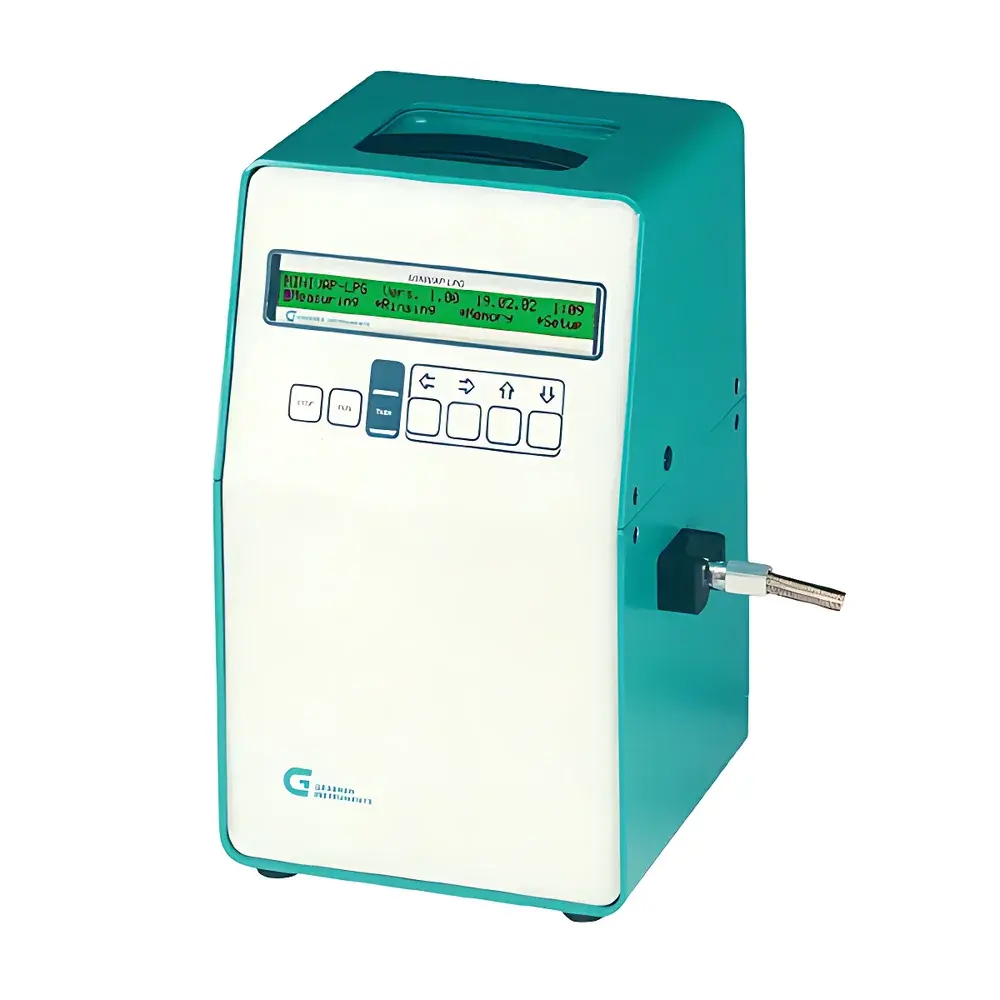
GRABNER MiniVAP VPS/VPSH Automated Vapor Pressure Analyzer
| Brand | GRABNER |
|---|---|
| Origin | Austria |
| Model | MiniVAP VPS/VPSH |
| Analysis Method | Three-Stage Piston Expansion Method |
| Pressure Range | 0–1000 kPa |
| Temperature Range | 0–100 °C |
| Test Time | ~5 min per sample |
| Dimensions | 196 × 315 × 175 mm |
| Weight | 8 kg |
| Power Supply | 100–230 V AC, 50 Hz, 65 W |
| Optional DC Input | 12 V / 8 A |
Overview
The GRABNER MiniVAP VPS/VPSH is a fully automated, micro-volume vapor pressure analyzer engineered for precision, regulatory compliance, and operational efficiency in petroleum, petrochemical, and hazardous materials testing laboratories. It implements the patented three-stage piston expansion method—a thermodynamically rigorous approach that enables direct determination of absolute vapor pressure (AVP) without equilibrium assumptions or phase separation artifacts. Unlike conventional Reid Vapor Pressure (RVP) instruments based on ASTM D323, the MiniVAP eliminates reliance on fixed-volume/temperature protocols and avoids thermal contamination from post-test chamber rinsing—critical for oxygenated fuels (e.g., ethanol-blended gasoline), where RVP overestimation errors exceeding 10 kPa are well documented. Its methodology is codified in ASTM D6377 and D6378, recognized by the U.S. Environmental Protection Agency (EPA) under 40 CFR Part 79 and incorporated into federal regulation 58 Fed. Reg. 14478 (March 17, 1993). The instrument is also aligned with EN 13016-1/2, IP 394/IP 409, ISO 3015, and China’s SH/T 0769–2005 and SH/T 0794–2007 standards—making it the only vapor pressure analyzer globally referenced in national regulatory frameworks for fuel volatility assessment.
Key Features
- Patented three-stage piston expansion method for true absolute vapor pressure measurement—no calibration drift due to solvent residue or chamber wetting
- Micro-sample consumption (≤1 mL), minimizing hazardous waste generation and reducing exposure risk during handling of volatile or toxic hydrocarbons
- Integrated temperature-controlled test chamber (0–100 °C) with high-stability Peltier regulation and real-time PID feedback
- Automated syringe-based sample introduction, followed by sequential inert-gas purge and vapor-phase equilibration cycles
- Self-diagnostic pressure transducer system with NIST-traceable calibration certificate included
- Compact benchtop footprint (196 × 315 × 175 mm) and low mass (8 kg) enable deployment in mobile labs, refinery field stations, and quality control trailers
- Dual-power architecture supports both AC mains operation and direct 12 V DC input from vehicle batteries—validated for on-site testing at loading racks or pipeline terminals
Sample Compatibility & Compliance
The MiniVAP VPS/VPSH is validated for analysis of unstabilized crude oils, reformulated gasoline (RFG), ethanol/gasoline blends (E10–E85), liquefied petroleum gas (LPG), naphthas, jet fuels (Jet A-1, JP-8), and bio-derived hydrocarbons including Fischer–Tropsch liquids. Its dynamic expansion protocol ensures accurate AVP determination even for samples exhibiting non-ideal vapor–liquid behavior (e.g., high-volatility light ends or multi-component mixtures with azeotropic tendencies). Regulatory alignment includes full support for REACH Annex VII–XI volatility reporting, GHS Classification Criteria (UN GHS Chapter 2.6), and EPA Tier 3 gasoline certification requirements. Instrument firmware and audit trail logs comply with GLP and GMP data integrity expectations; optional 21 CFR Part 11-compliant software module available for pharmaceutical-grade documentation workflows.
Software & Data Management
Control and data acquisition are managed via GRABNER’s proprietary VAPWin software (Windows 10/11 compatible), featuring intuitive wizard-driven method setup, customizable report templates (PDF/CSV/XLSX), and embedded statistical evaluation (mean, SD, RSD, confidence intervals per ASTM E177). All measurements include timestamped metadata: ambient pressure, chamber temperature stability window, expansion cycle fidelity metrics, and transducer zero-drift compensation logs. Data export supports direct integration with LIMS platforms via ODBC and HL7 interfaces. Internal flash memory retains ≥10,000 test records with tamper-evident digital signatures; optional network-enabled Ethernet/Wi-Fi module enables remote monitoring and centralized fleet management across multi-site operations.
Applications
- Gasoline volatility compliance testing for EPA Reformulated Gasoline (RFG) and Anti-Smog programs
- Crude assay characterization—early identification of light-end content impacting distillation yield and stabilization design
- LPG and natural gas liquid (NGL) specification verification per ASTM D1837 and EN 15470
- Quality assurance of oxygenated blendstocks (MTBE, ETBE, ethanol) where traditional RVP methods fail
- Hazard classification and SDS preparation under CLP/GHS for chemical transport and storage
- Research into alternative fuel volatility behavior—including synthetic paraffinic kerosene (SPK) and hydrotreated esters and fatty acids (HEFA)
FAQ
Is the MiniVAP compliant with ASTM D6378 and D6377?
Yes—the MiniVAP VPS/VPSH is the reference instrument cited in both standards and is the only analyzer approved by ASTM International for primary method implementation.
Can it measure vapor pressure of crude oil without stabilization?
Yes—its sealed expansion chamber and rapid equilibration algorithm allow direct AVP determination of unstabilized crudes, eliminating the need for flashing or fractionation prior to analysis.
Does it require daily calibration verification?
No—each test includes an internal pressure transducer self-check and temperature sensor validation; annual NIST-traceable recalibration is recommended per ISO/IEC 17025 laboratory accreditation requirements.
How does it handle samples with suspended water or particulates?
A built-in 5-µm inline filter protects the expansion piston and pressure sensor; however, grossly contaminated samples should be pre-filtered to maintain long-term mechanical reliability.
Is method transfer possible from existing D323 or D5191 workflows?
Yes—VAPWin includes cross-method correlation tools and uncertainty propagation models to facilitate seamless transition while maintaining historical data continuity.