
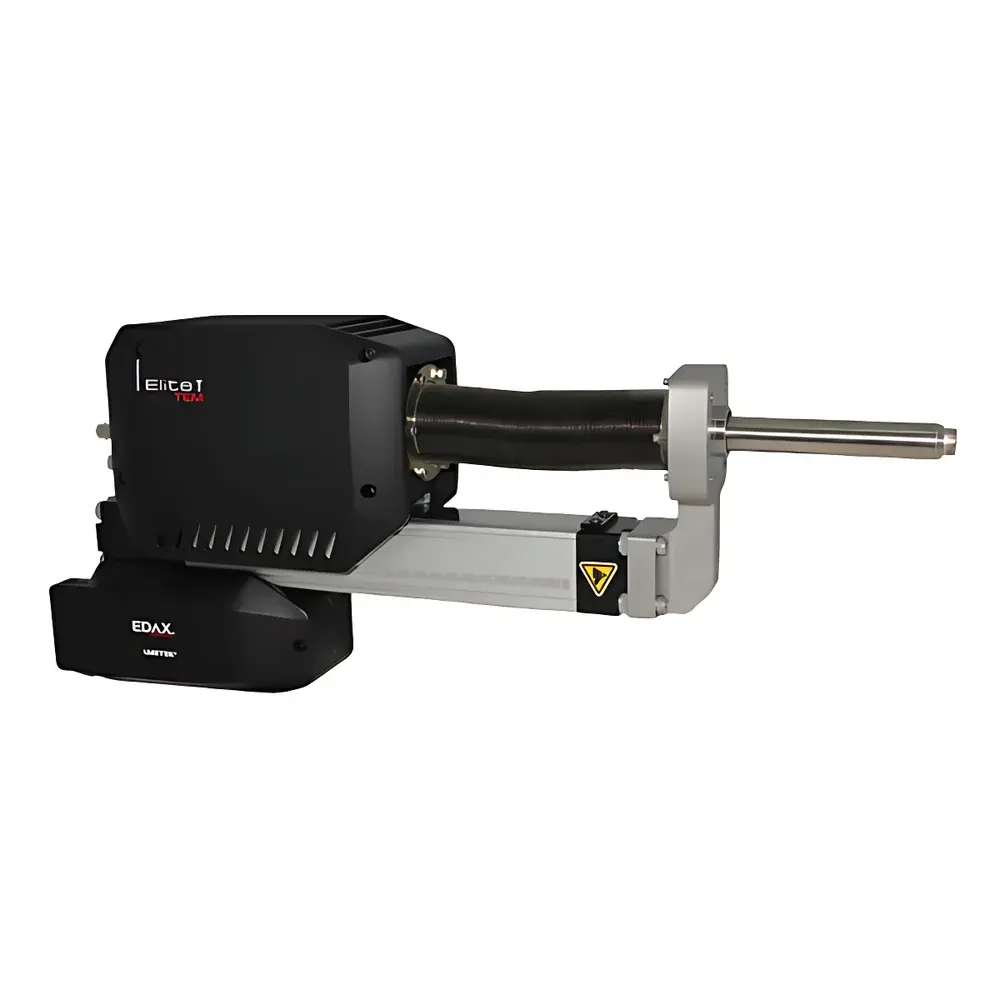
EDAX Elite T Energy Dispersive Spectrometer for Transmission Electron Microscopy
| Brand | EDAX |
|---|---|
| Origin | USA |
| Model | Elite T |
| Energy Resolution | 127 eV (Mn Kα) |
| Peak-to-Background Ratio | Not Specified |
| Maximum Count Rate | 850 kcps |
| Detector Active Area | 70 mm² |
| Window Option | Optional Windowless Configuration |
Overview
The EDAX Elite T Energy Dispersive Spectrometer (EDS) is a high-performance, TEM-integrated analytical system engineered specifically for quantitative elemental characterization at the nanoscale. Built upon silicon drift detector (SDD) technology with fully integrated front-end electronics, the Elite T delivers exceptional spectral fidelity and counting efficiency in transmission electron microscopy environments. Its core measurement principle relies on the detection and energy discrimination of characteristic X-rays generated by electron–sample interactions within the TEM column. Unlike conventional EDS systems designed for SEM, the Elite T is optimized for the low-signal, high-resolution demands of thin-film TEM specimens—enabling precise compositional mapping, line scans, and point analysis with sub-nanometer spatial registration. The system operates under ultra-high vacuum compatibility and is mechanically and electrically synchronized with major TEM platforms including JEOL, Thermo Fisher Scientific (FEI), and Hitachi models.
Key Features
- High-Efficiency SDD Architecture: Features a 70 mm² active-area silicon drift detector with integrated CMOS preamplifier and pulse processor, minimizing electronic noise and maximizing throughput.
- Enhanced Solid Angle Collection: Optimized mechanical geometry supports single- or dual-detector configurations; dual setup achieves >2 steradian solid angle, significantly improving X-ray collection efficiency and enabling rapid acquisition without compromising spectral resolution.
- Windowless Operation Option: Optional ultra-thin polymer or graphene-based windowless configuration enhances sensitivity to light elements (B, C, N, O, F) by eliminating absorption losses—critical for organic materials, battery cathodes, and oxide interfaces.
- High-Speed Counting Capability: Sustains up to 850,000 counts per second (kcps) with minimal dead-time distortion, facilitating statistically robust quantification even from beam-sensitive or low-Z specimens.
- Advanced Quantitative Engine: Incorporates physics-based ZAF/φ(ρz) correction algorithms and Monte Carlo simulation-assisted background modeling to ensure traceable, ISO/IEC 17025-aligned compositional results.
Sample Compatibility & Compliance
The Elite T is compatible with standard 3-mm TEM grids and advanced holders including heating, cooling, and in situ biasing stages. It supports both crystalline and amorphous specimens, including beam-sensitive polymers, metal–organic frameworks (MOFs), and lithium-ion battery electrode cross-sections. From a regulatory standpoint, data acquisition workflows comply with GLP and GMP documentation requirements when paired with EDAX’s TEAM™ Software v5.x, which includes full audit trail functionality per FDA 21 CFR Part 11. System calibration adheres to ASTM E1508-22 (Standard Guide for Quantitative Analysis by Energy Dispersive Spectroscopy) and ISO 16700:2016 (Microbeam analysis — Electron probe microanalysis — Guidelines for quantitative analysis by wavelength- and energy-dispersive X-ray spectrometry).
Software & Data Management
Controlled via EDAX’s TEAM™ Software platform, the Elite T integrates seamlessly with TEM operating systems through standard RS-232, Ethernet, or proprietary OEM APIs. TEAM™ provides real-time spectrum visualization, automated peak identification (using NIST X-ray database), multi-frame spectral imaging (Spectrum Imaging), and drift-corrected elemental mapping. All raw spectra, processing parameters, and metadata are stored in vendor-neutral HDF5 format, ensuring long-term archival integrity and third-party interoperability (e.g., with HyperSpy or DigitalMicrograph plugins). Audit logs record user actions, instrument state, and calibration history—supporting laboratory accreditation and internal quality audits.
Applications
- Phase identification and stoichiometric analysis of nanoscale precipitates in aerospace superalloys
- Interface chemistry characterization across heterostructures in 2D materials (e.g., MoS₂/graphene)
- Quantitative oxygen vacancy mapping in perovskite oxides for solid oxide fuel cell research
- In situ elemental evolution tracking during thermal or electrical stimulation in operando TEM experiments
- Light-element distribution analysis in pharmaceutical amorphous dispersions and biopolymer composites
FAQ
What vacuum compatibility does the Elite T require?
The Elite T is rated for operation under standard TEM column vacuum conditions (≤1×10⁻⁷ Pa) and features differential pumping-compatible flange mounting.
Is the Elite T compatible with aberration-corrected TEMs?
Yes—the compact detector housing and low-profile design allow integration with double- and triple-corrected TEM systems without obstructing illumination or imaging apertures.
How is energy resolution measured and verified?
Resolution is reported as full-width-at-half-maximum (FWHM) of the Mn Kα peak (5.895 keV) under standardized test conditions (100 kcps, room temperature, 1 µs peaking time), per ISO 15632:2012.
Can the Elite T perform simultaneous EELS–EDS correlation?
While EELS and EDS acquisition are not hardware-synchronized, TEAM™ software enables post-acquisition spatial and temporal alignment of EELS spectra and EDS maps using common fiducial markers and stage coordinate logging.



