
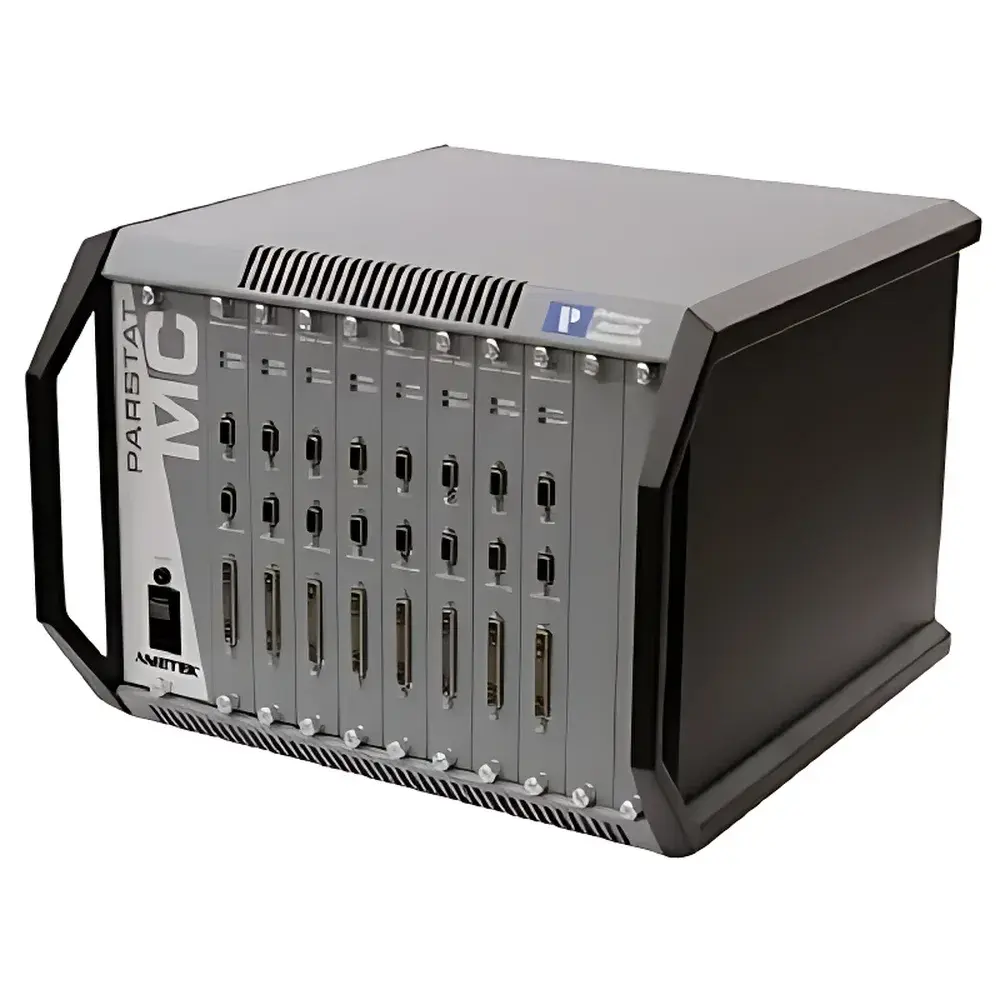
Princeton Applied Research PAR STAT MC Multi-Channel Electrochemical Workstation
| Brand | Princeton Applied Research |
|---|---|
| Origin | USA |
| Model | PAR STAT MC |
| Channel Capacity | Up to 8 independent, hot-swappable channels |
| Current Range | 2 A to 4 nA (120 fA resolution) |
| Voltage Range | ±30 V |
| Impedance Frequency Range | 10 μHz to 7 MHz |
| Data Acquisition Rate | 1 MS/s (max), 500 kS/s per channel |
| Software | VersaStudio™ |
| Grounding | Standard floating architecture |
| Compliance | Designed for GLP/GMP environments with audit-trail–capable software logging |
Overview
The Princeton Applied Research PAR STAT MC Multi-Channel Electrochemical Workstation is a modular, high-fidelity platform engineered for rigorous electrochemical research and industrial quality control. Built upon over five decades of expertise in potentiostat/galvanostat design, the PAR STAT MC implements a true parallel multi-channel architecture—each channel operating as an independent, fully functional electrochemical measurement unit with synchronized timing and isolated signal paths. Its core measurement principle relies on precision-controlled three-electrode potentiostatic/galvanostatic operation, enabling accurate quantification of current, potential, charge transfer kinetics, interfacial capacitance, and impedance response under controlled mass transport and thermal conditions. The system supports standard electrochemical techniques—including cyclic voltammetry (CV), linear sweep voltammetry (LSV), chronoamperometry (CA), chronopotentiometry (CP), electrochemical impedance spectroscopy (EIS), and pulse-based methods—with full compliance to ASTM G5, G59, G106, and ISO 16773 standards for corrosion and battery testing.
Key Features
- Modular scalability: Up to eight independent channels housed in a single mainframe; channels can be added incrementally without system downtime or firmware reconfiguration.
- Hot-swap capability: Individual channel modules (PMC-500, PMC-1000, PMC-2000) may be installed or removed during active experiments—zero interruption to ongoing measurements on other channels.
- Ultra-low noise performance: PMC-1000 module delivers 120 fA current resolution across a 4 nA–2 A dynamic range, optimized for microelectrode and ultra-low-current biosensor applications.
- Broad electrochemical operating envelope: ±30 V polarization range and 10 μHz–7 MHz EIS frequency coverage enable characterization of high-impedance coatings, solid-state electrolytes, and fast kinetic interfaces.
- High-speed data acquisition: 1 MS/s aggregate sampling rate with 500 kS/s per active channel ensures fidelity in transient analysis, such as double-layer charging dynamics or rapid redox switching events.
- Floating architecture: Standard galvanic isolation per channel permits simultaneous multi-working-electrode measurements within a single electrochemical cell—critical for comparative electrode screening and differential sensing configurations.
Sample Compatibility & Compliance
The PAR STAT MC accommodates standard three-electrode cells (e.g., glassy carbon, Pt, Ag/AgCl), rotating disk electrodes (RDE), rotating ring-disk electrodes (RRDE), and custom microfluidic or in situ/operando cells. Its hardware and VersaStudio™ software support 21 CFR Part 11–compliant user access control, electronic signatures, and immutable audit trails—making it suitable for regulated environments including pharmaceutical QC labs, battery R&D facilities, and corrosion certification laboratories adhering to NACE SP0169 or ISO 9223 protocols. All modules undergo factory calibration traceable to NIST standards, and documentation includes full uncertainty budgets per channel.
Software & Data Management
VersaStudio™ is a native Windows-based application offering real-time visualization, script-driven experiment sequencing, and post-acquisition modeling via equivalent circuit fitting (e.g., ZView® integration), Tafel analysis, and diffusion-controlled kinetic deconvolution. Raw data is stored in vendor-neutral binary format (.vmp) with embedded metadata (timestamp, operator ID, technique parameters, hardware configuration). Batch processing tools enable automated analysis of multi-channel EIS datasets across variable temperature or state-of-charge conditions. Export options include CSV, MATLAB (.mat), and Excel-compatible formats—ensuring seamless integration into LIMS or statistical process control (SPC) workflows.
Applications
- Battery materials development: Parallel cycling and EIS of cathode/anode composites under identical aging conditions.
- Corrosion science: Simultaneous monitoring of localized pitting onset across multiple alloy specimens in chloride-containing electrolytes.
- Electrocatalysis: High-throughput screening of catalyst libraries using identical CV scan protocols across eight working electrodes.
- Biosensor validation: Real-time amperometric detection of analyte binding events across replicate sensor surfaces with statistical confidence intervals.
- Coating integrity assessment: Multi-frequency EIS mapping of organic coating degradation on metallic substrates under accelerated humidity testing.
FAQ
Can I upgrade from a 2-channel to an 8-channel configuration without replacing the mainframe?
Yes—the PAR STAT MC mainframe is designed for field-expandable channel capacity. Additional PMC modules can be purchased and installed without firmware updates or recalibration of existing channels.
Is the system compatible with third-party electrochemical cells and accessories?
Yes—it supports standard BNC and banana-jack connections, and is interoperable with common cell stands, temperature controllers, and gas purging systems from major suppliers.
Does VersaStudio™ support automated sequence programming for unattended overnight experiments?
Yes—users can define multi-step protocols with conditional logic (e.g., “proceed to EIS only if charge capacity falls below X mAh”), scheduled start times, and automatic file naming conventions.
How is data integrity ensured during long-term multi-channel acquisitions?
Each channel writes data to separate memory buffers with timestamp synchronization via internal GPS-referenced clock; power-loss recovery preserves unsaved buffers up to 72 hours.
Are service and calibration services available outside the United States?
Yes—Princeton Applied Research maintains authorized service centers in Germany, Japan, China, and Brazil, with certified engineers trained to perform on-site calibration and module-level diagnostics.




