
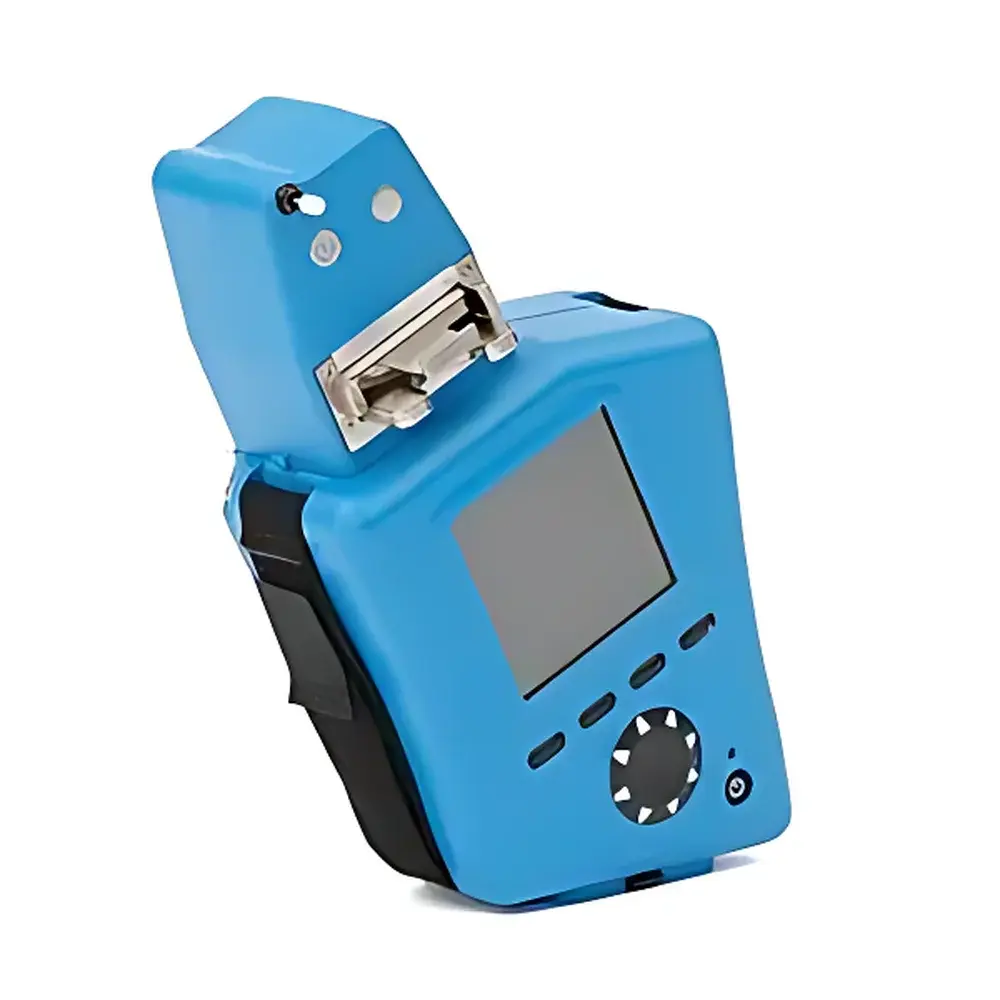
Spectro Scientific FluidScan 1100 Portable Oil Condition Analyzer
| Brand | Spectro Scientific |
|---|---|
| Origin | USA |
| Manufacturer Type | Original Equipment Manufacturer (OEM) |
| Product Origin | Imported |
| Model | FluidScan 1100 |
| Pricing | Available Upon Request |
Overview
The Spectro Scientific FluidScan 1100 is a field-deployable, Fourier Transform Infrared (FTIR) spectrometer engineered for rapid, quantitative in-situ analysis of lubricating oils. Unlike conventional lab-based FTIR systems requiring sample dilution or complex calibration workflows, the FluidScan 1100 integrates a patented flip-top sample cell and embedded multivariate chemometric algorithms trained on a proprietary reference database of over 20,000 validated oil spectra. It operates on the principle of mid-infrared absorbance spectroscopy (4000–650 cm⁻¹), where molecular functional groups—such as O–H (water), C=O (oxidation), S=O (sulfation), –COOH (acidic species), and C–O–C (glycol contamination)—produce characteristic spectral signatures. Quantification is achieved via partial least squares (PLS) regression models calibrated against ASTM-standard reference methods, enabling direct measurement of key oil health indicators without external reagents or consumables.
Key Features
- Patented flip-top sample cell enables <15-second sample loading, cleaning, and drying—eliminating cross-contamination and reducing operator dependency.
- Quantitative analysis of water content (ppm), Total Acid Number (TAN), Total Base Number (TBN), oxidation, nitration, sulfation, soot (diesel engines), fuel dilution (% v/v), and ethylene glycol contamination—all in a single 30-second scan.
- Validated measurement accuracy: TAN and TBN results correlate with ASTM D4739 and D664 (potentiometric titration); water quantification meets ASTM D6304 (Karl Fischer coulometric titration) performance thresholds.
- Battery-powered operation (up to 8 hours continuous use) with IP54-rated enclosure for industrial environments—including wind turbine nacelles, marine engine rooms, and remote compressor stations.
- No routine optical alignment or wavelength calibration required; factory-calibrated PLS models are stored onboard and support firmware-upgradable method libraries.
Sample Compatibility & Compliance
The FluidScan 1100 supports direct analysis of unaltered used and unused mineral, semi-synthetic, and fully synthetic lubricants—including Group I–V base stocks, polyalphaolefins (PAOs), polyalkylene glycols (PAGs), and phosphate esters. It accommodates viscosity ranges from ISO VG 10 to VG 680 and handles dark, opaque, or heavily sooted samples without filtration or dilution. Regulatory compliance includes adherence to ASTM International standards for oil condition monitoring (D7883, D7918), ISO 17359:2014 (condition monitoring—general guidelines), and compatibility with GLP/GMP data integrity requirements when paired with OilView software’s audit-trail-enabled reporting.
Software & Data Management
The FluidScan 1100 interfaces seamlessly with Spectro’s OilView™ desktop and cloud-based platform (v5.0+). OilView provides traceable sample metadata capture (equipment ID, sampling date, operating hours), automated trend analysis across fleets, and configurable alerting based on industry-accepted limits (e.g., ISO 4406 for particle counts, OEM-specific TBN depletion thresholds). All analytical results include full spectral data export (CSV, JCAMP-DX), digital signature support, and 21 CFR Part 11-compliant electronic records—including user authentication, change history, and immutable audit logs. Integration APIs allow synchronization with CMMS (e.g., IBM Maximo, SAP PM) and predictive maintenance platforms leveraging vibration or thermal imaging data.
Applications
- Rotating equipment monitoring: Gearboxes, hydraulic systems, compressors, and turbine lubricants across power generation, mining, and manufacturing.
- Diesel and natural gas engine oil management in rail, marine, and heavy-duty trucking fleets—enabling TBN-based oil drain interval extension.
- Wind energy operations: On-turbine oil analysis to reduce unplanned downtime and optimize service logistics.
- Preventive maintenance programs: Correlating FTIR-derived oxidation/nitration ratios with bearing temperature trends or vibration spectra to identify incipient degradation mechanisms.
- Field validation of laboratory results: Rapid verification of critical parameters prior to costly component disassembly or replacement decisions.
FAQ
Does the FluidScan 1100 require annual recalibration or third-party certification?
No. The instrument uses factory-validated PLS models with built-in diagnostic checks; periodic verification using Spectro’s certified reference oils (SRM-100 series) is recommended every 6 months per ISO/IEC 17025 guidance.
Can it analyze greases or solid-lubricant pastes?
No. The FluidScan 1100 is designed exclusively for liquid lubricants and hydraulic fluids. Grease analysis requires solvent extraction and is outside its operational scope.
Is spectral data export compatible with third-party chemometric tools like MATLAB or Unscrambler?
Yes. Raw interferograms and processed absorbance spectra are exportable in JCAMP-DX format, supporting import into commercial multivariate analysis environments.
How does it handle water emulsions versus free water in oil?
The FluidScan 1100 quantifies total water content (dissolved + emulsified + suspended) via O–H stretch band integration (3700–3100 cm⁻¹); it does not distinguish phase states but correlates strongly with Karl Fischer total water measurements.
What is the minimum sample volume required?
Only 3 mL of oil is needed per analysis, with the flip-top cell accommodating volumes from 2–5 mL without adjustment.






