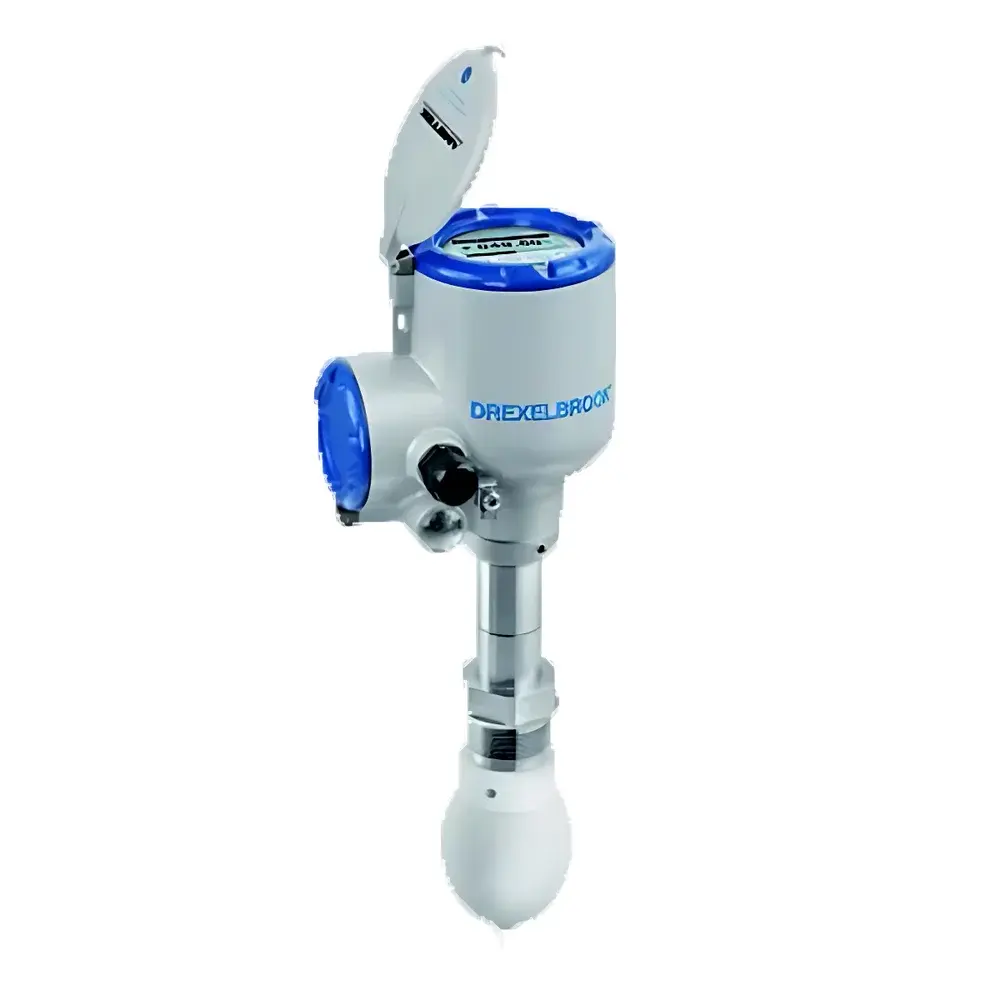
Drexelbrook DR7400 Series FMCW Radar Level Transmitter
| Brand | Drexelbrook |
|---|---|
| Frequency | 24 GHz |
| Measurement Principle | FMCW (Frequency-Modulated Continuous Wave) |
| Output Signal | 4–20 mA with HART Protocol |
| Power Supply | 2-Wire |
| Max. Measuring Range | 100 m |
| Accuracy | ±2 mm |
| Beam Angle | as low as 5° |
| Antenna Options | Horn (316L stainless steel) or Droplet (PP) |
| Process Temperature Range | –50 °C to +200 °C |
| Process Pressure Rating | –0.1 MPa to +10 MPa |
| Enclosure & Connection Options | Customizable per application |
| Environmental Suitability | Corrosion-resistant, ATEX/IECEx-certified variants available |
| Compliance | IEC 61326-1 (EMC), IEC 61000-6-2/6-4, RoHS |
Overview
The Drexelbrook DR7400 Series is an industrial-grade, frequency-modulated continuous wave (FMCW) radar level transmitter engineered for high-precision, non-contact level measurement in demanding process environments. Operating at 24 GHz, the DR7400 leverages FMCW technology to emit a continuously sweeping microwave signal and analyze the frequency difference between transmitted and reflected waves—enabling millimeter-level resolution and exceptional immunity to vapor, dust, foam, and condensation. Unlike pulse radar systems, FMCW architecture delivers superior signal-to-noise ratio and consistent performance across variable dielectric media, including low-εr liquids (e.g., hydrocarbons, solvents) and bulk solids with irregular surface topography. Designed for integration into continuous process control loops, the DR7400 supports SIL 2 capability per IEC 61508 and meets functional safety requirements for critical level monitoring in refineries, chemical plants, and water treatment facilities.
Key Features
- FMCW measurement principle ensures stable, high-reproducibility readings independent of medium dielectric constant (εr ≥ 1.4)
- 24 GHz operating frequency enables narrow beam divergence (as low as 5°), minimizing interference from tank walls, agitators, or internal structures
- Two antenna configurations: corrosion-resistant 316L stainless steel horn antenna for high-temperature/pressure applications; polypropylene (PP) droplet antenna for aggressive chemical service
- 2-wire loop-powered design with integrated HART 7 protocol for bidirectional communication, diagnostics, and remote configuration via standard control systems or handheld communicators
- Robust process rating: temperature range from –50 °C to +200 °C; pressure range from vacuum (–0.1 MPa) to 10 MPa gauge
- IP67/NEMA 4X-rated aluminum or stainless steel housing with optional explosion-proof (ATEX II 1G Ex ia IIC T6 Ga / IECEx ia IIC T6 Ga) certification
- Advanced echo processing algorithms suppress false echoes from nozzles, ladders, and feed streams—critical for reliable measurement in agitated or turbulent vessels
Sample Compatibility & Compliance
The DR7400 is validated for continuous level measurement across liquid, slurry, and solid-phase media in pressurized, vacuum, or atmospheric vessels—including cryogenic tanks, high-temperature reactors, and corrosive storage silos. It complies with international electromagnetic compatibility (EMC) standards IEC 61326-1 and IEC 61000-6-2/6-4, ensuring stable operation in electrically noisy plant environments. For regulated industries, firmware supports audit-trail logging and user-access control aligned with FDA 21 CFR Part 11 requirements when integrated with compliant DCS/SCADA platforms. Optional hazardous-area certifications include ATEX, IECEx, and CSA for global deployment in Zone 0/1 and Div 1 environments.
Software & Data Management
Configuration and diagnostics are performed using Drexelbrook’s PC-based SmartConfig software or via HART-enabled field tools (e.g., AMS Device Manager, FieldCare). The transmitter stores up to 100 historical echo curves with timestamps, enabling post-event analysis of filling dynamics, sedimentation patterns, or interface detection anomalies. Real-time diagnostics include signal strength monitoring, signal-to-noise ratio tracking, and health status alerts for antenna fouling or process coating buildup. All configuration changes are logged with user ID, timestamp, and parameter delta—supporting GLP/GMP traceability requirements.
Applications
- Refining & petrochemicals: Interface level monitoring in desalters, crude oil separators, and amine contactors
- Chemical manufacturing: Level control of corrosive reagents (e.g., sulfuric acid, caustic soda) in lined or unlined carbon steel tanks
- Power generation: Condensate and deaerator tank level monitoring under high-temperature steam conditions
- Water & wastewater: Sludge level detection in digesters and clarifiers with minimal maintenance
- Food & pharma: Sanitary-level measurement in jacketed mixing vessels where CIP/SIP cycles demand chemically resistant antenna materials
FAQ
What is the minimum dielectric constant the DR7400 can reliably measure?
The DR7400 achieves stable detection down to εr = 1.4—suitable for light hydrocarbons, propane, butane, and liquefied natural gas (LNG).
Can the DR7400 measure through foam or heavy vapor layers?
Yes—its 24 GHz FMCW signal penetrates thin to moderate foam layers and steam-saturated atmospheres without signal loss, provided foam density remains below 0.3 g/cm³.
Is remote calibration supported without physical access to the device?
Yes—full calibration, ranging, and echo curve analysis can be executed remotely via HART communication using compatible asset management software.
Does the DR7400 support Modbus RTU or Profibus PA protocols?
No—the DR7400 natively supports only 4–20 mA with HART 7; protocol conversion requires external gateways compliant with IEC 61784-1.
How often does the device require verification in GMP-regulated environments?
Per EU GMP Annex 15 and ASTM E2500, periodic verification is recommended every 6–12 months depending on criticality, process stability, and historical performance data.
Related Products