
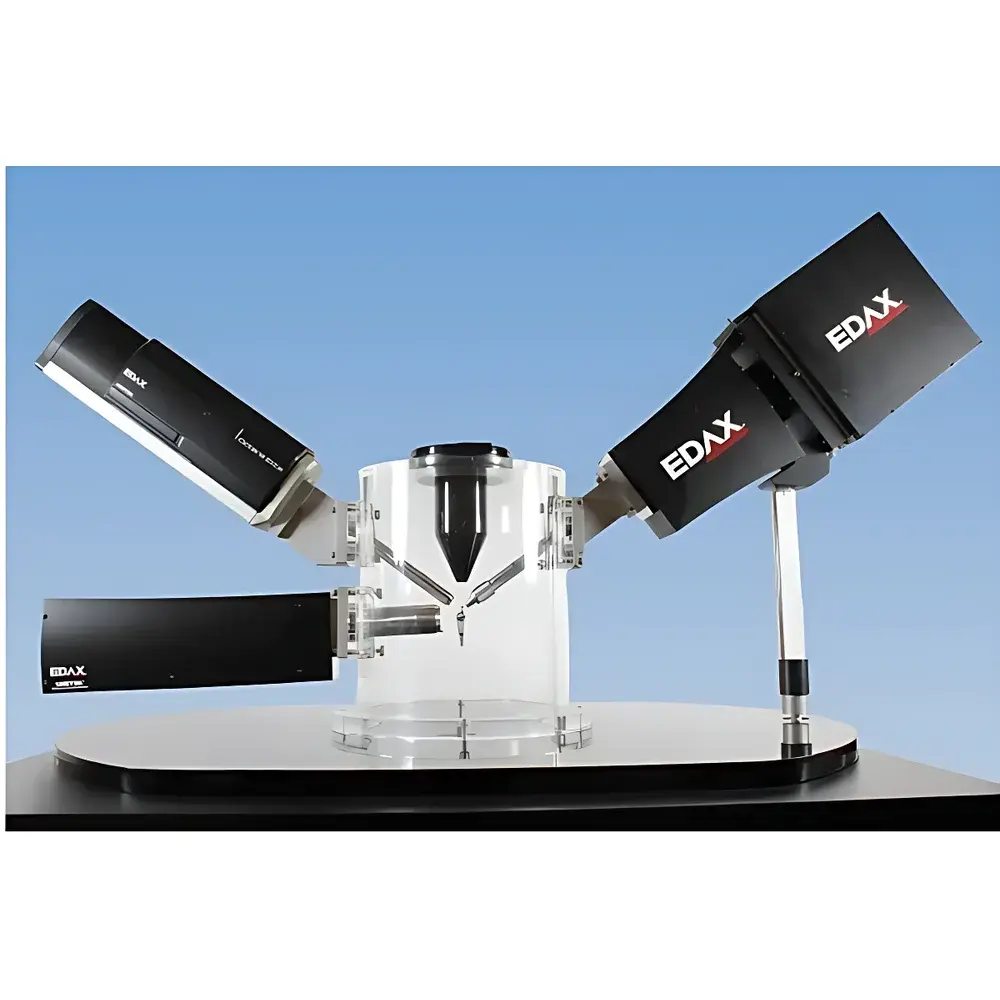
EDAX TEAM™ Trident (EDS-EBSD-WDS) Integrated Microanalysis System
| Brand | EDAX |
|---|---|
| Origin | USA |
| Model | TEAM™ Trident (EDS-EBSD-WDS) |
| Detector Type | Octane Elite SDD (EDS), Velocity™ Super / Orion™ / Hikari Super / DigiView (EBSD), TEXS (WDS) |
| Energy Resolution | ≤123 eV at Mn Kα (typical, 100k cps) |
| Peak-to-Background Ratio | >20,000:1 (Mn Kα, 10 kV) |
| Maximum Input Count Rate | ≥1,000,000 cps (EDS) |
| Active Detector Area | 100 mm² (Octane Elite SDD) |
| EBSD Camera Frame Rate | Up to 3,000 fps (Velocity™ Super, 1×1 binning) |
| WDS Spectral Resolution | <10 eV (full width at half maximum) |
Overview
The EDAX TEAM™ Trident (EDS-EBSD-WDS) Integrated Microanalysis System is a high-performance, multi-modal analytical platform engineered for comprehensive materials characterization within scanning electron microscopes (SEM) and electron probe microanalyzers (EPMA). It unifies three complementary microbeam techniques—Energy Dispersive Spectroscopy (EDS), Electron Backscatter Diffraction (EBSD), and Wavelength Dispersive Spectroscopy (WDS)—into a single, synchronized hardware and software architecture. Each technique operates on the same electron beam interaction volume, enabling spatially registered, correlative analysis of elemental composition, crystallographic orientation, phase identification, and trace-element quantification with sub-micron precision. The system leverages fundamental physical principles: EDS detects characteristic X-rays emitted from excited atoms using solid-state silicon drift detectors (SDD); EBSD reconstructs lattice orientation from Kikuchi band patterns captured by high-speed CMOS or CCD cameras; and WDS achieves superior spectral resolution via Bragg diffraction of characteristic X-rays across curved crystals. This tri-technique integration eliminates sequential repositioning artifacts and ensures metrological consistency across datasets—critical for advanced metallurgy, geoscience, semiconductor failure analysis, and additive manufacturing R&D.
Key Features
- Unified hardware platform with synchronized EDS, EBSD, and WDS acquisition—no manual stage repositioning required between modalities.
- Octane Elite SDD detector with 100 mm² active area, delivering high count-rate capability (>1 Mcps) and energy resolution ≤123 eV at Mn Kα under standard operating conditions.
- Multiple EBSD camera options: Velocity™ Super (ultra-high-speed CMOS, up to 3,000 fps), Orion™ (low-noise, high-fidelity pattern acquisition), Hikari Super (optimized signal-to-noise for challenging phases), and DigiView (high-resolution static mapping).
- TEXS (Transition X-ray Spectrometer) WDS module with selectable analyzing crystals (e.g., LiF, PET, TAP) for resolving overlapping peaks (e.g., S Kα/Pb Mα, Si Kα/W Mα) and achieving detection limits down to 10–50 ppm for selected elements.
- TEAM™ software suite with intelligent automation: EXpert ID for automated peak deconvolution and minor-element identification; Confidence Index (CI) and ChI-Scan™ algorithms for robust multi-phase EBSD indexing and phase discrimination.
- Real-time data fusion: Overlay EBSD orientation maps directly onto EDS elemental distribution maps; correlate WDS quantitative line scans with EBSD grain boundary networks.
Sample Compatibility & Compliance
The TEAM™ Trident system supports conductive and non-conductive bulk specimens, polished cross-sections, thin foils, and FIB-prepared lamellae. Standard operation requires vacuum-compatible samples (≤10⁻⁴ Pa chamber pressure); optional low-vacuum or environmental SEM modes may be enabled with compatible microscope configurations. All analytical workflows comply with ISO 14782:2022 (EBSD terminology and reporting), ASTM E1508-21 (quantitative EDS microanalysis), and ASTM E2627-20 (EBSD data acquisition and interpretation). For regulated environments, TEAM™ software supports audit trails, electronic signatures, and user-access controls aligned with FDA 21 CFR Part 11 requirements when deployed in GLP/GMP-compliant laboratories.
Software & Data Management
TEAM™ software provides a unified interface for acquisition, processing, and reporting across all three modalities. Raw data—including EDS spectra, EBSD pattern files (.h5), and WDS intensity profiles—are stored in vendor-neutral HDF5 format with embedded metadata (beam energy, working distance, detector geometry, calibration parameters). Batch processing scripts enable reproducible quantification using ZAF or φ(ρz) matrix corrections. Export modules support ASTM E1358-compliant CSV, TIFF-based map exports, and OIM Analysis™-compatible formats for third-party crystallographic modeling. Data integrity is enforced through checksum validation, version-controlled processing histories, and timestamped operator logs—essential for traceability in quality assurance and inter-laboratory comparison studies.
Applications
- Metallurgical phase mapping: Simultaneous identification of austenite/ferrite/martensite in steels with quantitative carbon distribution via WDS and grain boundary character analysis via EBSD.
- Geological mineral assemblage analysis: Discrimination of polymorphs (e.g., quartz vs. coesite) using EBSD, coupled with trace-element zoning (e.g., Ti-in-zircon thermobarometry) via WDS.
- Advanced battery electrode characterization: Correlating Li distribution (via low-kV EDS mapping) with crystallographic degradation (via EBSD misorientation gradients) in cycled cathode particles.
- Semiconductor defect root-cause analysis: Localizing dopant segregation at dislocation cores using WDS line scans, overlaid on strain fields derived from high-resolution EBSD.
- Additive manufacturing process qualification: Quantifying elemental segregation in as-built Ti-6Al-4V builds and linking texture evolution (EBSD pole figures) to build-direction thermal gradients.
FAQ
What distinguishes TEAM™ Trident from standalone EDS or EBSD systems?
It provides true spatial and temporal synchronization of EDS, EBSD, and WDS signals from identical beam positions—eliminating registration errors inherent in sequential acquisitions and enabling statistically valid correlation of composition, structure, and chemistry.
Can TEAM™ Trident perform automated phase classification in multiphase alloys?
Yes—ChI-Scan™ and CI-based indexing in TEAM™ software enable reliable phase identification across complex microstructures (e.g., Al-Si-Cu-Mg alloys), even with low-symmetry or nanoscale precipitates.
Is WDS quantification traceable to international standards?
Yes—calibration uses NIST-traceable reference materials (e.g., NIST SRM 2100a, 2101), and quantification routines follow ISO/IEC 17025-compliant uncertainty propagation models.
How does the system handle beam-sensitive materials?
TEAM™ supports low-dose acquisition protocols, including beam-blanking during EBSD camera readout, variable dwell time per pixel, and dynamic frame averaging—all configurable without interrupting multi-technique workflows.
What file formats are supported for long-term archival?
HDF5 (primary), with optional export to ASTM E1358-compliant CSV, TIFF stacks with embedded scale bars, and OIM Analysis™ .ang/.ctf formats for interoperability with Thermo Scientific™ and Oxford Instruments™ ecosystems.




