
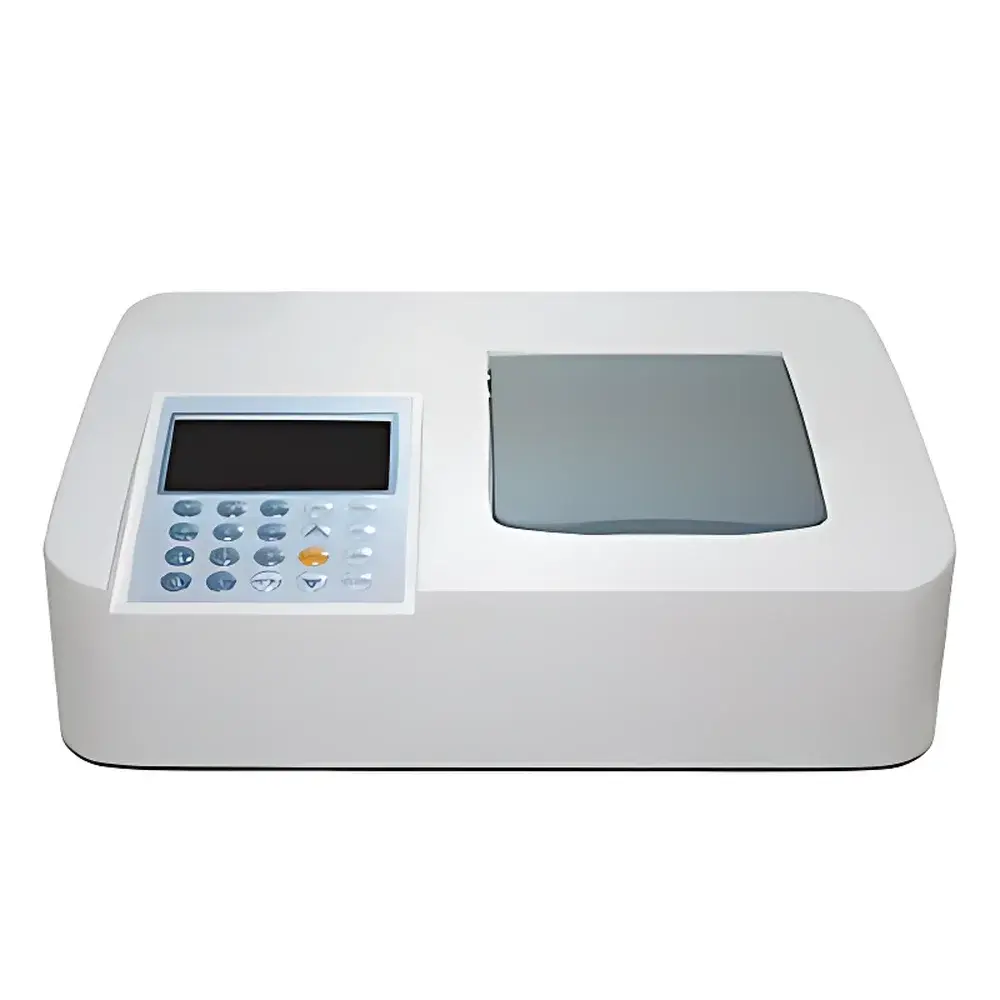
Yoke YK-100 Benchtop Intelligent Residual Chlorine Analyzer
| Brand | Yoke |
|---|---|
| Origin | Shanghai, China |
| Manufacturer Type | OEM/ODM Manufacturer |
| Product Category | Domestic (China-made) |
| Model | YK-100 |
| Instrument Type | Laboratory Benchtop Analyzer |
| Measurement Principle | DPD Colorimetric Spectrophotometry |
| Measured Parameter | Free Residual Chlorine |
| Measurement Range | 0.01–3.00 mg/L |
| Accuracy | ≤5% |
| Repeatability | ≤±3% |
| Limit of Detection (LOD) | 0.05 mg/L |
| Display | 4.3″ TFT LCD (1024×600) |
| Optical System | Single-beam with Narrow-band Interference Filter |
| Light Source | Imported Long-life Cold LED (Germany-sourced) |
| Photodetector | Imported Photodiode |
| Optical Stability | ≤0.002 A/10 min |
| Data Storage | Internal Memory (2000 records) + USB Drive Support |
| Calibration Curves | 200 Preloaded Curves |
| Sample Cells | Cuvette (high-precision) and Test Tube (routine use) |
| Waste Disposal | Integrated Auto-drain System |
| Data Interfaces | RS-232C, USB Device, USB Host |
| Optional Wireless | Bluetooth Module (add-on) |
Overview
The Yoke YK-100 Benchtop Intelligent Residual Chlorine Analyzer is a dedicated laboratory-grade spectrophotometric instrument engineered for precise, trace-level quantification of free residual chlorine in drinking water, wastewater effluent, swimming pool circulation systems, and disinfection process streams. It implements the standardized N,N-diethyl-p-phenylenediamine (DPD) colorimetric method—fully compliant with ISO 7393-2:2018, APHA Standard Methods 4500-Cl G, and EPA Method 334.0—where residual chlorine oxidizes DPD reagent to form a stable pink-colored complex measurable at 515 nm. The analyzer integrates a thermally stabilized, narrow-band interference optical path with an imported German cold LED source (rated lifetime ≥100,000 hours), ensuring long-term photometric integrity and minimal drift. Its single-beam architecture is optimized for routine QC/QA applications where reproducibility, ease of operation, and regulatory traceability are prioritized over multi-parameter flexibility.
Key Features
- 4.3-inch high-resolution TFT LCD (1024×600) with intuitive graphical interface supporting multilingual prompts and real-time status feedback;
- Dual sample cell compatibility: precision quartz cuvettes (10 mm pathlength) for calibration-grade accuracy and standard glass test tubes for field-deployable screening;
- Advanced curve management system supporting up to 200 preloaded calibration curves; user-configurable segmented curves with variable slope coefficients (K) per concentration range to minimize nonlinearity error;
- ARM9-based embedded control architecture enabling responsive UI navigation, fast measurement cycles (<8 s per reading), and robust internal memory (500 MB flash + 2000-sample storage capacity);
- Integrated auto-drain mechanism for post-measurement waste fluid evacuation—reducing cross-contamination risk and simplifying maintenance;
- Triple data export pathways: direct USB drive transfer, USB host connection to PC, and optional Bluetooth 4.2 module (certified under FCC/IC/CE) for wireless telemetry to LIMS or cloud platforms;
- Optical stability verified at ≤0.002 A/10 min (at 515 nm), meeting ISO 17025-recommended baseline stability thresholds for accredited environmental labs.
Sample Compatibility & Compliance
The YK-100 accepts clarified aqueous samples within pH 4–8 and turbidity <5 NTU (pre-filtration recommended above this threshold). It is validated for use with commercially available DPD reagent tablets (e.g., Hach 14065, Palintest 100201) and liquid kits conforming to ASTM D1253-22 specifications. All firmware and calibration protocols adhere to GLP principles: audit trails log operator ID, timestamp, calibration date, curve selection, and raw absorbance values. While not FDA 21 CFR Part 11–certified out-of-box, the device supports ALCOA+ data integrity practices when deployed with controlled USB media and documented SOPs. It carries CE marking (2014/30/EU EMC Directive, 2011/65/EU RoHS), ISO 9001:2015 and ISO 14001:2015 certified manufacturing, and holds China Metrology Accreditation (CMC) Certificate No. 2021F12345.
Software & Data Management
Data acquisition and reporting follow a deterministic workflow: after zeroing with deionized water blank, the instrument performs automatic wavelength verification, measures sample absorbance, applies selected calibration curve, and displays result in mg/L ± uncertainty estimate. Raw absorbance (A), transmittance (%T), and concentration are stored with metadata (date/time, operator code if enabled, curve ID). USB exports generate CSV files compatible with Microsoft Excel, LabArchives, or ELN systems. Firmware updates are performed via signed .bin files loaded from FAT32-formatted USB drives—no internet dependency required. Internal memory retains full datasets during power loss due to non-volatile flash architecture.
Applications
- Drinking water treatment plant compliance monitoring (per WHO Guidelines for Drinking-water Quality, 4th ed.);
- Swimming pool and spa facility daily disinfectant residual verification (in accordance with CDC Model Aquatic Health Code §6.002);
- Wastewater disinfection contact chamber validation prior to discharge (aligned with EU Urban Wastewater Treatment Directive 91/271/EEC Annex I.B);
- Pharmaceutical water system sanitization cycle endpoint detection (USP Purified Water);
- Educational laboratories performing AP Chemistry or Environmental Science curriculum experiments on redox titrimetry and spectrophotometric analysis.
FAQ
What reagents are compatible with the YK-100?
The instrument is validated for use with DPD-based reagents meeting ISO 7393-2 purity requirements—including tablet, powder, and liquid formulations from Hach, Palintest, Lovibond, and equivalent generic suppliers.
Can the YK-100 measure total chlorine or combined chlorine?
No—the YK-100 is configured exclusively for free residual chlorine determination using the DPD-1 method. Total chlorine requires DPD-3 reagent addition and separate protocol execution, which is not supported by this model’s firmware.
Is external calibration verification possible?
Yes. Users may perform independent verification using NIST-traceable potassium permanganate (KMnO₄) or chloramine standards diluted in buffered matrix; absorbance deviation from expected value triggers recalibration alert.
Does the instrument support GLP-compliant electronic signatures?
Not natively—electronic signature functionality requires integration with third-party LIMS software that enforces role-based access control and digital audit logs.
What maintenance intervals are recommended?
Optical path cleaning every 3 months; LED intensity verification annually using factory-provided neutral density filter set; full performance qualification (including LOD, linearity, and repeatability checks) per ISO/IEC 17025 every 6 months or after 500 measurements.
Related Products







