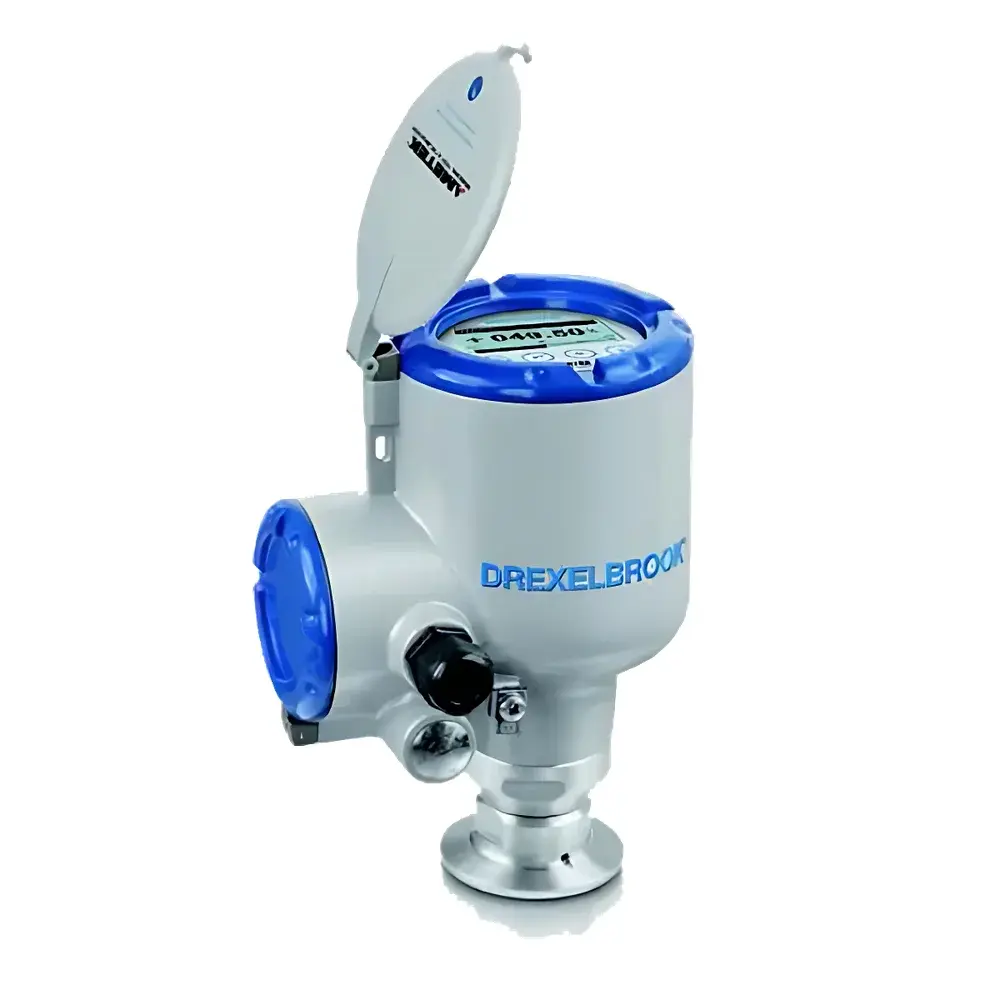
Drexelbrook DR6500 Series FMCW Radar Level Transmitter
| Brand | Drexelbrook |
|---|---|
| Origin | Shanghai, China |
| Manufacturer Type | Authorized Distributor |
| Product Category | Domestic (China-sourced) |
| Model | DR6500 Series |
| Output Signal | 4–20 mA with HART Protocol |
| Power Supply | 2-wire loop-powered |
| Measurement Principle | Frequency-Modulated Continuous Wave (FMCW) Radar |
| Max. Measuring Range | 100 m |
| Accuracy | ±2 mm |
| Beam Angle | As low as 5° |
| Antenna Type | Planar Convex Lens Antenna |
| Process Temperature Range | –50 °C to +130 °C |
| Process Pressure Rating | –0.1 MPa to +4 MPa |
| Environmental Suitability | High-dust, high-dynamics solids applications |
| Special Function | Empty Tank Analysis (ETA) for interference suppression |
Overview
The Drexelbrook DR6500 Series is a high-frequency, 80 GHz Frequency-Modulated Continuous Wave (FMCW) radar level transmitter engineered for precise, non-contact measurement of bulk solid materials in demanding industrial silos, hoppers, and bins. Unlike pulse radar technology, FMCW radar continuously transmits a swept-frequency signal and calculates distance by analyzing the frequency difference between emitted and reflected waves—enabling superior signal-to-noise ratio, enhanced resolution, and immunity to false echoes from tank walls, agitators, or internal structures. Designed specifically for solids handling environments—including cement, fly ash, plastic pellets, grain, coal, and mineral ores—the DR6500 delivers consistent performance under heavy dust loading, rapid material movement, and variable dielectric conditions. Its compact planar convex lens antenna focuses energy into a narrow beam (as tight as 5°), minimizing side-lobe interference and maximizing target reflectivity—even from low-dielectric or irregularly shaped materials.
Key Features
- 80 GHz FMCW radar operation ensures high spatial resolution and minimal beam divergence, critical for accurate level detection in narrow or obstructed vessels.
- Planar convex lens antenna provides stable radiation pattern, mechanical robustness, and inherent resistance to dust accumulation and condensation.
- 2-wire loop-powered design with integrated HART 7 protocol enables seamless integration into existing 4–20 mA analog control systems while supporting digital diagnostics, configuration, and firmware updates.
- Empty Tank Analysis (ETA) algorithm automatically identifies and suppresses fixed echoes from nozzles, ladders, or weld seams during commissioning and recalibrates baseline reference dynamically.
- Wide process temperature and pressure tolerance (–50 °C to +130 °C; –0.1 MPa to +4 MPa) supports installation in extreme thermal and mechanical environments without external cooling or pressure isolation.
- High dynamic response capability allows reliable tracking of fast-filling or rapidly discharging solids—essential for batch weighing, feed control, and inventory reconciliation applications.
Sample Compatibility & Compliance
The DR6500 Series is optimized for solid media with dielectric constants ranging from εr ≈ 2.5 (e.g., polystyrene pellets) to εr > 25 (e.g., wet clay or metal chips). It is not intended for conductive liquid interfaces or vapor-phase-only measurement. The transmitter complies with IEC 61326-1 (EMC for industrial environments), IEC 60079-0/-11 (ATEX/IECEx Zone 0/20 for explosive atmospheres when configured with appropriate housing options), and meets SIL 2 capability per IEC 61508 when deployed in safety instrumented systems (SIS) with certified logic solvers. Optional stainless steel housings and PTFE-coated antennas satisfy FDA 21 CFR Part 11 requirements for traceability and audit readiness in regulated manufacturing settings.
Software & Data Management
Configuration and diagnostics are performed via Drexelbrook’s PC-based DREXView™ software or through standard HART handheld communicators. The device supports full parameterization—including echo curve analysis, dynamic damping adjustment, and multi-point linearization—without requiring vessel shutdown. All configuration changes, calibration events, and diagnostic logs are timestamped and stored internally with user-accessible history. When integrated with DCS or SCADA platforms supporting HART-IP or Modbus TCP gateways, the DR6500 enables real-time health monitoring, predictive maintenance alerts (e.g., signal strength decay, temperature drift), and automated report generation aligned with ISO 9001 and GMP documentation workflows.
Applications
- Cement and ready-mix batching plants: continuous monitoring of clinker, limestone, and gypsum silos.
- Power generation facilities: level verification in fly ash and bottom ash hoppers subject to vibration and thermal cycling.
- Plastics and polymer processing: inventory control of resin pellets in pneumatic conveying-fed hoppers.
- Agricultural cooperatives: granular fertilizer and grain storage management across seasonal humidity variations.
- Mineral processing operations: level assurance in abrasive ore feed bins with high dust generation and impact loading.
FAQ
What distinguishes FMCW radar from pulse radar in solids measurement?
FMCW offers higher signal stability, better signal-to-noise ratio, and improved immunity to multipath reflections—making it more suitable for dusty, uneven surfaces and small-diameter vessels where pulse radar may yield inconsistent echo returns.
Can the DR6500 be used in vacuum or negative-pressure vessels?
Yes—it is rated for operation down to –0.1 MPa (absolute), accommodating vacuum-assisted conveying and degassing applications when specified with vacuum-rated flange connections.
Is field calibration required after installation?
No. The Empty Tank Analysis (ETA) function performs automatic reference echo identification and suppression during initial setup, eliminating manual zero-point adjustment in most configurations.
How does the DR6500 handle buildup on the antenna surface?
The planar convex lens design minimizes surface area exposure and promotes natural shedding of dry particulates; optional air purge adapters are available for sticky or hygroscopic materials.
Does the device support SIL-certified safety loops?
The DR6500 transmitter itself is SIL 2 capable per IEC 61508; final SIL integrity depends on system architecture, including logic solver certification, wiring integrity, and proof-test procedures defined in the safety requirements specification (SRS).