
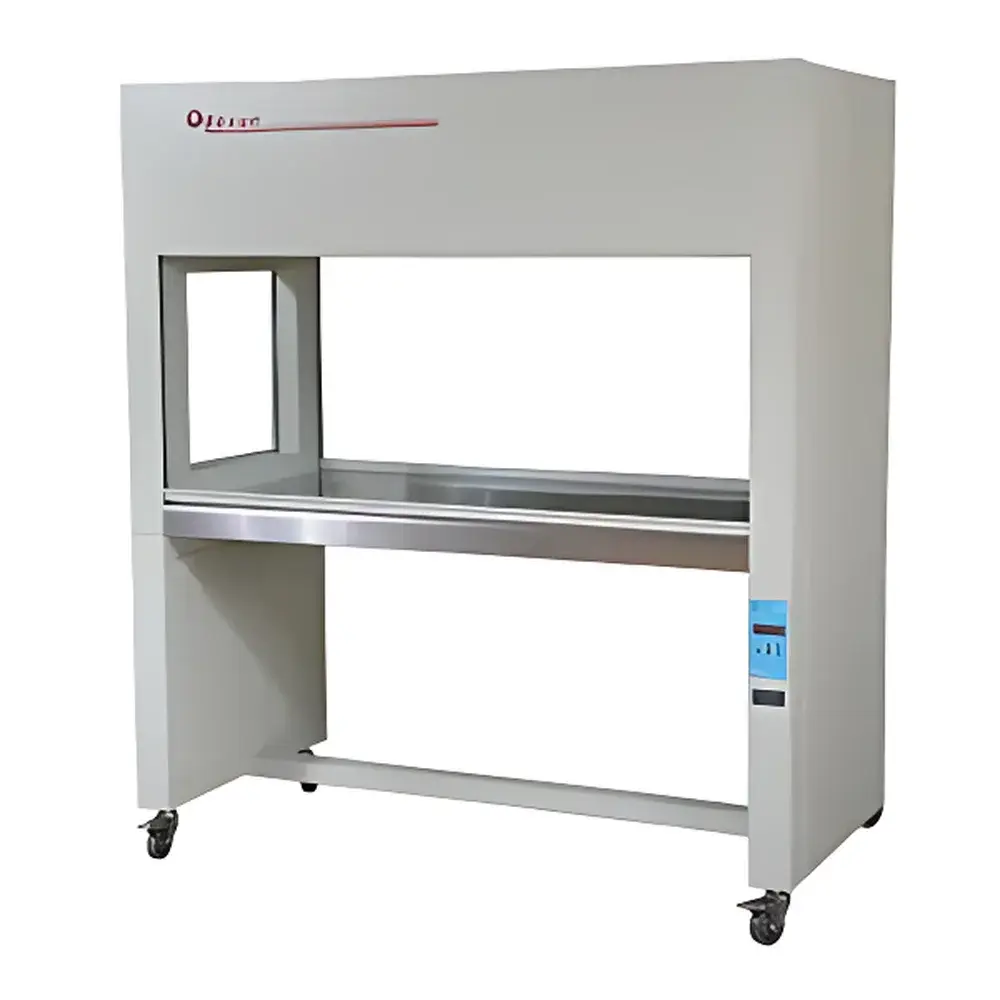
BOXUN SW-CJ-2F Vertical Laminar Flow Clean Bench
| Brand | BOXUN |
|---|---|
| Origin | Shanghai, China |
| Manufacturer Type | Direct Manufacturer |
| Product Category | Domestic |
| Model | SW-CJ-2F |
| Instrument Type | Vertical Laminar Flow Clean Bench |
| Cleanliness Class | ISO Class 5 (100-level, ≥99.99% filtration efficiency for particles ≥0.5 µm) |
| Noise Level | ≤67 dB(A) |
| User Capacity | Dual-user, dual-front configuration |
| Airflow Pattern | Vertical downward laminar flow |
| Working Surface Velocity Range | 0.3–0.6 m/s (adjustable in six steps) |
| Vibration Peak-to-Peak Amplitude | ≤5 µm (X/Y/Z axes) |
| Illumination | ≥300 lux |
| Work Area Dimensions (W×D×H) | 1300 × 650 × 520 mm |
| Overall Dimensions (W×D×H) | 1460 × 700 × 1650 mm |
| HEPA Filter Specification | 1250 × 560 × 50 mm (single unit) |
| Pre-filter | Medium-efficiency panel filter |
| Lighting | 40 W fluorescent lamp (1 unit) |
| UV Germicidal Lamp | 20 W (1 unit, timer-controlled: 0–999 min) |
| Weight | 210 kg |
| Power Consumption | 0.3 kW |
| Electrical Supply | AC 220 V ±10%, 50/60 Hz |
Overview
The BOXUN SW-CJ-2F Vertical Laminar Flow Clean Bench is an ISO Class 5-certified local containment workstation engineered to deliver unidirectional, particle-free airflow across the work surface via a vertically downward laminar flow pattern. Based on the fundamental principle of laminar air displacement—where filtered air moves uniformly at controlled velocity from top to bottom—the unit establishes a sterile microenvironment by continuously sweeping airborne contaminants away from the operator and sample zone. This architecture meets the operational requirements of aseptic technique in non-critical applications where product protection is prioritized over personnel or environmental protection (i.e., it is not a biological safety cabinet). Designed for consistent performance under routine laboratory conditions, the SW-CJ-2F complies with core design conventions outlined in ISO 14644-1 for cleanroom classification and aligns with general good laboratory practice (GLP) for microbiological and cell culture workflows.
Key Features
- Robust structural framework constructed from cold-rolled steel with electrostatic powder coating; work surface fabricated from brushed SUS304 stainless steel for corrosion resistance and ease of decontamination.
- High-efficiency particulate air (HEPA) filtration system (EN 1822 H14 grade), certified to remove ≥99.99% of particles ≥0.5 µm; integrated medium-efficiency pre-filter extends HEPA service life and reduces maintenance frequency.
- EC centrifugal blower delivering stable airflow across six discrete speed settings (0.3–0.6 m/s), optimized for both low-turbulence handling and energy-efficient operation.
- Intuitive LCD control interface with tactile membrane switches; independent, programmable controls for UV germicidal irradiation (0–999 min timer) and task lighting.
- Vertically oriented, quasi-enclosed work chamber with adjustable counterbalanced sash—enabling precise, tool-free positioning of the front access window within its operational range.
- Acoustically damped enclosure achieving ≤67 dB(A) at 1 m distance; vibration-isolated internal structure maintains ≤5 µm peak-to-peak displacement across all three orthogonal axes.
Sample Compatibility & Compliance
The SW-CJ-2F supports open-vessel manipulations involving non-hazardous biological agents (BSL-1), cell lines, sterile reagents, pharmaceutical intermediates, and precision electronic components. It is routinely deployed in environments governed by ISO/IEC 17025-accredited testing laboratories, cGMP-compliant pilot-scale bioprocessing areas, and academic research facilities conducting routine microbial culturing, plant tissue propagation, or assay plate preparation. While not certified to NSF/ANSI 49 or EN 12469 for biohazard containment, its ISO Class 5 performance is validated per ISO 14644-3 protocols using calibrated aerosol photometers and particle counters. Documentation includes factory-issued filter integrity test reports and airflow uniformity verification data—supporting audit readiness for GLP, ISO 9001, and internal quality system reviews.
Software & Data Management
The SW-CJ-2F operates as a standalone hardware platform with no embedded firmware-based data logging or network connectivity. All operational parameters—including fan speed setting, UV exposure duration, and lamp status—are manually configured and visually confirmed via the LCD display. For regulated environments requiring traceability, users may integrate external environmental monitoring systems (e.g., calibrated thermo-hygrometers or particle counters) connected to centralized LIMS or ELN platforms. The unit’s electrical design conforms to IEC 61010-1 safety standards, and its UV lamp circuitry incorporates interlock mechanisms preventing simultaneous UV activation and sash opening—supporting basic compliance with occupational health guidelines for ultraviolet radiation exposure (ACGIH TLV®).
Applications
- Aseptic transfer of microbial cultures, fungal spores, or mammalian cells in teaching and research laboratories.
- Preparation of media plates, serial dilutions, and reagent aliquots under particle-controlled conditions.
- Assembly and inspection of microelectronic components sensitive to particulate contamination.
- Environmental sampling kit preparation for water, soil, or air analysis in accredited environmental labs.
- Supporting upstream process development activities—including buffer formulation and filter integrity testing—in biopharmaceutical pilot facilities.
- Handling of non-pathogenic recombinant constructs during molecular cloning workflows.
FAQ
Is the SW-CJ-2F suitable for working with pathogenic organisms?
No. This unit provides product protection only and does not protect personnel or the environment from biohazards. BSL-2 or higher work requires certification to NSF/ANSI 49 or EN 12469 in a Class II biological safety cabinet.
What is the recommended HEPA filter replacement interval?
Filter lifespan depends on ambient air quality and usage intensity; typical service intervals range from 12 to 24 months. Pre-filter replacement every 3–6 months is advised to maintain optimal pressure differential and airflow stability.
Can the unit be installed in a non-temperature-controlled room?
Yes, but ambient temperature should remain between 15–30°C and relative humidity below 70% to prevent condensation on internal optics or electrical components and ensure consistent filter performance.
Does the UV lamp meet germicidal efficacy standards for surface decontamination?
The 20 W low-pressure mercury UV-C lamp emits at 254 nm and achieves ≥30 mJ/cm² fluence over 30 minutes at 15 cm distance—sufficient for inactivation of common vegetative bacteria and viruses on exposed stainless steel surfaces, per ISO 15714 guidance.
Is calibration documentation provided with shipment?
Factory-verified airflow velocity profiles, noise measurements, and illumination intensity readings are included in the delivery dossier. On-site user qualification (IQ/OQ) must be performed per institutional SOPs using third-party calibrated instrumentation.



