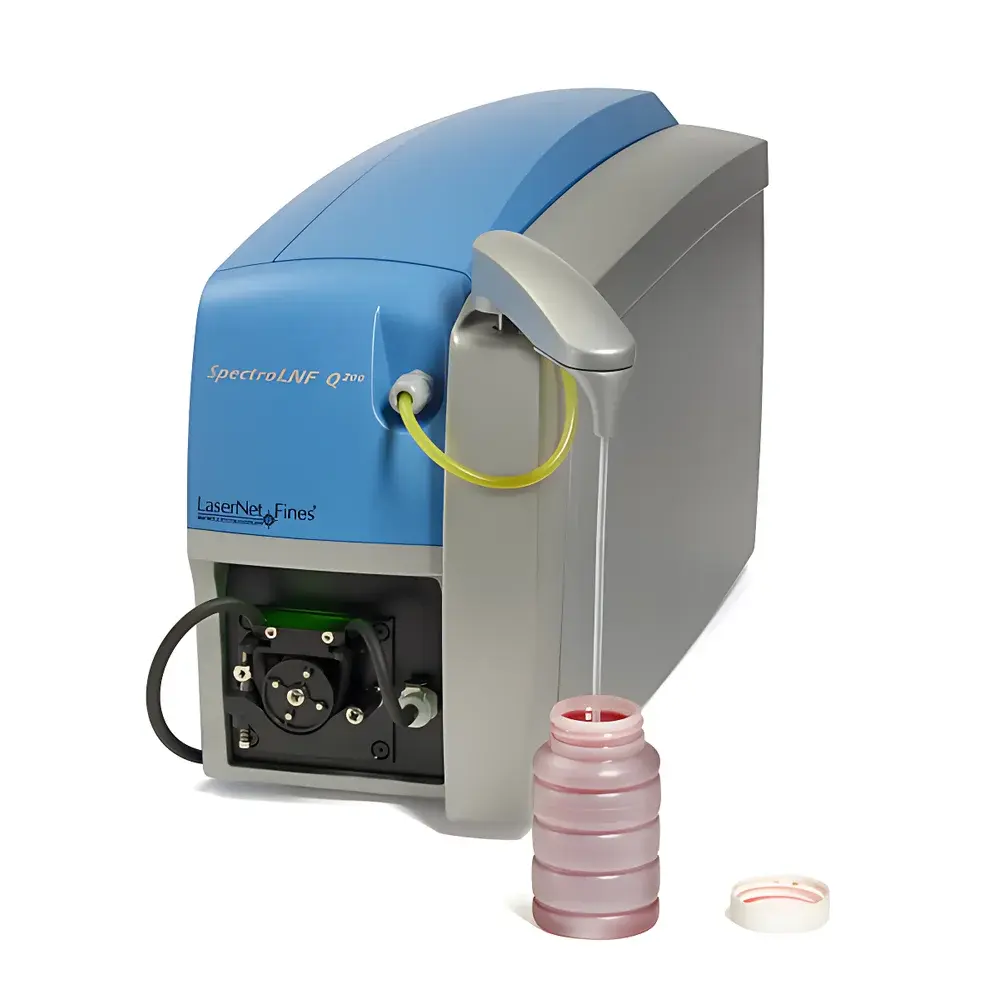
Spectro Scientific LaserNet 200 Multi-Function Wear Particle Analyzer
| Brand | Spectro Scientific |
|---|---|
| Origin | USA |
| Manufacturer | Spectro Scientific |
| Product Type | Imported Instrument |
| Model | LaserNet 200 |
| Pricing | Upon Request |
Overview
The Spectro Scientific LaserNet 200 Multi-Function Wear Particle Analyzer is an advanced, benchtop oil condition monitoring instrument engineered for precision analysis of wear debris, contamination, and fluid properties in lubricating oils and hydraulic fluids. It employs LaserNet Fines™ technology—a proprietary laser-based imaging and scattering methodology—to simultaneously perform automated particle counting, morphology-based classification, ferrous quantification, and optional kinematic/dynamic viscosity measurement. Unlike conventional optical blockage (light obscuration) particle counters, the LaserNet 200 captures high-resolution digital images of individual particles suspended in oil, enabling deterministic shape analysis and physics-informed categorization. Its core architecture integrates a pulsed laser illumination system, a high-magnification telecentric imaging path, and real-time image processing algorithms trained on validated metallurgical wear databases. Designed for integration into predictive maintenance programs, the LaserNet 200 delivers actionable insights into machine health by correlating particle morphology with failure modes—such as cutting, fatigue, sliding, or corrosion wear—thereby supporting root-cause diagnostics in turbines, gearboxes, compressors, diesel engines, and hydraulic systems.
Key Features
- Laser-based digital imaging particle analysis with 4–100 µm detectable size range (ISO 4406 compliant)
- Automated particle classification using neural network–trained morphology recognition: cutting wear, fatigue wear, sliding wear, non-metallic debris, fibers, water droplets, and air bubbles
- Direct analysis of highly contaminated oils up to 5,000,000 particles/mL without dilution
- Automatic gain control (AGC) laser intensity adjustment enables reliable analysis of dark, soot-laden oils (up to 2% soot content)
- Viscosity-compatible operation across 15–320 cSt without sample dilution or pre-treatment
- Integrated ferrous particle detection module: measures ferrous concentration (ppm), >25 µm ferrous particle count, and size distribution
- Optional dynamic/kinematic viscosity measurement at 40 °C via differential pressure flow cell and density input
- Compliance with international cleanliness standards including ISO 4406, NAS 1638, SAE AS4059, ASTM D6786, GOST R 52663, and NAVAIR 01-1A-17
Sample Compatibility & Compliance
The LaserNet 200 accepts standard 10–20 mL oil samples in industry-standard vials (e.g., ASTM D5185-compliant containers). It supports mineral, synthetic, and bio-based lubricants—including engine oils, turbine oils, hydraulic fluids, and gear oils—with no requirement for solvent dilution or filtration prior to analysis. Its optical design accommodates high-absorbance matrices (e.g., used diesel engine oils with up to 2% soot) through adaptive laser power modulation and background subtraction algorithms. All analytical outputs—including particle counts, morphology classifications, ferrous ppm values, and viscosity metrics—can be traceably linked to GLP/GMP-aligned workflows. Data integrity is maintained per FDA 21 CFR Part 11 requirements when deployed with SpectroTrack LIMS or AMS platforms, featuring electronic signatures, audit trails, and user-access controls.
Software & Data Management
The LaserNet 200 operates under Spectro’s proprietary AnalyzeNet™ software suite, which provides intuitive workflow navigation, real-time image review, customizable reporting templates, and embedded trend analysis tools. Raw particle images are stored with full metadata (timestamp, operator ID, calibration status, environmental conditions). Export capabilities include CSV, PDF, and XML formats compatible with enterprise CMMS and PdM platforms. Seamless bidirectional integration with SpectroTrack Laboratory Information Management System (LIMS) and Asset Management System (AMS) enables automated data ingestion, rule-based alerting (e.g., ISO code threshold breaches), and longitudinal fleet-level analytics. Software updates follow a controlled release cycle with documented version history and validation support packages for regulated environments.
Applications
- Root-cause failure analysis in rotating equipment: distinguishing fatigue spalls from abrasive cutting debris in gearbox oil
- Early detection of bearing degradation via morphology-driven identification of spherical vs. laminar ferrous particles
- Monitoring diesel engine cylinder liner wear through quantification of angular, high-aspect-ratio cutting particles
- Hydraulic system contamination control: differentiating silica dust (non-metallic) from internal component wear debris
- Verification of filter efficiency via upstream/downstream particle size distribution comparison
- Condition-based oil change decisions supported by combined particle count, ferrous load, and viscosity drift trends
FAQ
Does the LaserNet 200 require periodic recalibration?
No. The system utilizes a self-referencing optical architecture and factory-traceable reference standards; routine calibration is not required between scheduled performance verifications.
Can it analyze used transformer oil?
Yes—provided the oil falls within the specified viscosity (15–320 cSt) and particulate loading limits; however, dissolved gas analysis (DGA) requires complementary instrumentation.
Is the ferrous sensor capable of distinguishing Fe from other magnetic metals?
The integrated magneto-optical sensor responds primarily to elemental iron and its alloys; cobalt and nickel exhibit significantly lower magnetic susceptibility and are not reliably quantified as “ferrous” in this configuration.
What sample preparation steps are necessary before analysis?
Minimal preparation: homogenize sample via gentle inversion (no shaking), then load directly into the instrument’s sample chamber; no filtration, dilution, or degassing is required.
How does the LaserNet 200 handle air bubbles during analysis?
Its dual-wavelength imaging and temporal contrast analysis algorithm discriminates transient air bubbles from solid particles based on refractive index, edge sharpness, and motion dynamics—reporting them separately in classification output.