
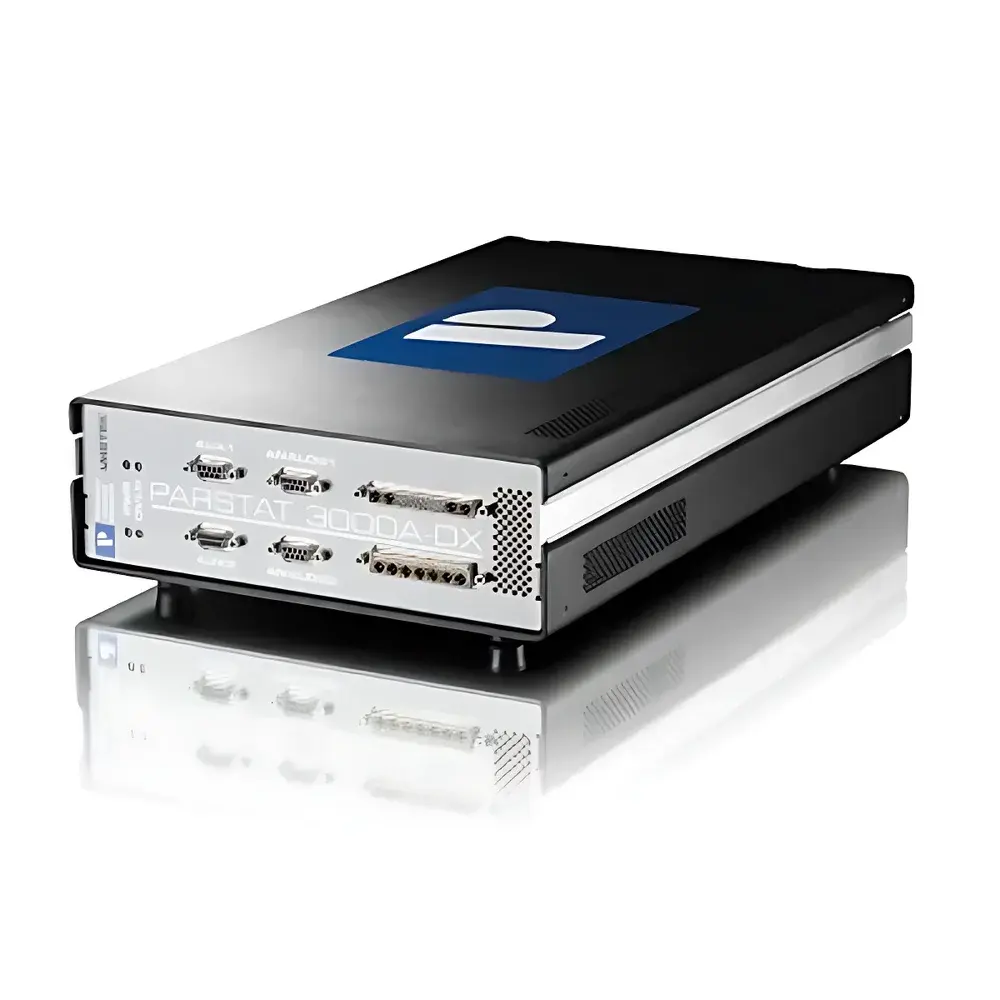
Princeton Applied Research PARSTAT 3000A DX Dual-Channel Potentiostat
| Brand | Princeton Applied Research |
|---|---|
| Origin | USA |
| Model | PARSTAT 3000A DX |
| Instrument Type | Electrochemical Workstation |
| Channel Count | Dual-Channel |
| Current Range | ±1 A (full-scale, auto-ranging from ±4 nA to ±1 A) |
| Current Resolution | 122 fA |
| Current Accuracy | ±0.2% of reading ± 0.2% of range ±50 pA (for 4 nA range) |
| Potential Range | ±30 V / ±6 V |
| Potential Resolution | 5 µV (applied), 46 µV (measured) |
| Potential Accuracy | ±0.2% of value ±2 mV |
| Potentiostatic Bandwidth | 7 MHz |
| EIS Frequency Range | 10 µHz – 7 MHz |
| Data Acquisition Rate | 1 MS/s (18-bit synchronized potential/current/auxiliary voltage) |
| Time Resolution | 1 µs |
| Rise Time (−1.0 V to +1.0 V) | <56 ns |
| Input Impedance | ≥10¹² Ω |
| Leakage Current | ≤5 pA (<25°C) |
| CMRR | >70 dB @ 300 kHz |
| iR Compensation | Positive feedback & dynamic iR compensation |
| Compliance | CE certified, compatible with GLP/GMP workflows requiring audit-trail-capable software and hardware traceability |
Overview
The Princeton Applied Research PARSTAT 3000A DX is a high-performance, dual-channel potentiostat/galvanostat designed for advanced electrochemical research and industrial R&D laboratories requiring simultaneous, independent control and measurement across two electrochemical cells. Engineered on a modular, low-noise analog architecture, it implements true four-quadrant operation with fast settling, ultra-low drift, and exceptional signal fidelity—critical for time-resolved techniques such as transient voltammetry, pulsed electrodeposition, and high-frequency electrochemical impedance spectroscopy (EIS). Its 7 MHz potentiostatic bandwidth and sub-nanosecond rise time support stable control under highly capacitive or low-impedance conditions, while the 18-bit synchronized data acquisition system captures correlated potential, current, and auxiliary analog inputs at up to 1 million samples per second—enabling precise reconstruction of fast kinetic events without phase lag or aliasing.
Key Features
- Dual independent channels with full galvanostatic/potentiostatic/EIS capability—no shared hardware bottlenecks or cross-talk
- Ultra-high-resolution current measurement: 122 fA minimum resolution over 10 auto-ranging decades (±4 nA to ±1 A)
- Applied potential resolution of 5 µV and measurement resolution of 46 µV, with accuracy maintained across full ±30 V compliance range
- 7 MHz analog control loop bandwidth and <56 ns rise time ensure stability in demanding applications including rotating disk electrode (RDE), scanning electrochemical microscopy (SECM), and battery cycling with rapid load transients
- Integrated electrostatic meter with ≥10 MHz bandwidth, input impedance ≥10¹² Ω || ≤5 pF, and leakage current ≤5 pA—optimized for high-impedance biosensor and corrosion monitoring setups
- Real-time digital noise filtering, programmable stability settings (10-step), and adaptive iR compensation (both positive feedback and dynamic modes) for robust operation in variable solution resistance environments
- CE-certified power amplifier with ±30 V output and ±1 A current delivery, supporting high-power electrolysis, fuel cell testing, and large-area electrode characterization
Sample Compatibility & Compliance
The PARSTAT 3000A DX accommodates a broad spectrum of electrochemical configurations—including three-electrode cells, bipolar stacks, microelectrodes, thin-film sensors, and embedded battery test fixtures—via its flexible auxiliary analog inputs (±10 V, 6:1 scaling), TTL-triggered digital I/O (5 outputs, 2 inputs), and isolated floating ground architecture. It supports ASTM G5, G59, G102, and ISO 16773-2 compliant test protocols out-of-the-box when paired with VersaStudio software. The instrument’s hardware design meets IEC 61010-1 safety requirements for laboratory equipment, and its deterministic timing, non-volatile parameter storage, and hardware-enforced calibration traceability align with FDA 21 CFR Part 11 and EU Annex 11 expectations for regulated environments. All firmware and calibration constants are digitally signed and version-locked to ensure reproducibility across instrument deployments.
Software & Data Management
Controlled exclusively via VersaStudio software (Windows 7/8/10, 64-bit recommended), the PARSTAT 3000A DX provides a unified interface for method development, real-time visualization, automated sequence execution, and post-experiment analysis. VersaStudio implements full audit-trail logging—including user actions, parameter changes, calibration events, and raw data provenance—with optional electronic signature enforcement. Data files (.PAR) store metadata (instrument ID, firmware revision, timestamp, operator ID), raw waveforms, FFT spectra, and EIS Nyquist/Bode plots in an open binary format with documented structure for third-party import. Batch processing, scripting (VBScript/Python API), and export to CSV, MATLAB (.mat), or Origin-compatible formats facilitate integration into LIMS and statistical process control pipelines.
Applications
- Battery materials R&D: multi-step charge/discharge profiling, differential capacity analysis (dQ/dV), and high-frequency EIS for SEI formation kinetics
- Corrosion science: zero-resistance ammeter (ZRA) coupling, galvanic current mapping, and long-term potentiodynamic polarization under simulated service conditions
- Electrocatalysis: rotating ring-disk electrode (RRDE) studies with synchronized channel triggering, CO stripping, and Tafel analysis at scan rates up to 25,000 V/s
- Biosensor development: amperometric detection of neurotransmitters, enzymatic reaction monitoring, and impedance-based label-free DNA hybridization assays
- Electrodeposition & electropolishing: pulse-reverse plating control, nucleation overpotential quantification, and in-situ thickness monitoring via AC harmonic analysis
- Fuel cell & electrolyzer testing: single-cell polarization curves, impedance mapping across humidification gradients, and degradation protocol automation
FAQ
Is the PARSTAT 3000A DX compatible with rotating disk or ring-disk electrodes?
Yes—its dual-channel architecture, TTL synchronization, and auxiliary analog inputs enable precise coordination between rotation speed controllers and electrochemical measurements, including simultaneous collection of disk and ring currents.
Does the system support compliance with 21 CFR Part 11 for regulated pharmaceutical or medical device testing?
VersaStudio software offers configurable electronic signatures, audit trails, and role-based access control; hardware-level parameter locking and calibration traceability meet foundational requirements for Part 11 adherence when deployed in validated environments.
Can the instrument perform EIS measurements below 10 µHz?
No—the specified lower limit is 10 µHz; sub-millihertz measurements require extended acquisition times and environmental stabilization not guaranteed by the standard configuration.
What is the maximum recommended cable length between the instrument and working electrode?
For optimal noise immunity and bandwidth preservation, shielded twisted-pair cables should not exceed 2 meters; longer runs necessitate active guarding or local signal conditioning.
Is external current shunt support available for measuring beyond ±1 A?
Yes—through the auxiliary voltage input and user-defined scaling, calibrated external shunts can extend effective current measurement range, subject to bandwidth and noise constraints of the selected shunt.



