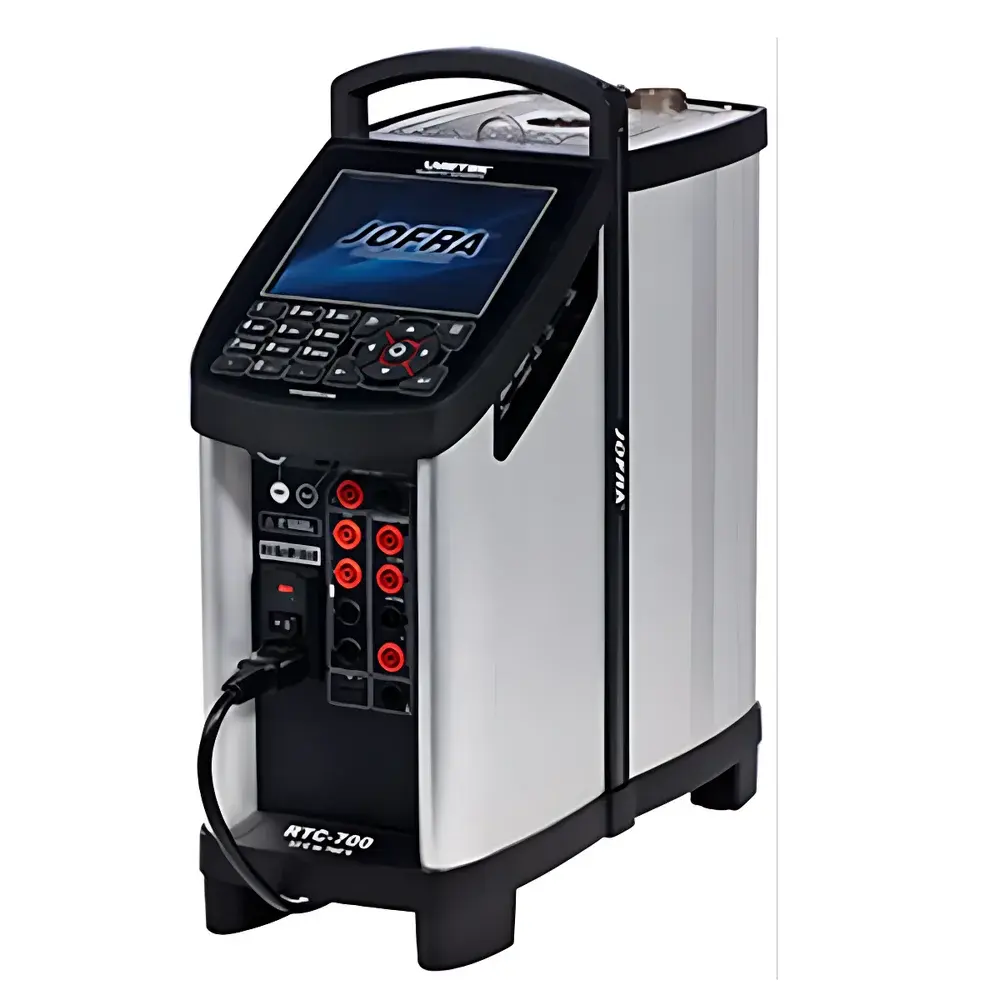
JOFRA RTC Series Reference Dry-Block Calibrator
| Brand | JOFRA |
|---|---|
| Origin | Denmark |
| Model | RTC Series |
| Temperature Range | –100 °C to 700 °C (6 models available) |
| Stability | ±0.005 °C |
| Accuracy | ±0.04 °C |
| Control Zones | Active dual-zone and tri-zone |
| Design | Dry-block, liquid-bath, or hybrid configuration |
| Display | Full-color touchscreen with intuitive navigation |
| Portability | Lightweight, field-deployable chassis |
| Sensor Interface | Plug-and-play reference sensor support |
| Cooling/Heating | Rapid thermal ramping capability |
| Insert Compatibility | Multi-hole well blocks for simultaneous multi-sensor calibration |
Overview
The JOFRA RTC Series Reference Dry-Block Calibrator is a high-precision, metrology-grade temperature calibration system engineered for laboratory, manufacturing, and field service applications requiring traceable, repeatable thermal verification. Based on resistive heating and active forced-air or solid-conduction thermal management, the RTC employs a closed-loop control architecture that integrates real-time thermal modeling with proprietary Dynamic Load Compensation (DLC) technology — a patented algorithm that continuously adjusts power distribution across heating elements to counteract thermal gradients induced by sensor mass, insertion depth, or ambient load variations. This ensures exceptional axial and radial temperature uniformity within the calibration well—even during multi-sensor operations or when calibrating large-diameter probes such as RTDs, thermocouples, and PRTs. Designed and manufactured in Denmark by AMETEK STC, the RTC series complies with international metrological requirements for primary and secondary calibration tasks under ISO/IEC 17025-accredited environments.
Key Features
- Dynamic Load Compensation (DLC) system — actively corrects for thermal perturbations caused by sensor quantity, size, and immersion depth, maintaining uniformity across all well positions
- Active dual-zone and tri-zone temperature control — independently regulated upper and lower heating zones (and optional third zone) minimize axial gradients and improve setpoint fidelity
- Wide operational range from –100 °C to 700 °C — achieved via six distinct model variants, each optimized for specific sub-ranges using calibrated heater assemblies and cold-junction compensation strategies
- Stability of ±0.005 °C over 30 minutes — verified per ASTM E2877 and ISO 17025 internal validation protocols
- Accuracy of ±0.04 °C (at 0 °C to 100 °C), traceable to NIST and DKD standards — supported by factory-issued calibration certificates with uncertainty budgets
- Modular well block design — accommodates multiple probe diameters and lengths; configurable multi-hole inserts enable parallel calibration of up to six sensors without sacrificing uniformity
- Rapid thermal response — typical ramp rates of 3 °C/min (heating) and 2 °C/min (cooling) reduce turnaround time between calibration points
- Integrated full-color touchscreen interface — supports multilingual menus, graphical trend display, and on-device data logging with timestamped event markers
Sample Compatibility & Compliance
The RTC Series supports calibration of contact temperature sensors including Type T, J, K, E, R, S, B, and N thermocouples; Pt100, Pt1000, and Ni120 RTDs; glass-liquid and bimetallic thermometers; and digital handheld probes. All models meet IEC 61000-4 electromagnetic compatibility requirements and operate within Class II safety insulation boundaries. The system is fully compatible with GLP and GMP workflows: audit trails, user access levels, electronic signatures, and data export formats (CSV, PDF, XML) conform to FDA 21 CFR Part 11 and EU Annex 11 expectations. Calibration reports generated through JOFRA’s SmartCal software include full uncertainty analysis per GUM (Guide to the Expression of Uncertainty in Measurement) and are accepted by national metrology institutes for inter-laboratory comparisons.
Software & Data Management
SmartCal PC software provides comprehensive instrument control, automated calibration sequence execution, and report generation compliant with ISO 17025 clause 7.8. It supports customizable calibration templates (e.g., ITS-90 fixed points, custom point lists), real-time deviation monitoring, and pass/fail evaluation against user-defined tolerances. Raw measurement data—including reference sensor output, block temperature, ambient conditions, and stability metrics—is stored with cryptographic hash integrity. Export functions support direct integration into LIMS and MES platforms via OPC UA or RESTful API interfaces. Firmware updates are delivered through secure over-the-air (OTA) channels with version rollback capability and change-log documentation.
Applications
- Primary and secondary temperature calibration in accredited calibration laboratories
- In-process verification of sterilization cycles (autoclaves, depyrogenation tunnels) per ISO 13485 and FDA guidance
- Validation of HVAC-R sensor networks in pharmaceutical cleanrooms and bioreactor systems
- Field calibration of portable thermometers used in food safety inspections and environmental monitoring
- Research-grade thermal characterization of novel sensor materials and packaging configurations
- Support for temperature uncertainty budget development in ISO/IEC 17025 scope accreditation
FAQ
What distinguishes the RTC Series from conventional dry-well calibrators?
Its proprietary Dynamic Load Compensation (DLC) system and active multi-zone control architecture deliver superior temperature uniformity—especially under variable thermal loads—without requiring manual recalibration or external reference probes.
Can the RTC calibrate both thermocouples and RTDs simultaneously?
Yes—multi-hole well inserts allow concurrent calibration of mixed sensor types, provided they fall within the same temperature range and do not exceed maximum well loading specifications.
Is the RTC suitable for use in ISO 17025-accredited laboratories?
Yes—each unit ships with DKD/NIST-traceable calibration certificates, documented uncertainty budgets, and full compliance documentation supporting metrological traceability and quality system integration.
How is traceability maintained during firmware or software updates?
All firmware revisions undergo metrological revalidation; update logs are retained in device memory and included in calibration certificate appendices to preserve chain-of-custody integrity.
Does the RTC require annual recalibration?
While not mandatory, AMETEK STC recommends annual performance verification against certified references to maintain stated accuracy and stability specifications—particularly in regulated environments governed by FDA, EMA, or ISO 13485.