
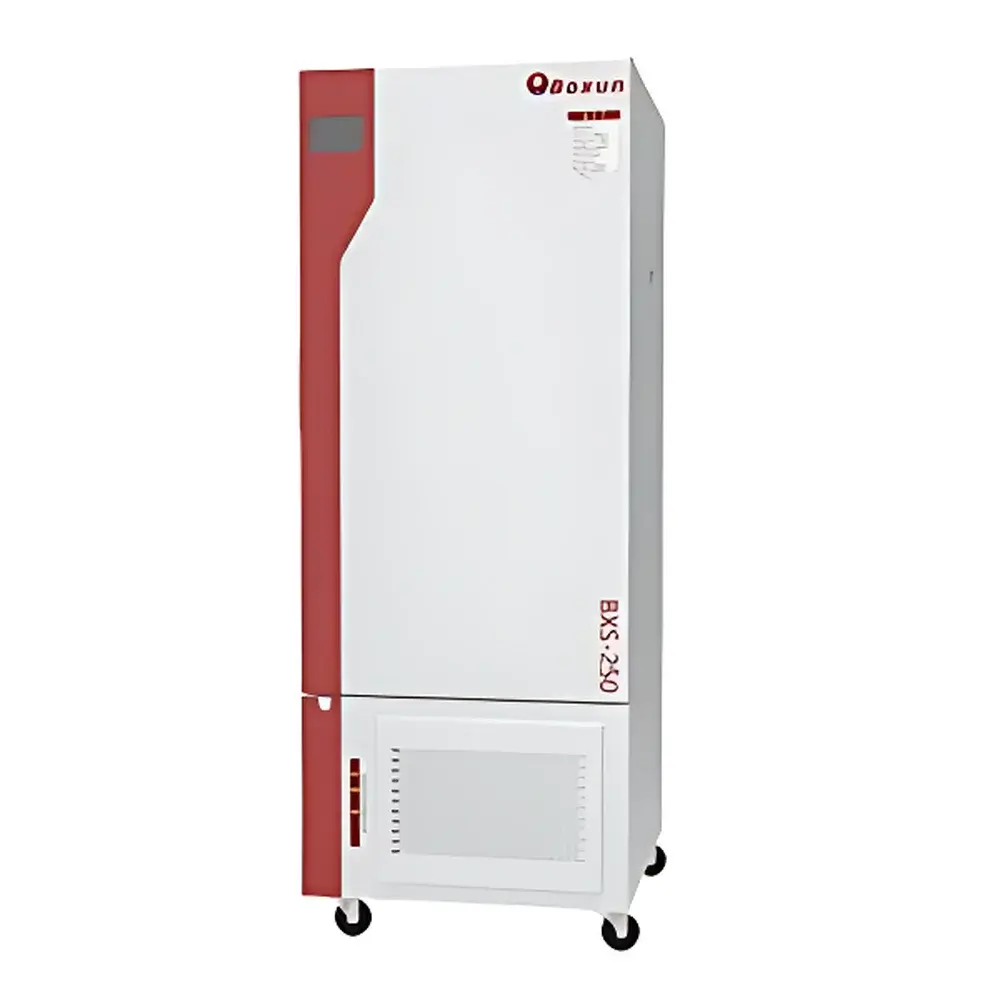
Boxun BXS-400 Expandable Drug Stability Testing Chamber
| Brand | Boxun |
|---|---|
| Origin | Shanghai, China |
| Manufacturer Type | Direct Manufacturer |
| Model | BXS-400 |
| Temperature Control Range | 0–70 °C (10–70 °C with illumination active) |
| Temperature Resolution | 0.1 °C |
| Temperature Uniformity (at 25 °C) | ±1.5 °C |
| Temperature Fluctuation (at 25 °C) | ±0.5 °C |
| Humidity Control Range (optional) | 25–95 %RH |
| Humidity Fluctuation | ±3 %RH |
| Illumination Range | 0–10,000 Lux (continuously adjustable) |
| Illumination Deviation | ±500 Lux |
| UV Irradiance Range | 0–2 W/m² |
| UV Spectral Band | 320–400 nm |
| Internal Chamber Dimensions (L×W×H) | 600×640×1050 mm |
| Power Consumption | 1250 W (base), up to 2000 W (full humidity + UV configuration) |
| Data Storage Capacity | 250,000 records |
| Interface Options | USB, RS232, RS485 |
| Compliance Support | FDA 21 CFR Part 11 (via optional software), GMP/GLP audit trail ready |
Overview
The Boxun BXS-400 Expandable Drug Stability Testing Chamber is an engineered environmental simulation system designed explicitly for pharmaceutical stability studies in accordance with ICH Q1, Q5C, and the Chinese Pharmacopoeia (ChP) guidelines. It provides precise, reproducible control of temperature, relative humidity, visible light, and near-ultraviolet (UV-A) irradiation—three critical stress factors required for forced degradation and long-term stability assessment of active pharmaceutical ingredients (APIs) and finished dosage forms. Unlike generic climate chambers, the BXS-400 integrates modular, field-upgradable subsystems—humidity, illumination, and UV—that operate under synchronized PID regulation and share a unified data acquisition architecture. Its chamber design employs C.H. (Circulating Heat) thermal recovery technology to minimize overshoot and accelerate temperature stabilization after door opening, while the dual-wall insulated structure with high-efficiency compressors ensures low thermal drift over extended test durations (≥6 months). The system operates within ambient conditions of 10–30 °C and is validated for use in ISO 17025-accredited laboratories and GMP-compliant manufacturing environments.
Key Features
- Modular expandability: Base unit supports seamless integration of humidity control, programmable illumination, and UV-A irradiation modules—each certified to meet ICH Q1B photo-stability testing thresholds (≥1.2 × 10⁶ Lux·hr total visible exposure; ≥200 W·hr/m² near-UV energy dose).
- High-fidelity environmental control: Equipped with imported high-precision Pt100 temperature sensors, capacitive humidity transducers, and calibrated Lux/UV-A photodiodes—all traceable to national metrology standards.
- Intelligent multi-segment programming: 30-step, 99-cycle scheduling with independent setpoint definition per segment for temperature, humidity, light intensity, UV irradiance, and duration—enabling complex ICH Q1A(R3) real-time and accelerated protocols.
- Comprehensive data integrity architecture: Onboard storage of 250,000 timestamped records (temperature, humidity, Lux, UV-W/m²); full event logging (door openings, parameter changes, alarms) with time-stamped USB export; optional FDA 21 CFR Part 11-compliant software with electronic signatures and audit trail.
- Robust hardware safeguards: Dual-stage overtemperature cutoff, door-open alarm with auto-hold function, sensor fault detection, low-water level alert (for humidification), and password-protected screen lock with configurable access levels.
- Integrated peripheral support: Standard embedded thermal printer, mechanical safety lock, RS232/RS485 for SCADA integration, and optional GPRS-based SMS alerts for critical deviations.
Sample Compatibility & Compliance
The BXS-400 accommodates standard pharmaceutical packaging configurations—including blister packs, HDPE bottles, glass vials, and aluminum foil pouches—on up to seven adjustable stainless-steel shelves (4 standard, 3 optional). Its internal volume (400 L net) complies with ICH-recommended minimum chamber-to-sample volume ratios for representative air exchange and uniform exposure. All operational modes are compatible with USP , EP 2.2.42, and ChP General Chapter 9101 stability testing requirements. Optional 3Q validation documentation (IQ/OQ/PQ) is provided per ASTM E2500 and EU Annex 15 guidelines. Humidity and UV modules undergo annual recalibration verification using NIST-traceable reference standards; calibration certificates for temperature (0 °C, 60 °C, 121 °C) and combined温/humidity points (15 °C/40 %RH, 20 °C/60 %RH, 30 °C/80 %RH) are available upon request.
Software & Data Management
The embedded Windows CE operating system hosts a deterministic real-time control kernel with 512 MB RAM and dual-core ARM processor, ensuring deterministic response to setpoint changes and alarm events. Data is stored in encrypted binary format with SHA-256 checksum validation. USB export generates CSV or PDF reports containing raw sensor traces, event logs, and statistical summaries (min/max/mean/stdev per parameter). Optional FDA Edition software enables role-based user accounts, electronic signatures, and immutable audit trails compliant with 21 CFR Part 11 Subpart B. GMP Edition adds batch-level metadata tagging, deviation investigation workflows, and automated report generation aligned with ALCOA+ principles. Third-party integration via Modbus RTU (RS485) or OPC UA is supported for enterprise LIMS/MES connectivity.
Applications
- ICH Q1A(R3) long-term (25 °C/60 %RH) and accelerated (40 °C/75 %RH) stability studies for registration dossiers.
- ICH Q1B Option 1 & 2 photo-stability testing of APIs and formulations under D65 daylight simulators and UV-A lamps.
- Forced degradation studies per ICH Q5C to assess product robustness against thermal, hygroscopic, and photolytic stress.
- Storage condition qualification for cold chain intermediates, lyophilized products, and moisture-sensitive biologics.
- Method suitability verification for dissolution, HPLC, and spectroscopic assays requiring controlled pre-conditioning environments.
- Environmental stress screening during formulation development and packaging selection (e.g., barrier performance of primary containers).
FAQ
Does the BXS-400 meet ICH Q1B photo-stability requirements for both Option 1 and Option 2?
Yes—the illumination module delivers ≥1.2 × 10⁶ Lux·hr cumulative exposure using daylight-simulating LEDs, and the UV-A module achieves ≥200 W·hr/m² within the 320–400 nm band, fully satisfying ICH Q1B specifications.
Can humidity and UV be operated simultaneously without compromising temperature stability?
Yes—the chamber’s adaptive thermal compensation algorithm dynamically adjusts compressor output and heater duty cycle to maintain ±0.5 °C fluctuation even during concurrent 95 %RH and 2 W/m² UV operation.
Is remote monitoring and alarm notification supported out of the box?
Standard RS232/RS485 interfaces enable integration with building management systems; GPRS SMS alerting is available as a factory-installed option with configurable recipient lists and alarm severity tiers.
What validation documentation is included with the system?
Base delivery includes Factory Acceptance Test (FAT) report and calibration certificates for all primary sensors; optional IQ/OQ/PQ packages conform to ASTM E2500 and include protocol templates, executed reports, and traceability matrices.
How is data integrity ensured during power interruption?
Non-volatile flash memory retains all logged data and program settings during outage; system resumes prior operational state automatically upon power restoration, with no loss of timestamp continuity or record integrity.






