
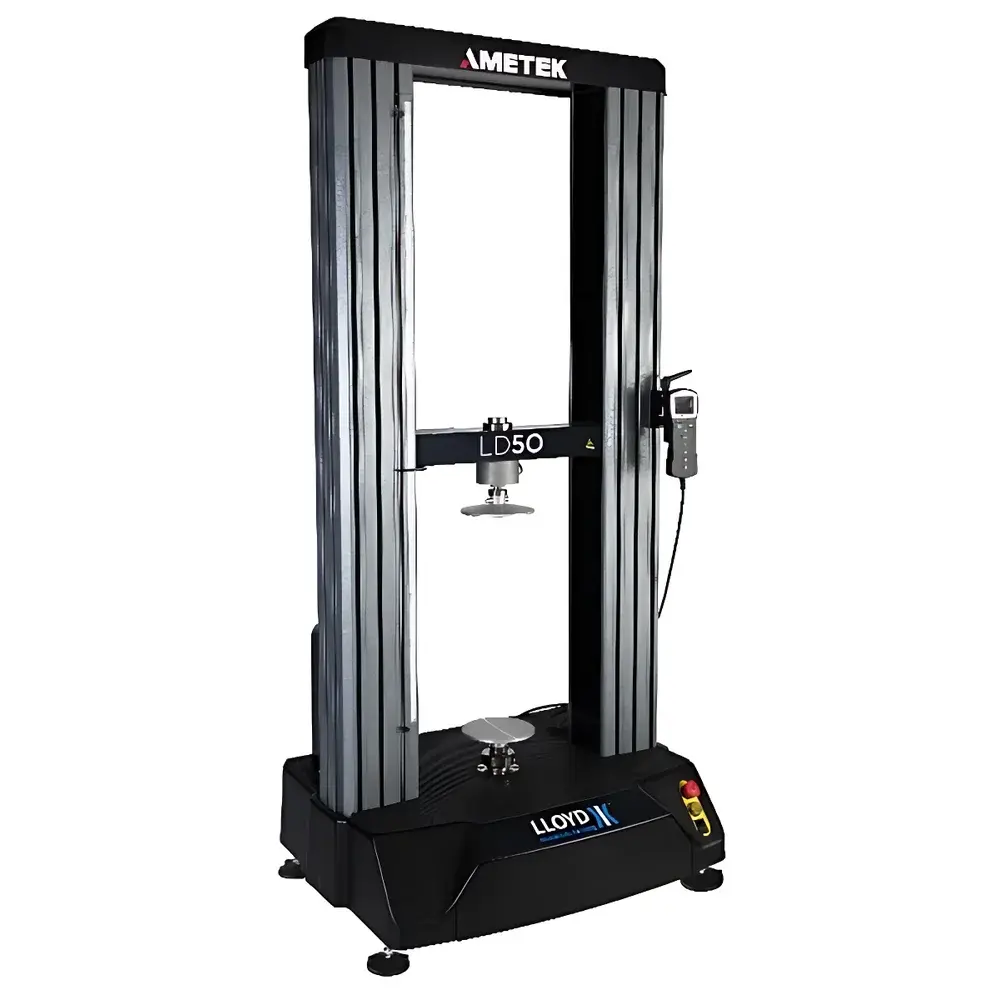
Lloyd LD5 Dual-Column Universal Testing Machine
| Brand | Lloyd |
|---|---|
| Origin | USA |
| Model | LD5 |
| Maximum Load Capacity | 5 kN (1124 lbf) |
| Column Spacing | 452 mm (17.8 in) |
| Crosshead Travel (Standard) | 1070 mm (42 in) |
| Crosshead Travel (Extended) | 1669 mm (65.7 in) |
| Drive System | AC Servo Motor with Preloaded Ball Screw |
| Load Cell | Interchangeable Spoke-Type Sensor |
| Compliance | CE Certified |
| Software | NEXYGENPlus with Built-in Standards Library |
| Data Export | Native Integration with Microsoft Excel and Word |
Overview
The Lloyd LD5 Dual-Column Universal Testing Machine is an electromechanical static materials testing system engineered for precision, repeatability, and operational flexibility in laboratory and quality control environments. Based on fundamental principles of uniaxial force application—compliant with ISO 6892-1 (tensile testing of metallic materials), ASTM E8/E8M, and ISO 7500-1 (calibration of force-proving instruments)—the LD5 applies controlled tensile, compression, flexure, peel, shear, and cyclic loads to specimens using a rigid dual-column frame and high-stiffness crosshead assembly. Its design prioritizes mechanical integrity: the load frame incorporates reinforced aluminum extrusions and steel-reinforced base plates to minimize deflection under load, while the preloaded ball screw drive ensures sub-micron positional resolution and minimal backlash during displacement-controlled tests. The system operates within a defined force range of up to 5 kN (1124 lbf), making it suitable for testing polymers, composites, elastomers, thin metals, medical devices, packaging materials, and adhesives where high-resolution load-displacement characterization is required without over-engineering.
Key Features
- Dual-column architecture with 452 mm (17.8 in) column spacing—enables accommodation of large or irregularly shaped specimens and facilitates integration with environmental chambers or extensometers.
- High-rigidity crosshead guided by precision linear bearings and anti-lateral-load support columns—reduces parasitic bending moments and improves axial alignment fidelity during testing.
- Interchangeable spoke-type load cells calibrated to ISO 376 Class 0.5 accuracy—provides traceable force measurement across multiple ranges without recalibration of the entire system.
- AC servo motor drive coupled with preloaded recirculating ball screw—delivers smooth, low-noise motion, high torque density, and long-term dimensional stability under repeated loading cycles.
- CE-compliant electrical architecture with integrated safety interlocks, emergency stop circuitry, and overload protection—meets Machinery Directive 2006/42/EC requirements for industrial equipment deployment in EU-regulated facilities.
- Modular hardware interface supporting analog and digital I/O expansion—enables synchronization with video extensometers, temperature controllers, or acoustic emission sensors for multi-parameter test protocols.
Sample Compatibility & Compliance
The LD5 accommodates specimens ranging from miniature biomedical sutures (diameter < 0.1 mm) to structural polymer panels (up to 400 mm wide × 100 mm thick). Grip options include pneumatic, wedge, hydraulic, and custom-fabricated fixtures—each designed to maintain uniform stress distribution and prevent premature slippage or jaw-induced damage. All standard test methods embedded in NEXYGENPlus are aligned with internationally recognized standards including ASTM D638 (plastics tensile), ISO 527 (polymer tensile), ASTM D790 (flexural properties), ISO 179 (Izod impact), and ISO 1133 (melt flow index auxiliary testing). The system supports GLP/GMP documentation workflows through audit-trail-enabled test logging and user-access-level permissions, ensuring compliance with FDA 21 CFR Part 11 when configured with electronic signature modules.
Software & Data Management
NEXYGENPlus is a Windows-based, modular test control and analysis platform that operates natively on Windows 10/11 (64-bit). It provides real-time graphical feedback of load, displacement, strain (when paired with extensometers), and calculated engineering parameters (e.g., modulus, yield point, elongation at break, secant stiffness). The software includes over 200 preconfigured test templates mapped to ASTM, ISO, DIN, and JIS standards, all editable without scripting. Raw data export is supported in CSV, XML, and proprietary .nxd formats; direct output to Microsoft Excel and Word templates allows automated report generation compliant with internal QA documentation systems. All test sessions record operator ID, timestamp, calibration history, and environmental metadata—critical for traceability in regulated manufacturing and R&D settings.
Applications
- Mechanical characterization of thermoplastics, thermosets, and biodegradable polymers for automotive and consumer electronics applications.
- Validation of adhesive bond strength and peel resistance in flexible packaging and medical device assembly processes.
- Tensile and compression testing of hydrogels, suture materials, and tissue-engineered scaffolds per ISO 10993-12 biocompatibility guidelines.
- Quality assurance of elastomeric seals, O-rings, and gasket materials under static and dynamic loading conditions.
- Evaluation of composite laminate interlaminar shear strength (ILSS) and flexural modulus using three-point bend fixtures.
- Calibration and verification of secondary force-measuring devices in metrology laboratories accredited to ISO/IEC 17025.
FAQ
What is the maximum crosshead speed of the LD5 system?
The LD5 achieves speeds from 0.001 mm/min to 2000 mm/min, programmable in 0.001 mm/min increments, supporting both quasi-static and high-rate deformation studies.
Can the LD5 be used for fatigue testing?
Yes—when equipped with optional closed-loop servo control and compatible waveform generators, the LD5 supports sinusoidal, triangular, and trapezoidal cyclic loading protocols up to 5 Hz, suitable for low-cycle fatigue evaluation.
Is NEXYGENPlus validated for use in regulated industries?
NEXYGENPlus includes IQ/OQ documentation packages and supports 21 CFR Part 11 compliance features such as electronic signatures, audit trails, and role-based access control—subject to site-specific validation by the end user.
Does the LD5 require annual recalibration?
Per ISO 7500-1, load cell calibration must be verified at least annually—or after any event affecting mechanical integrity—and traceable to national standards via accredited third-party laboratories.
How is specimen alignment ensured during testing?
The LD5’s self-aligning upper grip mount and adjustable lower crosshead leveling mechanism reduce angular misalignment to < 0.1°, minimizing eccentric loading effects and improving data reproducibility across operators and shifts.



