
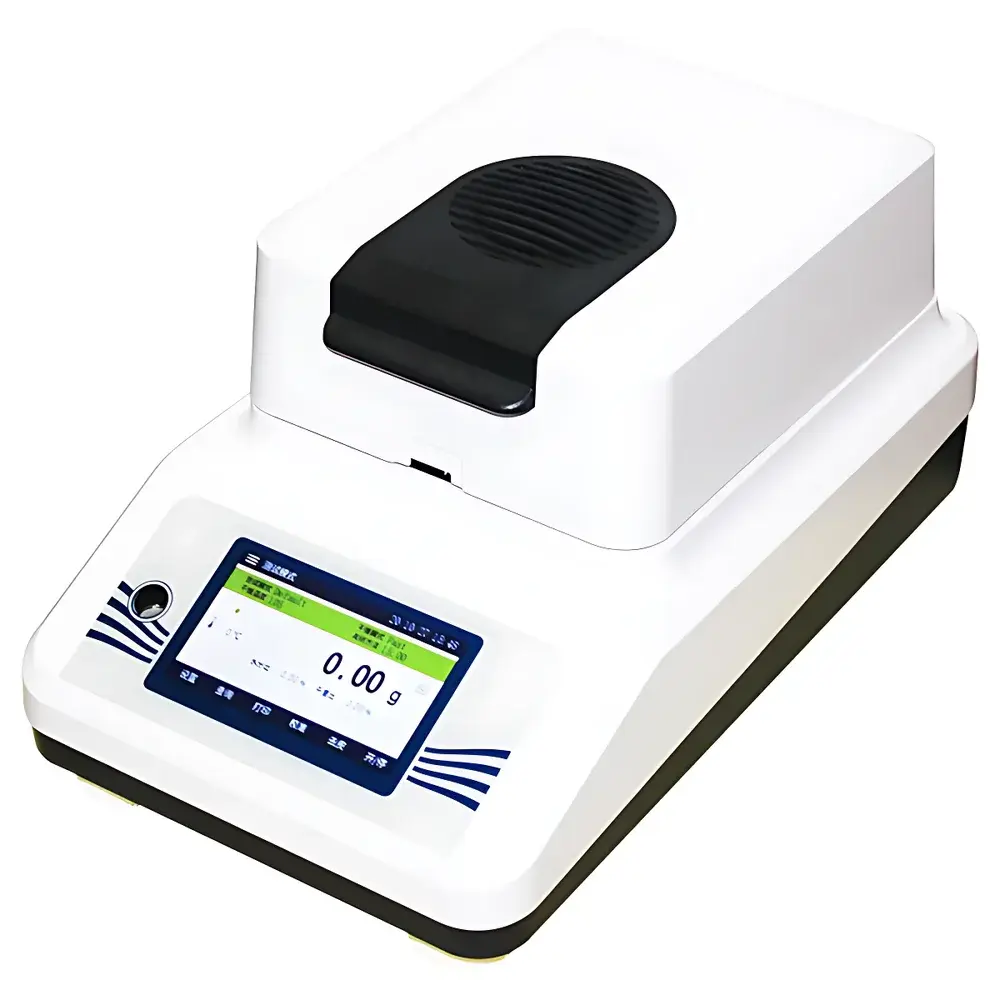
Yoke TSF-10A Touchscreen Halogen Moisture Analyzer
| Brand | Yoke |
|---|---|
| Origin | Shanghai, China |
| Manufacturer | Yoke Instrument Co., Ltd. |
| Model | TSF-10A |
| Heating Source | Halogen Lamp |
| Weighing Range | 0–10 g |
| Readability | 10 mg |
| Repeatability (3 g sample) | ±0.5% |
| Sample Capacity | 0.5–10 g (recommended: 3–10 g) |
| Temperature Range | 50–160 °C (adjustable in 1 °C increments) |
| Drying Time | 1–99 min (adjustable in 1 min increments) |
| Drying Modes | Standard, Rapid |
| Display | 4.3″ TFT LCD touchscreen |
| Communication | USB interface |
| Pan Diameter | 80 mm |
| Dimensions (L×W×H) | 340 × 210 × 180 mm |
| Net Weight | 3.6 kg |
| Operating Environment | 10–30 °C, ≤75% RH |
| Compliance | GB/T 29249–2012 |
Overview
The Yoke TSF-10A Touchscreen Halogen Moisture Analyzer is a precision laboratory instrument engineered for rapid, gravimetric determination of moisture content in solid and semi-solid samples using the loss-on-drying (LOD) principle. It employs a high-intensity halogen lamp as its heating source—delivering uniform, controllable thermal energy across the sample surface—combined with an integrated, thermally isolated electromagnetic force compensation weighing sensor. This architecture minimizes thermal drift during heating cycles, ensuring stable mass measurement throughout the drying process. Unlike conventional oven-drying methods requiring hours, the TSF-10A achieves endpoint detection in minutes while maintaining metrological equivalence to reference ASTM E1447 and ISO 12373-1 protocols. Its design adheres strictly to GB/T 29249–2012, the Chinese national standard for electronic moisture analyzers based on thermogravimetric principles, making it suitable for regulated environments where traceable, repeatable LOD data are required.
Key Features
- 4.3-inch high-resolution TFT LCD touchscreen interface enabling intuitive parameter configuration—including temperature setpoint (50–160 °C), drying duration (1–99 min), and mode selection (Standard or Rapid)—without external software.
- Thermally isolated weighing sensor system that mitigates heat-induced signal noise, preserving measurement integrity at elevated temperatures and delivering 10 mg readability with ±0.5% repeatability (tested on 3 g reference samples).
- Halogen heating module providing fast thermal response (<30 s to reach setpoint), precise radiant energy distribution, and minimal sample oxidation risk compared to traditional infrared or convection ovens.
- Real-time multi-parameter graphical display showing dynamic trends of moisture %, dry weight %, sample mass (g), chamber temperature (°C), and elapsed time—supporting immediate process assessment and method optimization.
- USB port compliant with USB 2.0 specifications for direct connection to host computers (for data export via CSV/Excel-compatible formats) or label printers (for GLP-compliant result documentation).
- Robust mechanical construction with adjustable leveling feet, compact footprint (340 × 210 × 180 mm), and lightweight aluminum alloy housing (net weight: 3.6 kg) optimized for benchtop deployment in QC labs, production floors, and field testing stations.
Sample Compatibility & Compliance
The TSF-10A accommodates diverse sample types including powders, granules, pellets, pastes, and thin films within the 0.5–10 g operational range. Its open pan geometry (80 mm diameter) supports heterogeneous materials without pre-grinding, provided particle size permits uniform heat penetration. The instrument meets GB/T 29249–2012 requirements for accuracy, linearity, temperature stability, and drying kinetics validation. While not inherently 21 CFR Part 11 compliant, audit-ready operation is achievable through procedural controls—such as documented calibration logs (external weight calibration at startup), defined drying protocols, and timestamped USB-exported reports—enabling alignment with GMP/GLP documentation standards in pharmaceutical, food, and agricultural testing laboratories.
Software & Data Management
No proprietary software installation is required. All instrument control and data visualization occur natively on the embedded touchscreen OS. Measurement results—including final moisture %, dry residue %, initial/final mass, peak temperature, and drying curve metadata—are stored internally and exportable via USB mass storage mode. Exported files follow ISO/IEC 8859-1 encoding with tab-delimited structure, compatible with LIMS integration, statistical process control (SPC) tools, and regulatory submission packages. Timestamps include date and time (YYYY-MM-DD HH:MM:SS), supporting traceability per ISO/IEC 17025 clause 7.7.
Applications
The TSF-10A delivers validated moisture quantification across multiple regulated and industrial sectors: active pharmaceutical ingredient (API) release testing per USP ; flour and cereal grain moisture verification per AOAC 950.46; polymer resin quality control prior to extrusion; feedstuff compliance with EU Directive 2009/138/EC; and soil moisture profiling in environmental monitoring workflows. Its speed-to-result advantage significantly reduces throughput bottlenecks in high-volume QA/QC environments without compromising comparability to classical vacuum oven methods.
FAQ
What calibration procedures are required before first use?
External calibration using certified weights (e.g., 10 g Class M2) is mandatory prior to operation. Temperature calibration is factory-performed and does not require user intervention unless sensor replacement occurs.
Can the TSF-10A be used for volatile organic compound (VOC) analysis?
No. It measures total volatile loss under defined thermal conditions—not compound-specific volatiles. For VOC identification, GC-MS or headspace-GC is required.
Is automatic endpoint detection based on mass change rate or fixed time?
It uses a dual-criteria algorithm: termination occurs when either mass change falls below 0.1 mg/min for 30 consecutive seconds OR the preset drying time elapses—whichever comes first.
Does the instrument support method transfer from oven-drying SOPs?
Yes. Method equivalence studies per ASTM E2655 demonstrate correlation coefficients ≥0.995 between TSF-10A results and 105 °C forced-air oven data for common matrices including starch, lactose, and sodium chloride.
What maintenance is recommended for long-term accuracy?
Daily cleaning of the pan and chamber with lint-free cloth; quarterly inspection of halogen lamp intensity using a calibrated photometer; annual verification of weighing sensor linearity per OIML R76 guidelines.
Related Products




