
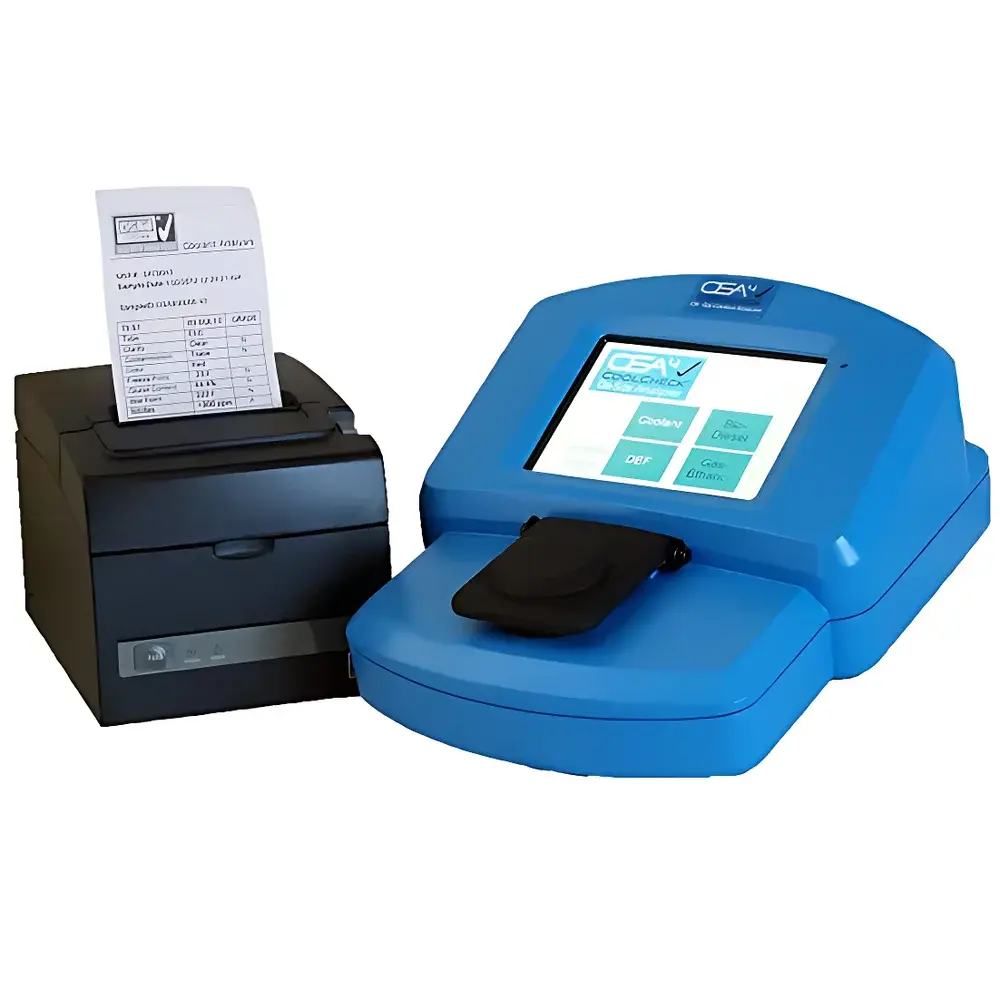
Spectro Scientific CoolCheck Engine Coolant and DEF Solution Analyzer
| Brand | Spectro Scientific |
|---|---|
| Origin | USA |
| Manufacturer | Spectro Scientific |
| Country of Origin | Imported |
| Model | CoolCheck |
| Price | Upon Request |
| Optical Configuration | Dual-channel spectrometer with independent NIR (200–750 nm) and UV-Vis (750–1100 nm) optical paths |
| Measured Parameters | Ethylene glycol concentration, boiling point estimation, contamination index, coolant type classification, coolant quality assessment, inorganic additive (salt) concentration, DEF urea concentration |
| Interface | Touchscreen display with external mouse, keyboard, and printer support |
| Dimensions | 12.7 cm (H) × 17.8 cm (W) × 22.9 cm (L) |
| Weight | ~2.5 kg |
Overview
The Spectro Scientific CoolCheck Engine Coolant and DEF Solution Analyzer is the world’s first purpose-built, fully automated benchtop instrument engineered exclusively for rapid, on-site condition monitoring of heavy-duty engine coolants and Diesel Exhaust Fluid (DEF). Unlike generic spectrometers or multi-parameter fluid analyzers, the CoolCheck integrates dual-spectral-domain optical architecture—simultaneously acquiring data across the near-infrared (200–750 nm) and ultraviolet-visible (750–1100 nm) ranges—to deliver chemometrically validated, application-specific diagnostics. Its core measurement principle relies on spectral absorption profiling calibrated against reference standards traceable to NIST-certified materials, enabling quantitative and qualitative analysis without reagents or consumables. Designed for deployment in fleet maintenance bays, OEM service centers, and third-party testing laboratories, the CoolCheck supports predictive maintenance workflows by detecting early-stage coolant degradation, glycol depletion, inorganic additive depletion, and DEF urea concentration drift—parameters directly linked to corrosion risk, thermal efficiency loss, and SCR system failure.
Key Features
- Dual-channel optical design with independent light sources and path lengths ensures simultaneous, non-interfering acquisition of NIR and UV-Vis spectra—critical for resolving overlapping absorbance bands from ethylene glycol, organic acids, nitrites, and urea.
- Onboard diagnostic engine applies proprietary algorithms trained on >15,000 real-world coolant and DEF samples, classifying coolant types (e.g., OAT, HOAT, IAT), estimating effective boiling point via vapor pressure correlation models, and quantifying urea concentration within ±0.3 wt% accuracy (per internal validation per ASTM D7622).
- Touchscreen interface with optional external HID peripherals (USB mouse, keyboard, thermal printer) enables operation in gloved-hand environments and facilitates audit-ready report generation compliant with ISO/IEC 17025 documentation requirements.
- Compact footprint (12.7 × 17.8 × 22.9 cm) and low mass (~2.5 kg) allow integration into mobile service carts or vibration-isolated lab benches without structural reinforcement.
- Firmware-upgradable architecture supports future method expansions—including compatibility with emerging low-GWP coolant formulations and next-generation DEF additives—as defined in SAE J2977 and ISO 22241-2 revision cycles.
Sample Compatibility & Compliance
The CoolCheck accepts undiluted, unfiltered liquid samples (0.5–2.0 mL volume) of conventional ethylene glycol–based antifreeze, propylene glycol–based coolants, hybrid organic acid technology (HOAT) formulations, and ISO 22241-compliant DEF solutions. It is not intended for use with oil-contaminated or particulate-laden samples without prior centrifugation or filtration (per ISO 4406:2022 Class 18/16/13). The analyzer complies with electromagnetic compatibility standards EN 61326-1:2013 and safety standard UL 61010-1:2012. All spectral calibrations are maintained under a documented calibration management system aligned with ISO/IEC 17025 Clause 6.6 and support GLP/GMP audit trails when paired with Spectro’s optional SecureLog software module.
Software & Data Management
CoolCheck operates on embedded Linux with Spectro’s CoolCheck Manager v4.x firmware, providing local data storage (16 GB internal flash), CSV export, and USB-host file transfer. Optional cloud synchronization (via SpectroLink™ secure gateway) enables centralized fleet-level trending, automatic alerting on out-of-spec results, and integration with CMMS platforms such as Fiix or UpKeep via RESTful API. All measurement records include timestamp, operator ID, instrument serial number, spectral raw data (in JCAMP-DX format), and digital signature—satisfying FDA 21 CFR Part 11 requirements for electronic records and signatures when configured with user authentication and audit logging enabled.
Applications
- Routine screening of coolant health in Class 8 truck fleets to extend drain intervals while mitigating cylinder liner pitting and water pump seal failure.
- Verification of DEF urea concentration pre-refill to prevent SCR catalyst poisoning and NOx emission noncompliance under EPA 40 CFR Part 1037 and EU Stage V regulations.
- Root-cause analysis of cooling system failures through correlation of inorganic salt depletion (e.g., silicates, phosphates, borates) with pH shift and conductivity trends.
- Validation of coolant batch consistency during manufacturing or repackaging operations per ASTM D3306 and ASTM D6210 specifications.
- Technical support for OEM warranty claim adjudication by generating tamper-evident, timestamped diagnostic reports admissible in arbitration proceedings.
FAQ
Does the CoolCheck require annual recalibration?
No—calibration is factory-performed using NIST-traceable reference fluids and remains stable for 24 months under normal operating conditions. Users perform daily verification with supplied QC check fluid (Spectro P/N CC-QC1); deviation beyond ±0.5% triggers guided recalibration protocol.
Can it analyze extended-life coolants containing organic acid inhibitors?
Yes—the CoolCheck’s multivariate spectral model includes training data for OAT and HOAT formulations up to 10-year service life; it detects organic acid depletion via carboxylate band attenuation at 1710 cm⁻¹ equivalent in NIR domain.
Is DEF analysis affected by temperature fluctuations?
The instrument incorporates Peltier-controlled sample chamber stabilization (±0.2°C) and applies temperature-compensated chemometric models per ISO 22241-3 Annex B, ensuring <±0.2 wt% urea uncertainty across 10–40°C ambient range.
What data security protocols are implemented?
All stored data is encrypted at rest (AES-256), and firmware updates require signed package verification; network-enabled units support TLS 1.2+ for remote communications and integrate with enterprise LDAP/Active Directory authentication.
Is the CoolCheck compatible with ISO 22241-2:2023 DEF specification updates?
Firmware v4.3.1 and later include updated spectral libraries and pass/fail logic aligned with ISO 22241-2:2023 Annex A requirements for biuret and aldehyde impurity detection via second-derivative UV-Vis analysis.





