
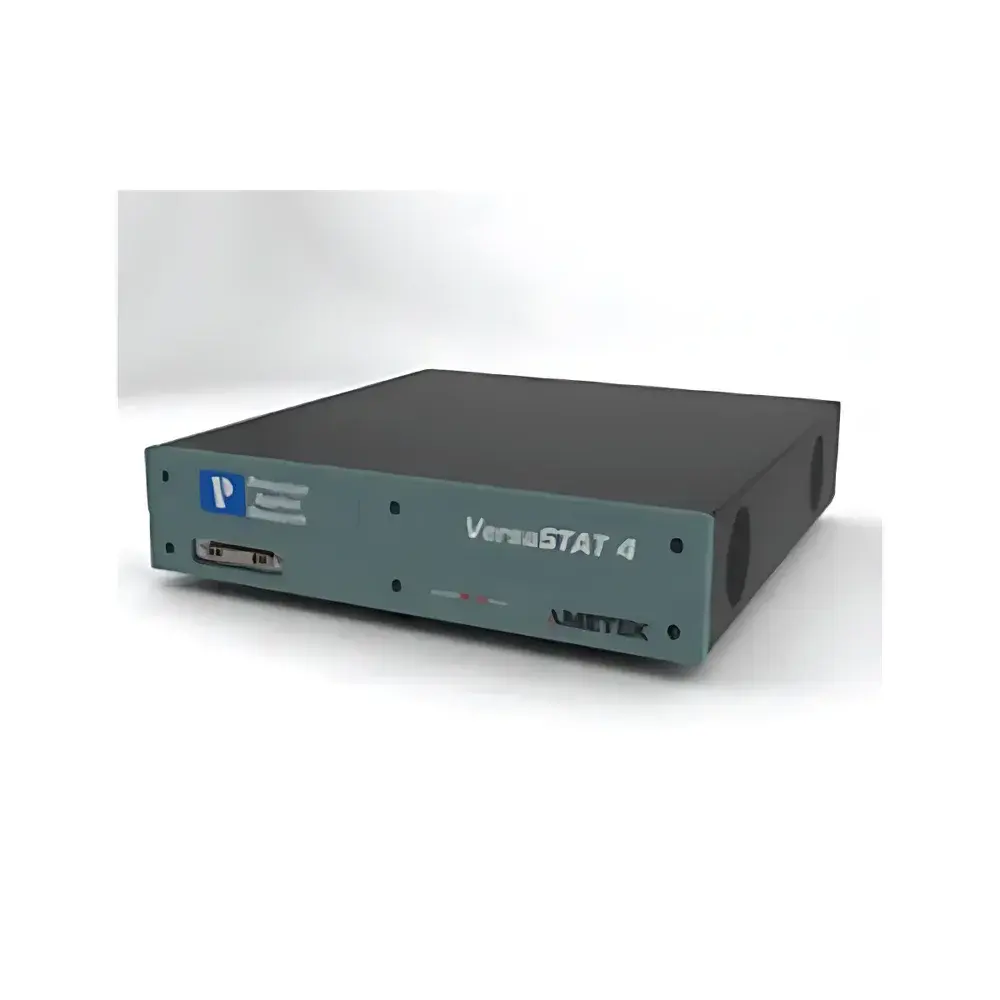
Princeton Applied Research VersaSTAT 3A/4A Multi-Channel Electrochemical Workstation
| Brand | Princeton Applied Research |
|---|---|
| Origin | USA |
| Model | VersaSTAT 3A / VersaSTAT 4A |
| Instrument Type | Potentiostat/Galvanostat |
| Channel Configuration | Single-Channel |
| Current Range | 4 nA – 2 A |
| Current Accuracy | ±0.2% |
| Potential Accuracy | ±0.2% |
| Potentiostatic Range | ±10 V |
| EIS Frequency Range | 10 µHz – 1 MHz |
| Electrode Configurations | 2-, 3-, and 4-electrode with ground connection |
| Data Acquisition | Triple 16-bit ADC (500 kS/s) |
| Time Resolution | 10 µs |
| Potentiostat Bandwidth | 1 MHz |
| Slew Rate | ≥8 V/µs |
| Rise Time (−1.0 V to +1.0 V) | <350 ns |
| Input Impedance | 10¹² Ω |
| Leakage Current | 5 pA |
| CMRR | 60 dB @ 100 kHz |
| IR Compensation | Positive Feedback & Dynamic Compensation |
| Interface | USB 2.0 (Plug-and-Play) |
| Software | VersaStudio Suite (VersaSTAT 300 / 400 editions) |
| Compliance | CE-marked, Designed for GLP/GMP-aligned workflows, Compatible with ASTM G5, G102, G106, ISO 17475, and USP <797> electrochemical validation frameworks |
Overview
The Princeton Applied Research VersaSTAT 3A and VersaSTAT 4A are high-precision, single-channel potentiostat/galvanostat systems engineered for rigorous electrochemical research and industrial quality control. Based on over five decades of instrumentation heritage, these workstations implement a robust analog front-end architecture with triple 16-bit synchronized data acquisition (500 kS/s), enabling high-fidelity transient capture and low-noise impedance measurements across six decades of frequency (10 µHz–1 MHz). The core design adheres to classical three-electrode potentiostatic control principles—utilizing a high-input-impedance differential electrometer (10¹² Ω, 5 pA leakage), fast slew-rate power amplifier (≥8 V/µs), and precision voltage/current feedback loops—to ensure stable polarization under dynamic load conditions. This architecture supports fundamental techniques including cyclic voltammetry, chronoamperometry, linear polarization resistance (LPR), Tafel analysis, and full-spectrum electrochemical impedance spectroscopy (EIS), making the system suitable for corrosion science, battery electrode characterization, sensor development, bioelectrochemistry, and nanomaterial interface studies.
Key Features
- Wide operational range: ±10 V compliance voltage and ±2 A current output (extendable to ±20 A with external booster modules)
- Ultra-low current detection capability: down to 4 nA with 120 fA resolution in the ±200 nA range
- High-accuracy DC performance: ±0.2% accuracy for both potential and current measurements across all ranges
- Integrated frequency response analyzer (FRA) supporting EIS with programmable AC amplitude (0.1 mV–1 V RMS) and phase-sensitive detection
- Real-time automatic noise filtering and adaptive IR compensation (positive feedback + dynamic correction)
- Flexible electrode support: 2-, 3-, and 4-electrode configurations with dedicated ground terminal for stray-current mitigation
- Sub-microsecond timing resolution (10 µs) and <350 ns rise time for rapid pulse and step experiments
- USB 2.0 plug-and-play interface compatible with Windows-based host systems (Windows 10/11 recommended; legacy support for Windows XP/2000)
Sample Compatibility & Compliance
The VersaSTAT 3A/4A accommodates standard electrochemical cells—including flat-cell, rotating disk electrode (RDE), and microelectrode configurations—as well as custom-built corrosion coupons, coated metal substrates, and solid-state battery half-cells. Its grounded 4-electrode mode enables accurate measurement of high-impedance samples (e.g., polymer electrolytes or insulating coatings) while minimizing solution resistance artifacts. The system meets CE regulatory requirements and is routinely deployed in laboratories operating under GLP and GMP frameworks. Its hardware and VersaStudio software architecture support audit-trail generation, user-access controls, and electronic signature capabilities aligned with FDA 21 CFR Part 11 expectations when configured with appropriate IT governance policies. Method validation complies with ASTM standards including G5 (potentiostatic polarization), G102 (electrochemical impedance calculation), G106 (electrochemical critical pitting temperature), and ISO 17475 (corrosion testing of metallic biomaterials).
Software & Data Management
VersaStudio software provides a modular, experiment-driven interface optimized for reproducible method development and cross-platform data exchange. Four tiered editions—VersaSTAT 300 (corrosion-focused), VersaSTAT 400 (full electrochemical suite), plus optional energy-module upgrades—allow scalable deployment based on application scope and budget. Each edition includes pre-validated test sequences (e.g., ASTM-compliant LPR, Tafel extrapolation, multi-frequency EIS), real-time parameter monitoring, and automated report generation with embedded metadata (timestamp, operator ID, instrument serial number, calibration status). Raw data exports to ASCII, CSV, and binary formats; processed results integrate with MATLAB, Python (via .csv/.txt), and commercial modeling tools (e.g., Thales, EC-Lab). All software updates are version-controlled and traceable, supporting laboratory documentation systems compliant with ISO/IEC 17025 clause 7.7.
Applications
- Corrosion science: Quantitative evaluation of inhibitor efficiency, coating defect density, and localized corrosion susceptibility via EIS, LPR, and potentiodynamic polarization
- Energy storage R&D: Half-cell and full-cell cycling of Li-ion, Na-ion, and solid-state battery materials; SEI formation kinetics; charge-transfer resistance mapping
- Biosensor development: Amperometric detection limits, enzyme kinetics (Michaelis-Menten fitting), and redox mediator characterization
- Nanomaterial electrochemistry: Size-dependent electron transfer rates at carbon nanotube or graphene-modified electrodes
- Electroplating process control: Real-time current efficiency monitoring and bath composition stability assessment
- Environmental electroanalysis: Trace heavy metal detection (anodic stripping voltammetry) and redox speciation in aqueous matrices
FAQ
What distinguishes the VersaSTAT 3A from the 4A model?
The VersaSTAT 3A is optimized for corrosion and general electrochemical analysis with integrated FRA functionality. The VersaSTAT 4A adds enhanced current fidelity at ultra-low ranges (sub-nA), extended software licensing for advanced energy applications (e.g., differential capacity analysis), and factory calibration traceability to NIST standards.
Can the system perform simultaneous multi-frequency EIS?
No—EIS is conducted using single-sine or pseudo-random binary sequence (PRBS) excitation per frequency point. However, the 10 µHz–1 MHz sweep range and 500 kS/s sampling enable high-resolution spectra with up to 200 frequency points per decade.
Is external current boosting supported?
Yes—optional high-current booster modules (e.g., HCP-10, HCP-20) extend the current range to ±10 A or ±20 A while maintaining system-level accuracy and synchronization.
Does VersaStudio support automated method sequencing?
Yes—users can define cascaded experiments (e.g., open-circuit potential stabilization → LPR → EIS → cyclic voltammetry) with conditional triggers and inter-step delays.
How is calibration maintained over time?
The system includes internal reference circuits for daily verification; full recalibration is performed annually by authorized service centers using metrologically traceable sources per ISO/IEC 17025 procedures.
Related Products





