
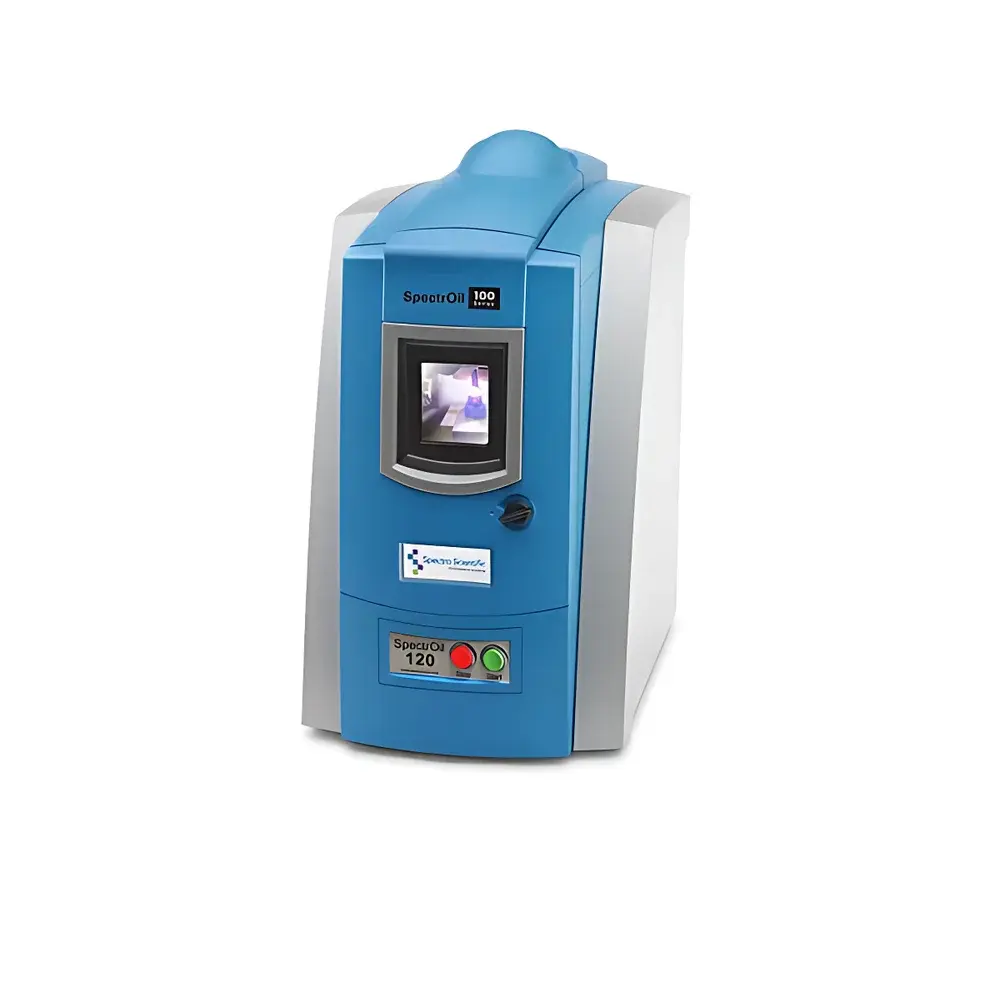
Spectro Scientific SpectrOil 120C Rotating Disc Electrode Atomic Emission Spectrometer
| Brand | Spectro Scientific |
|---|---|
| Origin | USA |
| Manufacturer Type | Original Equipment Manufacturer (OEM) |
| Product Category | Laboratory Instrument |
| Detection Method | Rotating Disc Electrode Atomic Emission Spectrometry (RDE-AES) |
| Compliance | ASTM D6595, ASTM D6728 |
| Dimensions | 66 cm (L) × 40 cm (W) × 74 cm (H) |
| Weight | 75 kg |
| Optical Detection Range | 200–800 nm |
| Detector | 15-Channel CCD Array on Rowland Circle |
| Sample Throughput | One oil sample per 30 seconds |
| Element Coverage | 24 standard elements + 7 optional upgrade elements |
| Power Requirement | Standard AC mains (no auxiliary gases or external peripherals required) |
Overview
The Spectro Scientific SpectrOil 120C is a benchtop rotating disc electrode atomic emission spectrometer (RDE-AES) engineered for rapid, precise elemental analysis of in-service lubricating oils, hydraulic fluids, fuels, and coolants. Leveraging the well-established RDE-AES principle—where a rotating carbon disc electrode atomizes and excites oil-borne elements under controlled arc discharge—the instrument generates characteristic emission spectra resolved by a high-resolution CCD array positioned along a Rowland circle. This optical architecture enables simultaneous multi-element quantification without sequential wavelength scanning, delivering high reproducibility and low detection limits across a broad spectral range (200–800 nm). With over seven decades of heritage in oil analysis instrumentation, the SpectrOil 120C represents a mature, field-proven platform deployed globally in condition monitoring laboratories, OEM service centers, and third-party testing facilities. Its design prioritizes operational robustness, analytical traceability, and seamless integration into predictive maintenance workflows aligned with ISO 55000 and SAE JA1011 frameworks.
Key Features
- Compliance with ASTM D6595 (for lubricants and hydraulic oils) and ASTM D6728 (for diesel fuel), ensuring method-validated results accepted by regulatory and accreditation bodies
- CCD-based dual-layer optical system with 15 discrete spectral channels on a Rowland circle—eliminating photomultiplier tube (PMT) drift and enabling superior signal-to-noise ratio and detection limits
- Direct liquid sampling: no acid digestion, dilution, or solvent extraction required; oil samples introduced via disposable capillary tubes
- 30-second analysis cycle time per sample, supporting high-throughput laboratory environments and real-time field diagnostics
- Compact footprint (66 × 40 × 74 cm) and 75 kg mass enable flexible placement in constrained lab spaces or mobile service vehicles
- Full-element parallel detection: simultaneous quantification of all 24 standard elements—including wear metals (Fe, Cu, Cr, Al, Pb), contaminants (Si, Na, B), and additives (Ca, Zn, P, Mg)—in a single exposure
- Expandable element library: optional 7 additional elements (Bi, As, In, Co, Zr, W, Ce) activated via software license—no hardware modification or recalibration needed
- Zero-gas operation: requires only standard AC power; no argon, nitrogen, or other support gases—reducing consumables cost and infrastructure dependency
- Intelligent standby mode maintains optical alignment and thermal stability, enabling immediate sample analysis without warm-up delays
- Intuitive touchscreen interface with guided workflow—designed for technicians with minimal spectroscopy training while retaining full method configuration access for advanced users
Sample Compatibility & Compliance
The SpectrOil 120C accepts undiluted used engine oils (mineral, synthetic, bio-based), turbine oils, gear oils, hydraulic fluids (including fire-resistant types), diesel and gasoline fuels, and antifreeze/coolant solutions. Sample viscosity range accommodates ISO VG 10 to VG 680 without preheating or dilution. All measurement protocols adhere strictly to ASTM D6595’s procedural requirements—including electrode conditioning, arc stabilization, background correction, and calibration verification using NIST-traceable reference oils. The system supports GLP-compliant data integrity through audit-trail-enabled software (optional 21 CFR Part 11 module available), electronic signatures, and secure user role management. Routine performance qualification (PQ) and periodic verification per ASTM D7418 are facilitated by built-in diagnostics and automated QC checks.
Software & Data Management
Controlled by Spectro’s proprietary OilView™ software, the SpectrOil 120C provides end-to-end data lifecycle management—from acquisition and calibration to trending, alarm generation, and report export. The software includes embedded ASTM D6595-compliant calibration curves, automatic spectral deconvolution for overlapping lines (e.g., Fe II 238.204 nm / Cr I 238.203 nm), and internal standard normalization (e.g., using carbon line intensity). Trending dashboards integrate with CMMS platforms via CSV, XML, or OPC UA interfaces. All raw spectral data, processed results, instrument logs, and user actions are stored in an encrypted SQLite database with configurable retention policies. Optional LIMS connectivity modules support ASTM WK57732-compliant data exchange formats for enterprise-scale deployment.
Applications
- Early-stage wear particle detection in rotating machinery (turbines, compressors, gearboxes) to identify abnormal component degradation before catastrophic failure
- Contaminant ingress monitoring—e.g., silicon from dust ingestion, sodium/potassium from coolant leakage, boron from glycol-based antifreeze
- Additive depletion tracking (Zn, Ca, Mg, P) to assess remaining useful life and optimize oil drain intervals
- Fuel quality assurance: detection of wear metals in diesel fuel indicating pump or injector wear; sulfur and vanadium content verification per ISO 8217
- Root cause analysis in forensic lubrication investigations following equipment failures
- Supporting ISO 4406:2017 particle count correlation studies through complementary elemental fingerprinting
- On-site analysis in remote industrial sites, marine vessels, and wind turbine nacelles where laboratory access is limited
FAQ
Does the SpectrOil 120C require carrier gas or vacuum pumps?
No. It operates exclusively on standard AC power with no compressed gases, vacuum systems, or external cooling required.
Can it analyze non-oil fluids such as coolants or fuels without hardware modification?
Yes. Pre-validated methods for antifreeze, diesel, and gasoline are included; method switching is software-controlled.
How is calibration maintained over time?
Calibration is verified daily using certified reference oils; drift correction is applied automatically using internal carbon line referencing.
Is spectral interference correction handled automatically?
Yes. OilView™ applies multivariate spectral deconvolution and matrix-matched calibration to resolve overlapping emission lines.
What documentation is provided for regulatory audits?
Full IQ/OQ/PQ documentation packages, ASTM compliance certificates, NIST-traceable calibration records, and 21 CFR Part 11 audit logs are available upon request.





