
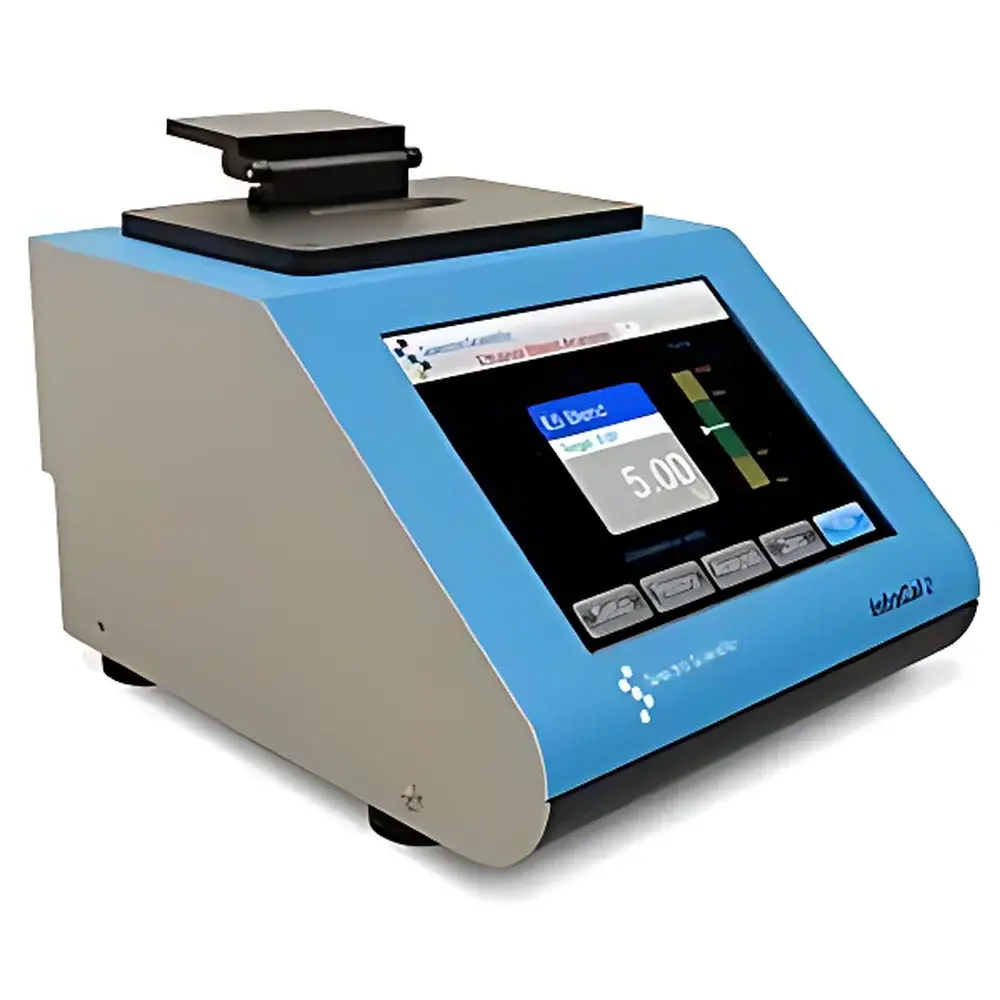
Spectro Scientific InfraCal 2 ATR-E Ethanol-in-Gasoline Analyzer
| Brand | Spectro Scientific |
|---|---|
| Origin | USA |
| Manufacturer Type | Manufacturer |
| Product Category | Imported |
| Model | InfraCal 2 ATR-E |
| Price | Upon Request |
| Measurement Principle | Attenuated Total Reflectance (ATR) Mid-Infrared Spectroscopy at 1045 cm⁻¹ (9.6 µm) |
| Ethanol Range | 0–20% and 70–98% v/v in gasoline |
| Repeatability | ±0.2% (0–20%), ±1.0% (70–98%) |
| Compliance | ASTM D4815 |
| Sample Interface | ATR crystal cell, solvent-free wipe cleaning |
| Display | Touchscreen LCD with multilingual UI (English, Spanish, French, Arabic) |
| Data Storage | Internal non-volatile memory with user, location, date/time stamping |
| Security | Password-protected calibration curves and data |
| Power | Rechargeable Li-ion battery (≥12 h operation), 18 V DC input |
| Dimensions | 17 × 19.8 × 13.2 cm |
| Weight | 2.6 kg (net), 3.2 kg (with battery) |
| Operating Environment | 5–40 °C |
| Analysis Time | <30 s per sample |
| Connectivity | USB 2.0, RS-232 |
| Calibration Options | Single or multi-point factory-certified standards (e.g., 403-1026: 0/5/10/15/20% v/v |
| 403-1027 | 70/80/90/95/100% v/v) |
Overview
The Spectro Scientific InfraCal 2 ATR-E Ethanol-in-Gasoline Analyzer is a field-deployable, mid-infrared (MIR) spectrophotometer engineered for rapid, trace-level quantification of ethanol concentration in gasoline blends. It operates on the principle of Attenuated Total Reflectance (ATR) spectroscopy at a fixed wavenumber of 1045 cm⁻¹ (corresponding to 9.6 µm), where ethanol exhibits strong, characteristic C–O stretching absorption—distinct from hydrocarbon matrix interferences. This targeted spectral interrogation eliminates the need for complex chemometric modeling or full-spectrum deconvolution, delivering robust, interference-resistant results under variable fuel composition and temperature conditions. Designed for regulatory compliance and operational simplicity, the instrument meets the performance criteria specified in ASTM D4815, the standard test method for determination of ethanol in gasolines by gas chromatography—making it suitable for custody transfer verification, blending control, quality assurance, and enforcement testing across fuel terminals, retail dispensing sites, and mobile inspection units.
Key Features
- Fixed-wavelength ATR-MIR detection at 1045 cm⁻¹ ensures high specificity for ethanol without cross-sensitivity to common oxygenates (e.g., MTBE, ETBE) or aromatic compounds.
- Integrated touchscreen interface with intuitive workflow navigation—no software installation or PC dependency required for routine analysis.
- Onboard non-volatile memory stores up to 1,000 test records, each time-stamped and annotated with operator ID, geographic location (manual entry), and batch identifier.
- Rechargeable lithium-ion battery supports ≥12 hours of continuous operation—enabling uninterrupted use during tanker loading, roadside audits, or off-grid laboratory assessments.
- Zero-solvent sample introduction: ATR crystal surface is cleaned in seconds using lint-free tissue—eliminating hazardous waste generation, solvent procurement, and associated disposal documentation.
- Multilingual firmware (English, Spanish, French, Arabic) and password-protected calibration management comply with multiregional deployment requirements and internal data governance policies.
- Compact form factor (17 × 19.8 × 13.2 cm; 2.6 kg net) and ruggedized housing meet MIL-STD-810G shock/vibration specifications for transport in fuel logistics environments.
Sample Compatibility & Compliance
The InfraCal 2 ATR-E is validated exclusively for ethanol-in-gasoline matrices meeting ASTM D439, D4814, or EN 228 specifications. It accommodates conventional gasoline (E0–E10), flex-fuel blends (E15–E25), and high-level ethanol mixtures (E70–E98), with no dilution or pre-treatment required. All measurements are traceable to NIST-traceable reference materials prepared by ISO/IEC 17025-accredited laboratories. The instrument’s measurement uncertainty profile satisfies the repeatability and reproducibility limits defined in ASTM D4815 Section 11.2. For regulated environments subject to GLP or GMP oversight, audit trails—including calibration history, user login events, and result modifications—are retained locally and exportable via USB in CSV format, supporting 21 CFR Part 11-compliant data integrity workflows when paired with validated laboratory information management systems (LIMS).
Software & Data Management
The embedded firmware provides complete standalone functionality: calibration curve selection, sample analysis, real-time result display, and metadata tagging. Raw absorbance values and final ethanol concentrations (reported as % v/v) are stored with ISO 8601-formatted timestamps and configurable operator credentials. Data export occurs via USB mass storage mode—no proprietary drivers required—enabling direct import into Excel, LIMS, or statistical process control (SPC) platforms. Optional RS-232 serial output supports integration with programmable logic controllers (PLCs) in automated blending facilities. Firmware updates are delivered via signed binary files to prevent unauthorized modification, and all calibration parameters reside in write-protected memory sections to ensure analytical continuity between maintenance intervals.
Applications
- Fuel terminal quality control: Real-time verification of ethanol blend ratios prior to pipeline injection or railcar loading.
- Retail forecourt auditing: On-site testing at service stations to confirm label accuracy and detect adulteration or misblending.
- Regulatory enforcement: Field screening by environmental or petroleum agencies conducting compliance inspections under EPA, CARB, or EU Fuel Quality Directive mandates.
- Research & development: Rapid evaluation of novel biofuel formulations during engine testing or stability studies.
- Logistics verification: Cross-checking supplier certificates of analysis (CoA) against actual delivered product composition.
FAQ
Does the InfraCal 2 ATR-E require daily recalibration?
No. Factory-installed calibration curves remain stable for ≥6 months under normal operating conditions. Verification checks using certified reference standards (e.g., 403-1026 or 403-1027) are recommended before each shift or after extended storage.
Can it measure ethanol in diesel or biodiesel blends?
No. The optical design and calibration are specific to gasoline hydrocarbon matrices. Diesel fuel’s higher aromaticity and viscosity produce significant spectral overlap and ATR coupling inefficiency.
Is the instrument compatible with explosion-proof environments?
It is not intrinsically rated. Use in classified hazardous locations requires external containment (e.g., purged enclosures) per NEC Class I, Division 2 guidelines.
What is the minimum sample volume required?
Less than 0.5 mL is sufficient to cover the ATR crystal surface; excess liquid drains freely without affecting measurement integrity.
How is measurement traceability maintained?
Each unit ships with a Certificate of Conformance referencing NIST SRM 2720a and includes lot-specific calibration reports from the manufacturer’s ISO/IEC 17025-accredited metrology lab.




