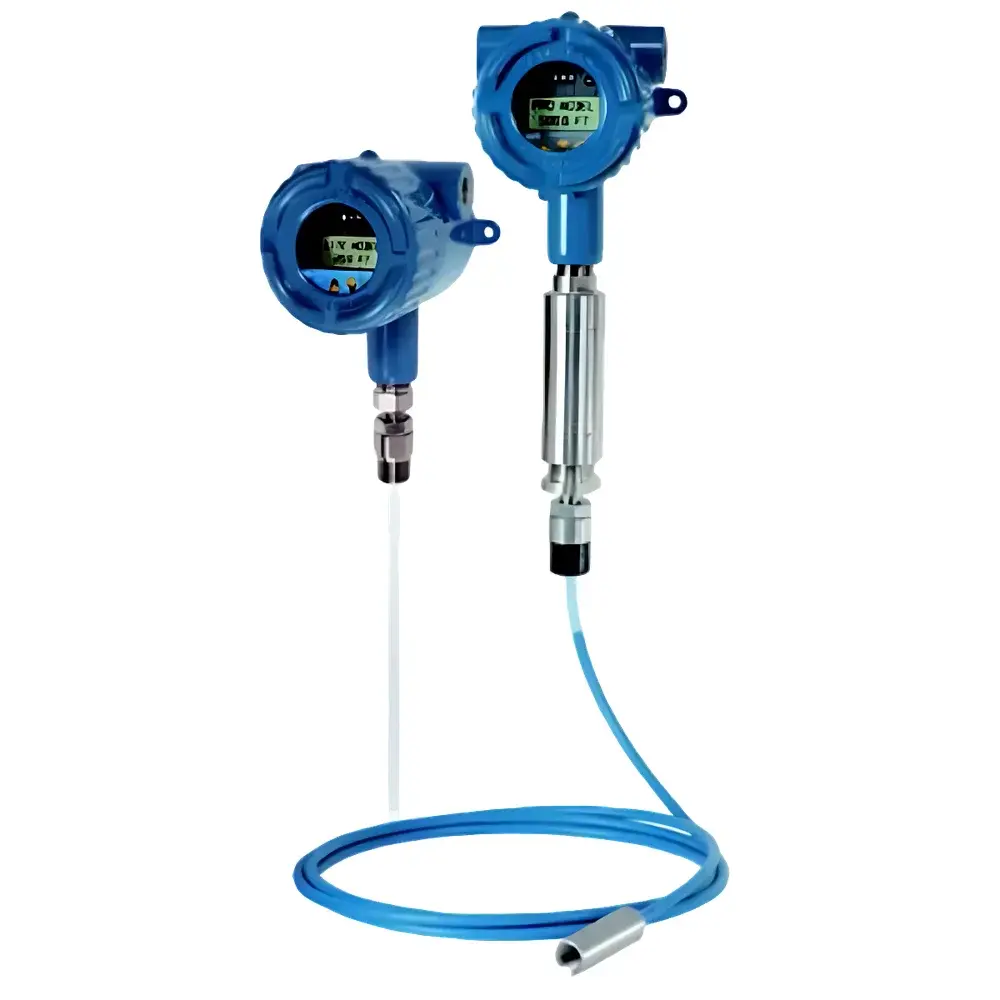
Drexelbrook UV Series RF Admittance Level Transmitter
| Brand | Drexelbrook |
|---|---|
| Origin | Shanghai, China |
| Manufacturer Type | Authorized Distributor |
| Product Category | Domestic |
| Model | UV Series RF Admittance Level Transmitter |
| Product Type | Level Transmitter |
| Output Signal | 4–20 mA + HART |
| Display | Integrated LCD |
| Power Supply | 2-wire loop-powered |
| Accuracy | ±0.25% of span |
| Measurement Range | 25 mm to 244 m (no dead zone) |
| Capacitance Range | Up to 40,000 pF |
| Temperature Rating | –196 °C to 815 °C |
| Pressure Rating | Vacuum to 34.8 MPa |
| Certifications | ATEX, IECEx, CSA, SIL2 (IEC 61508), FM, UL |
| Sensor Options | Over 125 standard and custom probe configurations (rod, cable, coaxial, high-temp/high-pressure variants) |
| Coating Technology | Cote-Shield™ anti-coating / anti-bridging surface treatment |
| Enclosure | IP66/IP67 rated housing |
Overview
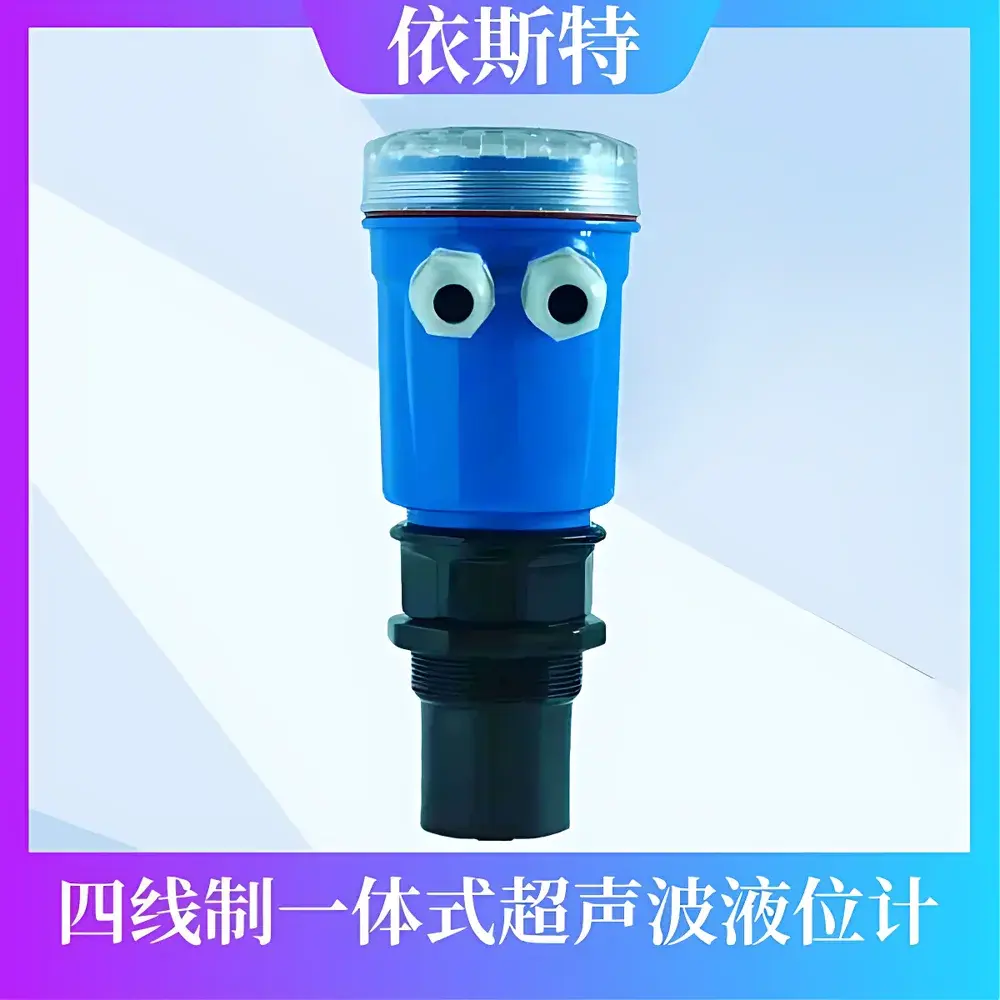
The Drexelbrook UV Series RF Admittance Level Transmitter is an industrial-grade continuous level measurement instrument engineered for reliable, drift-free detection of liquid, slurry, and interface levels in demanding process environments. It operates on the principle of radio-frequency (RF) admittance—measuring the change in capacitance and conductance between a probe and vessel wall (or reference electrode) as material level varies. Unlike basic capacitance transmitters, the UV Series employs a three-terminal sensing architecture that actively compensates for dielectric changes caused by coating, condensation, or temperature drift, enabling stable operation even in highly adhesive, viscous, or abrasive media. Its design eliminates traditional measurement blind zones, supporting applications from shallow sumps (25 mm) to ultra-deep silos (244 m), while maintaining consistent ±0.25% of span accuracy across the full range.
Key Features
- Proprietary Cote-Shield™ probe surface technology minimizes material build-up and prevents false readings due to bridging or coating—validated in cement, polymer, food & beverage, and pharmaceutical wet processing lines.
- True no-blind-zone measurement capability enabled by adaptive signal conditioning and dynamic baseline tracking, eliminating the need for mechanical offsets or software-based zero suppression.
- Wide operational envelope: probes rated for temperatures from cryogenic (–196 °C) to extreme high-temperature service (815 °C) and pressures up to 34.8 MPa (5,050 psi), with vacuum compatibility.
- Comprehensive sensor library—including rod, flexible cable, coaxial, and shielded variants—with over 125 pre-engineered configurations for tank geometry, material dielectric constant (εr = 1.2 to 80+), and process constraints.
- Integrated local LCD display with dual-line backlit interface supports real-time diagnostics, live capacitance/conductance values, and step-by-step guided calibration without external tools.
- 2-wire, loop-powered 4–20 mA output with HART 7 protocol enables seamless integration into DCS, PLC, and asset management systems, including support for device description (DD) and FDI EDD packages.
Sample Compatibility & Compliance
The UV Series is qualified for continuous level monitoring of conductive and non-conductive liquids, emulsions, slurries, powders, and granular solids across chemical, oil & gas, power generation, water/wastewater, and life sciences industries. Its RF admittance architecture inherently accommodates variable dielectric properties and moderate conductivity (up to ~100 mS/cm), making it suitable for interface detection between immiscible layers (e.g., oil/water, solvent/aqueous phases). All units comply with IEC 61508 SIL2 functional safety requirements for use in safety instrumented systems (SIS), and carry global hazardous area certifications including ATEX II 1/2G Ex ia IIC T6 Ga, IECEx ia IIC T6 Ga, FM Class I Div 1 Groups A–D, and UL/cUL Class I Div 1 Groups A–D. Mechanical construction meets NEMA 4X and IP66/IP67 ingress protection standards; wetted materials conform to FDA 21 CFR 177.2600 for food contact where specified.
Software & Data Management
Configuration and diagnostics are performed via HART-compatible handheld communicators (e.g., Rosemount 375/475) or PC-based Drexelbrook SmartConfig™ software. The transmitter supports full bidirectional communication—including parameter read/write, diagnostic logs, firmware updates, and audit trail export. All configuration changes are timestamped and user-identified, satisfying GLP/GMP traceability requirements per 21 CFR Part 11 when used with validated host systems. Built-in self-diagnostics continuously monitor probe integrity, grounding continuity, signal-to-noise ratio, and thermal stability—triggering configurable alarms for maintenance prioritization. Optional Modbus RTU or Foundation Fieldbus H1 interfaces are available via field-replaceable communication modules.
Applications
- Interface level control in API separation vessels and crude desalters
- Continuous inventory monitoring of asphalt, bitumen, and molten sulfur in heated storage tanks
- Slurry level assurance in lime slakers, flue gas desulfurization (FGD) absorbers, and mineral processing thickeners
- High-purity liquid level in USP / compliant pharmaceutical buffer tanks and clean-in-place (CIP) systems
- Low-dielectric hydrocarbon level in LNG transfer arms and cryogenic storage
- Aggressive chemical containment in sulfuric acid, caustic soda, and chlorine service with PTFE- or Hastelloy-clad probes
FAQ
How does RF admittance differ from conventional capacitance level measurement?
RF admittance adds conductance measurement and guard electrode compensation to standard capacitance sensing, enabling rejection of coating effects and improved signal stability in conductive or high-dielectric media.
Can the UV Series measure interface levels between two liquids?
Yes—when installed with a coaxial or dual-probe configuration and calibrated for the specific dielectric contrast between upper and lower phases, it provides accurate interface detection with resolution down to ±10 mm.
Is remote calibration supported without physical access to the transmitter?
Yes—HART-enabled devices allow full calibration, ranging, and verification remotely via DCS or asset management platforms using standard HART commands.
What maintenance is required for long-term reliability?
The Cote-Shield™ probe requires no routine cleaning under normal operating conditions; periodic verification of grounding integrity and loop current is recommended annually per IEC 61511 inspection schedules.
Are explosion-proof models available for Zone 0/20 environments?
Yes—intrinsically safe (ia) variants certified for Zone 0 (gas) and Zone 20 (dust) are part of the UV Series portfolio, with documentation aligned to IEC 60079-0 and IEC 60079-11.