
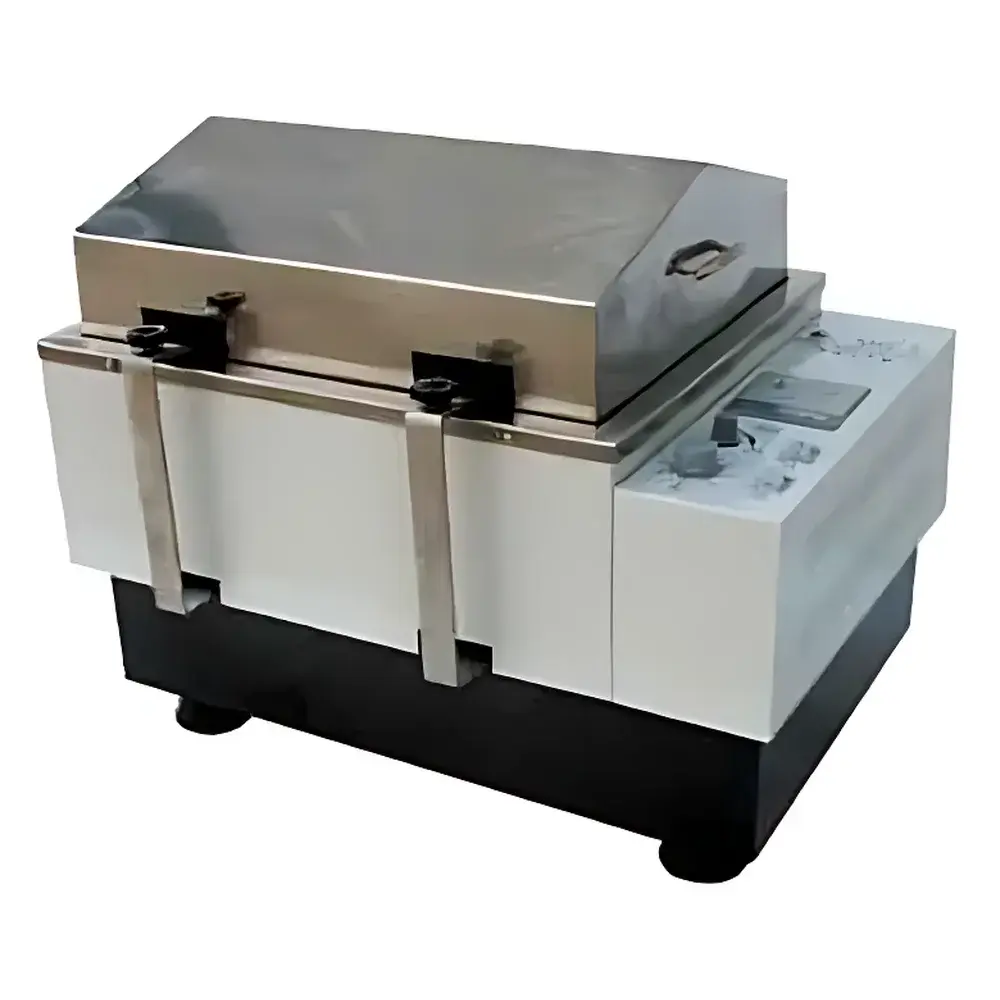
Ultrasonic Constant-Temperature Water Bath Shaker CSTHZ-82
| Origin | Jiangsu, China |
|---|---|
| Manufacturer Type | Authorized Distributor |
| Model | CSTHZ-82 |
| Price | USD 3,900 (FOB Jiangsu) |
| Temperature Control Range | RT–100 °C (digital display) |
| Oscillation Amplitude | 20 mm |
| Speed Control | Digital Display |
| Ultrasonic Frequency | 40 kHz |
Overview
The CSTHZ-82 Ultrasonic Constant-Temperature Water Bath Shaker is an integrated laboratory instrument engineered for simultaneous temperature-controlled incubation, mechanical oscillation, and high-frequency ultrasonic energy delivery. It operates on the principle of piezoelectric transduction to generate cavitation in aqueous media at a fixed frequency of 40 kHz—enabling efficient microbubble formation, collapse, and localized energy release. This synergistic combination supports applications requiring precise thermal regulation (RT to 100 °C), uniform agitation (via horizontal orbital shaking with 20 mm amplitude), and non-contact acoustic energy transfer—making it suitable for cell suspension homogenization, enzymatic reaction acceleration, nanoparticle dispersion, solvent extraction, and gentle sample cleaning without mechanical abrasion.
Key Features
- Digitally controlled PID temperature system with ±0.5 °C accuracy across the full 20–100 °C operating range (ambient start-up to maximum setpoint); real-time digital display ensures traceable setpoint verification.
- Adjustable orbital oscillation speed from 30 to 250 rpm, independently controllable from temperature and ultrasonic modules; motor-driven mechanism delivers consistent 20 mm amplitude with low vibration transmission to adjacent equipment.
- Integrated 40 kHz ultrasonic generator with stainless-steel transducer array mounted directly beneath the water bath chamber—optimized for uniform energy distribution and minimal standing-wave interference.
- Stainless-steel inner tank (304 grade) with reinforced silicone-sealed lid and overflow protection; external housing constructed from powder-coated cold-rolled steel for chemical resistance and structural rigidity.
- Programmable timer (1–999 minutes) supporting sequential operation modes: ultrasonic-only, oscillation-only, temperature-only, or full multimodal activation with independent start/stop control per function.
Sample Compatibility & Compliance
The CSTHZ-82 accommodates standard laboratory vessels including Erlenmeyer flasks (up to 2 L), beakers, centrifuge tubes, and custom sample racks (max. load: 5 kg). Its water bath design ensures indirect heating—eliminating direct contact between heating elements and samples—thereby minimizing thermal shock and enabling compatibility with temperature-sensitive biological reagents, polymer solutions, and volatile organic solvents. The unit conforms to IEC 61010-1:2010 for electrical safety in laboratory environments and incorporates overtemperature cutoff, dry-run protection, and current-limiting circuitry. While not certified for ISO 13485 or FDA 21 CFR Part 11 out-of-the-box, its digital logging capability (via optional RS-232/USB interface) supports GLP-compliant data recording when paired with validated third-party software for audit trail generation.
Software & Data Management
The CSTHZ-82 features embedded firmware with local parameter storage (up to 10 user-defined protocols), each retaining temperature setpoint, oscillation speed, ultrasonic duty cycle (continuous or pulsed mode), and timer duration. Optional communication modules enable serial or USB connection to Windows-based PCs for remote monitoring, real-time data export (.csv), and protocol synchronization across multiple units. When integrated into a validated laboratory information management system (LIMS), the device supports electronic record retention aligned with ALCOA+ principles—ensuring attributable, legible, contemporaneous, original, and accurate data capture for QC/QA workflows.
Applications
- Biological sample preparation: lysate clarification, DNA/RNA shearing optimization, antibody conjugation support, and microbial suspension resuspension.
- Chemical synthesis: catalyst dispersion in heterogeneous reactions, crystallization nucleation control, and solvent-assisted exfoliation of 2D materials.
- Quality control testing: cleaning validation for glassware and stainless-steel components per ASTM D4788-21; residue removal verification prior to HPLC or ICP-MS analysis.
- Pharmaceutical development: dissolution profile enhancement for poorly soluble APIs, excipient wetting studies, and stability-indicating assay preparation.
- Environmental testing: extraction of PAHs, PCBs, and heavy metals from soil/sediment matrices using EPA Method 3550C-compatible protocols.
FAQ
What is the maximum recommended water level for stable ultrasonic performance?
The bath must be filled to between 30 mm and 80 mm above the transducer surface (minimum 1.5 L, maximum 5.0 L) to ensure optimal acoustic coupling and prevent transducer overheating.
Can the CSTHZ-82 operate continuously for extended periods (e.g., 24 h)?
Yes—provided ambient temperature remains below 30 °C and ventilation clearance (≥10 cm on all sides) is maintained; continuous operation beyond 8 h requires periodic visual inspection of water level and bath clarity.
Is calibration documentation available for metrological traceability?
Factory calibration certificates (temperature, time, and speed) are provided with each unit; users may perform field verification using NIST-traceable thermistors, tachometers, and stopwatch measurements per internal SOPs.
Does the unit support external temperature probe input for sample-specific monitoring?
No—the CSTHZ-82 regulates bath temperature only; however, third-party PT100 probes can be immersed alongside samples and logged externally via compatible DAQ systems.
What maintenance intervals are recommended for long-term reliability?
Ultrasonic transducer performance should be verified quarterly using aluminum foil erosion test (ASTM E1777-19); water bath fluid must be replaced weekly when used with organic solvents or biologically active samples to prevent biofilm formation or residue accumulation.



