
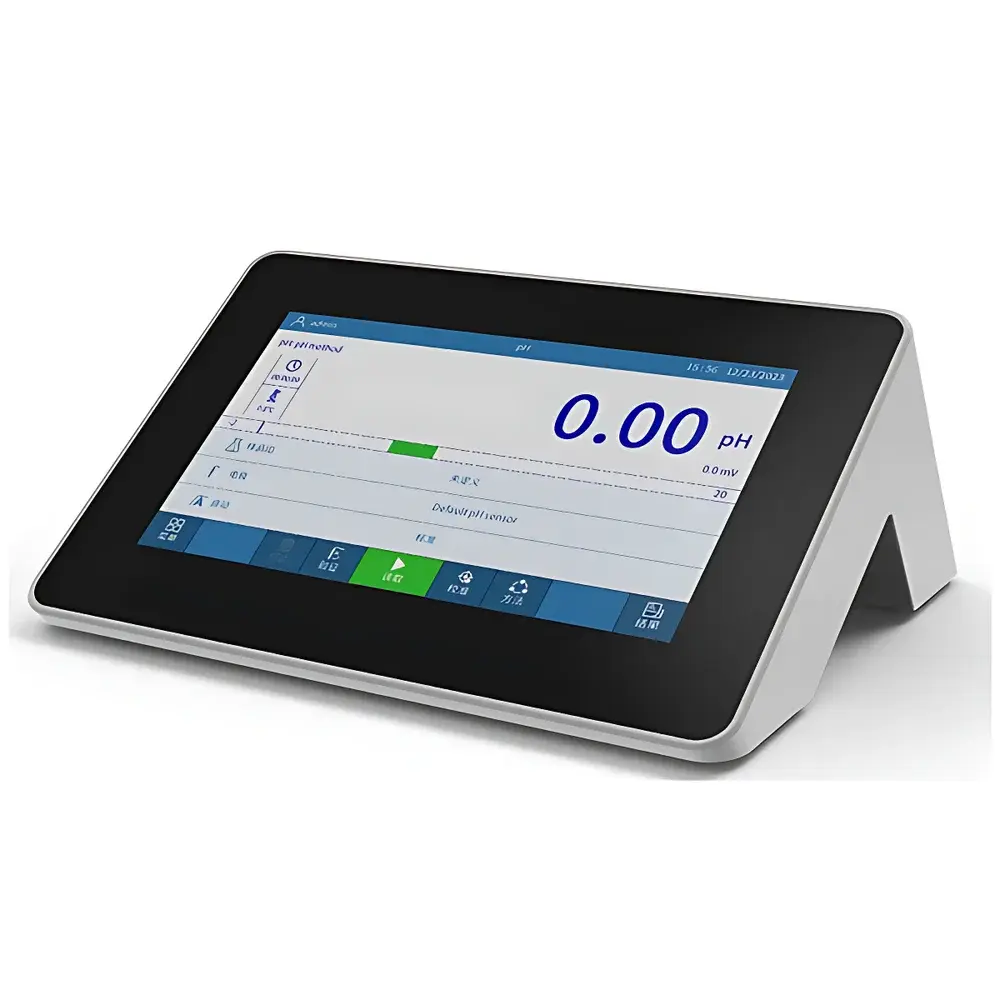
Luban Instruments M907 Multi-Ion Analyzer
| Brand | Yoke |
|---|---|
| Origin | Shanghai, China |
| Manufacturer Type | Direct Manufacturer |
| Instrument Category | Domestic (China) |
| Model | M907 |
| Instrument Type | Benchtop |
| Ion Capability | Multi-ion |
| Pricing | Upon Request |
| IP Rating | IP54 |
| Display | 7-inch Color Touchscreen |
| Accuracy Class | 0.01 Grade |
| pH/pX Range | −2.00 to 20.00 |
| mV Range | −1999.9 to +1999.9 mV |
| pH/pX Resolution | 0.01 / 0.1 |
| mV Resolution | 0.1 mV |
| Temperature Compensation | Integrated High-Stability Temperature Electrode (Auto-Recognition & Manual Input) |
| Endpoint Detection | Configurable Stability Criteria |
| Measurement Modes | Direct Concentration, Standard Addition, Sample Addition, Gran Plot |
| Units | mg/L, g/L, mol/L, pX |
| Calibration Logging | Automatic Electrode History & Expiry Alert |
| GLP Compliance | Full Audit Trail, User ID, Timestamp, Method Storage |
| Connectivity | USB Host (U-disk), RS232/USB-C for Printer & PC Sync |
| Stirring | Built-in Magnetic Stirrer |
| Enclosure Protection | IP54 (Dust & Splash Resistant) |
Overview
The Luban Instruments M907 Multi-Ion Analyzer is a benchtop potentiometric measurement system engineered for high-reproducibility quantification of multiple ionic species in aqueous environmental and industrial water samples. Based on the Nernst equation principle, the instrument measures equilibrium potential differences between ion-selective electrodes (ISEs) and a reference electrode under controlled temperature conditions. Its architecture integrates precision analog signal conditioning, real-time temperature compensation via a dedicated high-stability thermistor electrode, and adaptive endpoint detection algorithms—enabling robust determination of activity-based concentrations for H⁺, Ag⁺, Na⁺, K⁺, NH₄⁺, Cl⁻, F⁻, and other common ions. Designed for compliance-critical laboratories, the M907 meets fundamental requirements for method traceability, data integrity, and operational transparency in routine water quality monitoring per ISO 17025–accredited workflows.
Key Features
- 7-inch full-color capacitive touchscreen interface with intuitive workflow navigation—guiding users stepwise through calibration, verification, and sample analysis without procedural ambiguity.
- Integrated magnetic stirrer with adjustable speed control ensures homogeneous sample mixing during ISE measurements, minimizing diffusion layer effects and improving response time reproducibility.
- Automatic electrode lifecycle management: logs calibration history, validates electrode performance against user-defined criteria, and triggers visual/audible alerts when electrode response falls outside specified stability or slope thresholds.
- Selectable measurement resolution: pH/pX at 0.001/0.01/0.1 units; mV at 0.01/0.1/1 mV—configurable per application sensitivity requirements.
- Multi-mode quantitative analysis: direct concentration readout, single/multi-point standard addition, sample addition, and Gran plot titration—supporting both regulatory-compliant and research-grade protocols.
- IP54-rated enclosure provides protection against dust ingress and incidental water splashes—suitable for shared laboratory environments with variable ambient conditions.
Sample Compatibility & Compliance
The M907 supports analysis of potable water, wastewater effluents, surface water, groundwater, and industrial process streams across pH 2–12 and conductivity ranges typical of municipal and environmental testing labs. It accommodates standard combination pH electrodes, solid-state and liquid-membrane ISEs, and refillable reference electrodes compliant with ASTM D1293 (pH of water) and ISO 10523 (water quality — determination of pH). All calibration and measurement records include mandatory metadata: operator ID, timestamp, electrode serial number, temperature, and ambient humidity (if externally logged). Data storage adheres to GLP principles—including immutable audit trails, electronic signatures (via password-protected user accounts), and automatic backup to USB mass storage devices.
Software & Data Management
Data handling conforms to core elements of FDA 21 CFR Part 11—specifically electronic record retention, user authentication, and change control. The internal database stores ≥10,000 measurement records with full contextual metadata. Export options include CSV (for LIMS integration), PDF reports (with embedded calibration certificates), and direct printing via RS232 or USB-connected thermal printers. Users may define, save, and recall complete analytical methods—including electrode selection, temperature compensation model, endpoint criteria, unit preferences, and report templates—reducing setup variability between analysts and shifts. Firmware updates are delivered via encrypted USB firmware packages, maintaining system validation status.
Applications
- Regulatory compliance testing for drinking water (e.g., fluoride, nitrate, ammonium per WHO/EPA guidelines)
- Wastewater discharge monitoring (Cl⁻, NH₄⁺, F⁻) under national effluent standards
- Industrial cooling water chemistry control (Na⁺, K⁺, Ag⁺ in biocide formulations)
- Soil leachate and groundwater plume characterization in environmental site assessments
- Educational laboratories requiring modular, expandable ion analysis platforms with pedagogical interface design
FAQ
Does the M907 support GLP-compliant data archiving?
Yes—it maintains full audit trails including operator ID, calibration timestamps, electrode identification, and method version history, all stored in non-erasable memory.
Can custom ISEs be used with this analyzer?
Yes—the instrument accepts third-party ion-selective electrodes with standard BNC or DIN connectors, provided they operate within the input impedance and voltage range specifications (≥10¹² Ω, ±2000 mV).
Is temperature compensation mandatory during ion measurements?
Temperature compensation is strongly recommended and enabled by default; however, manual temperature entry is supported for applications where external probes cannot be immersed.
How does the Gran plot function assist in low-concentration fluoride analysis?
The built-in Gran transformation algorithm linearizes titration curves near the endpoint, improving precision for sub-mg/L F⁻ determinations using lanthanum fluoride electrodes—particularly in high-ionic-strength matrices.
What maintenance intervals are recommended for long-term accuracy?
Electrode calibration verification is advised before each analytical batch; reference electrolyte refills every 30 days; and full system performance verification (using NIST-traceable buffers and ionic standards) every 90 days or per internal QA schedule.
Related Products







