
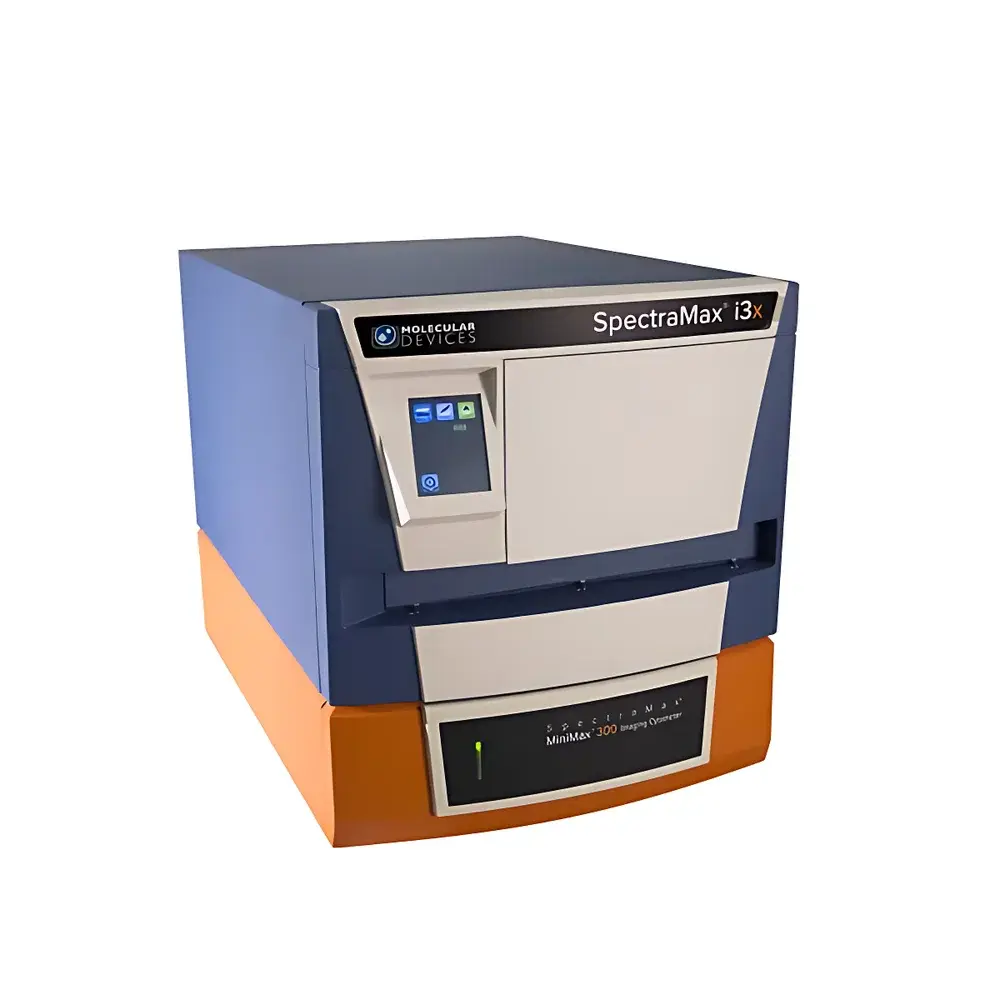
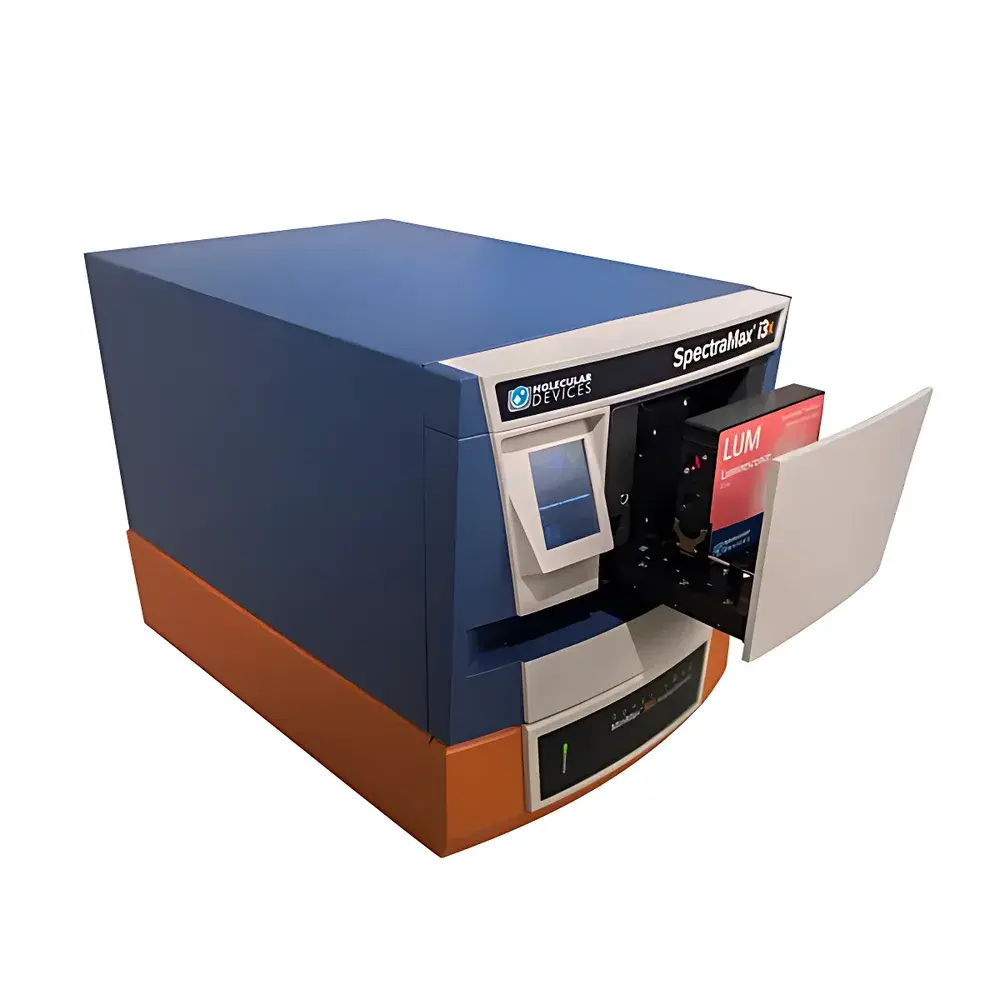
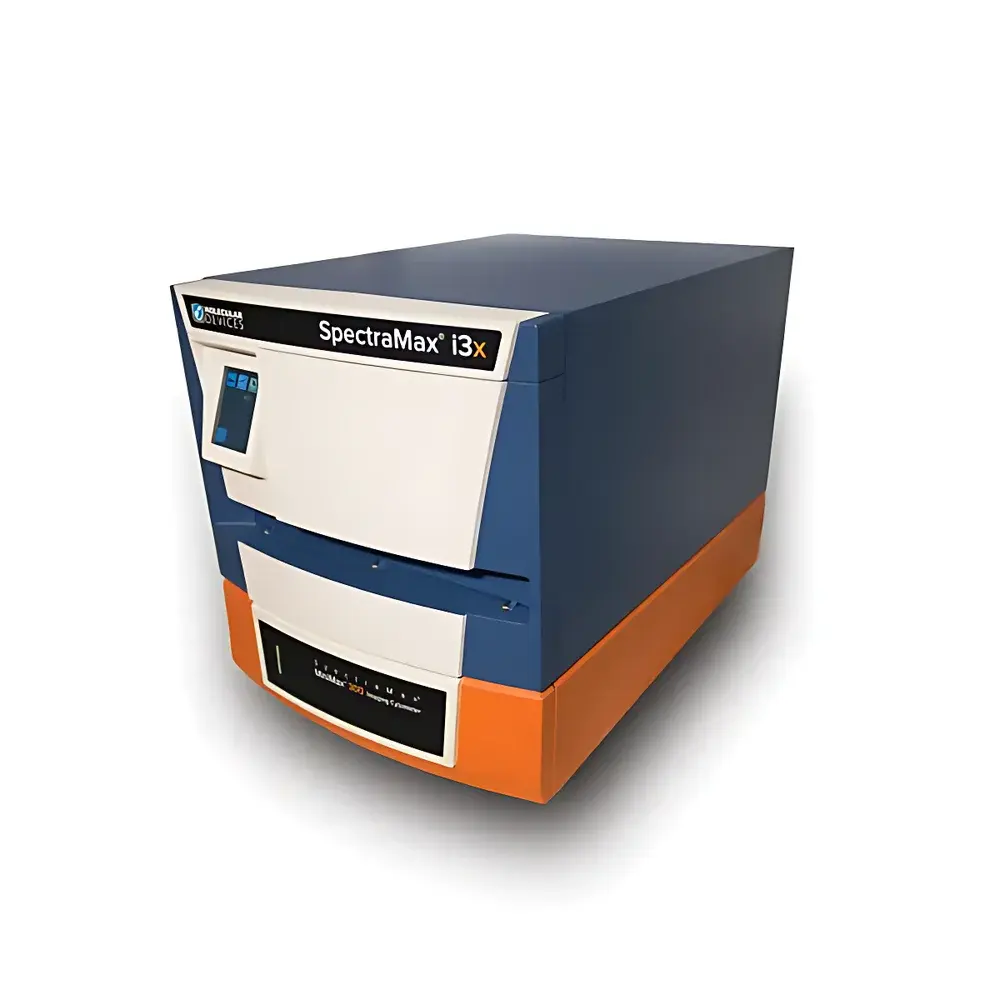
Molecular Devices SpectraMax i3x Multimode Microplate Reader
| Brand | Molecular Devices |
|---|---|
| Origin | Austria |
| Manufacturer Type | Original Equipment Manufacturer (OEM) |
| Origin Category | Imported Instrument |
| Model | SpectraMax i3x |
| Functionality | Multimode |
| Automation Level | Fully Automated |
| Assay Modes | Endpoint, Kinetic, Scanning |
| Curve Fitting | SoftMax Pro Software |
| Detector Types | Photomultiplier Tube (PMT) and Photodiode |
| Wavelength Ranges | Absorbance 230–1000 nm |
| Absorbance Range | 230–1000 nm |
| Absorbance Linearity | 0–2.0 OD |
| Optical Density Accuracy | ±0.010 OD (±1.0% from 0 to 2 OD) |
| Precision | <0.01 OD |
Overview
The Molecular Devices SpectraMax i3x Multimode Microplate Reader is a modular, future-ready detection platform engineered for precision, scalability, and regulatory compliance in academic, pharmaceutical, and clinical research laboratories. Built upon a robust optical architecture, it integrates multiple detection modalities—including absorbance (UV-Vis), fluorescence intensity (FI), fluorescence resonance energy transfer (FRET), time-resolved fluorescence (TRF), fluorescence polarization (FP), AlphaScreen/AlphaLISA, and luminescence—within a single instrument chassis. Its core measurement principles include photometric quantification via dual-beam referencing for absorbance, photon counting with thermoelectrically cooled PMT for low-noise fluorescence and luminescence detection, and spectral scanning using a monochromator-based excitation/emission system. The platform supports live-cell imaging when equipped with the optional MiniMax 300 Imaging System, enabling label-free and fluorescent morphological analysis alongside plate-based assays—making it uniquely suited for integrated phenotypic and biochemical profiling.
Key Features
- Modular Expandability: Patented cartridge-based design allows field-upgradable functionality—users install new detection modules (e.g., TRF, HTRF, AlphaScreen, or Western blot imaging) in under five minutes without service intervention or instrument return.
- Spectra Fusion Illumination: Intelligent light source switching between high-energy xenon flash lamp and tunable Auto-LEDs ensures optimal excitation across UV to NIR spectra, enhancing signal-to-noise ratio and dynamic range.
- Cryogenically Cooled PMT: Thermoelectric cooling to –20 °C reduces dark current noise, enabling reliable detection of low-abundance analytes in high-sensitivity assays such as luciferase reporter gene assays or ATP quantification.
- Z-Focusing Technology: Real-time top-read auto-focusing adjusts detection height per well to maintain optimal focal plane at the liquid surface—critical for reproducible kinetics and suspension-based cell assays.
- Smart Inject System: Integrated dual-injector module with 10 µL dead volume, programmable delay timing, and overflow protection enables precise reagent addition for flash-type luminescent assays (e.g., Dual-Luciferase®) and rapid kinetic measurements.
- Live-Cell Imaging Integration: Compatible with MiniMax 300 Imaging System featuring 4× objective, white-light transmittance, and dual-channel fluorescence (FITC/TRITC), supporting real-time monitoring of cell confluence, viability, protein expression, and cytotoxicity without plate transfer.
Sample Compatibility & Compliance
The SpectraMax i3x accommodates standard microplate formats (6–1536-well), including clear, black, white, and opaque-bottom plates, as well as specialized assay plates for AlphaScreen, TR-FRET, and cell culture applications. It complies with ISO/IEC 17025 calibration traceability requirements and supports audit-ready operation under GLP and GMP environments. SoftMax Pro software includes full 21 CFR Part 11 compliance features—including electronic signatures, user access controls, audit trails, and secure data archiving—ensuring data integrity for regulated workflows in drug discovery and diagnostic development.
Software & Data Management
Controlled exclusively by SoftMax Pro 7 software, the SpectraMax i3x provides unified acquisition, analysis, and reporting across all detection modes. The software offers built-in protocols for ELISA, BCA, Bradford, PicoGreen®, Dual-Luciferase®, and HTRF® assays, along with customizable curve-fitting algorithms (linear, quadratic, 4-/5-parameter logistic). Raw data export supports CSV, XML, and SDMX formats; integration with LIMS and ELN systems is enabled via ODBC and RESTful API interfaces. All instrument logs—including hardware diagnostics, calibration history, and user activity—are timestamped and cryptographically signed for regulatory review.
Applications
The platform supports broad application coverage across life science domains: nucleic acid and protein quantification (A260/A280); immunoassays (ELISA, CLIA); enzymatic activity profiling (kinase, protease, phosphatase); receptor-ligand binding (FP, TR-FRET); cellular functional assays (Ca²⁺ flux, ROS generation, mitochondrial membrane potential); reporter gene screening (luciferase, GFP); ADME/Tox profiling (CYP inhibition, hERG binding); biomarker validation (cytokines, cardiac troponins); epigenetic analysis (histone modification, DNA methylation); and quantitative Western blot densitometry. Its imaging capability extends utility into high-content screening (HCS)-adjacent workflows, including proliferation kinetics, apoptosis staging, and subcellular localization studies.
FAQ
Is the SpectraMax i3x compliant with FDA 21 CFR Part 11?
Yes—SoftMax Pro 7 implements role-based authentication, electronic signatures, immutable audit trails, and data encryption to meet Part 11 requirements for electronic records and signatures.
Can I perform time-resolved fluorescence assays without purchasing a separate instrument?
Yes—the i3x supports TRF and HTRF via optional TRF cartridge; no external hardware or software add-ons are required.
What is the minimum detectable concentration for luciferase assays?
Using the cooled PMT and Smart Inject system, typical detection limits reach ≤10 attomoles of firefly luciferase in 96-well format under optimized conditions.
Does the instrument support kinetic measurements with temperature control?
Yes—it integrates with an optional environmental control chamber (ECC) providing precise incubation from ambient +4 °C to 45 °C with humidity regulation for extended live-cell kinetic assays.
How does the Z-focusing feature improve assay reproducibility?
By dynamically adjusting the focal plane to the meniscus level in each well, Z-focusing eliminates variability caused by inconsistent sample volume or meniscus curvature—particularly critical for low-volume assays and suspension cultures.
Related Products




