
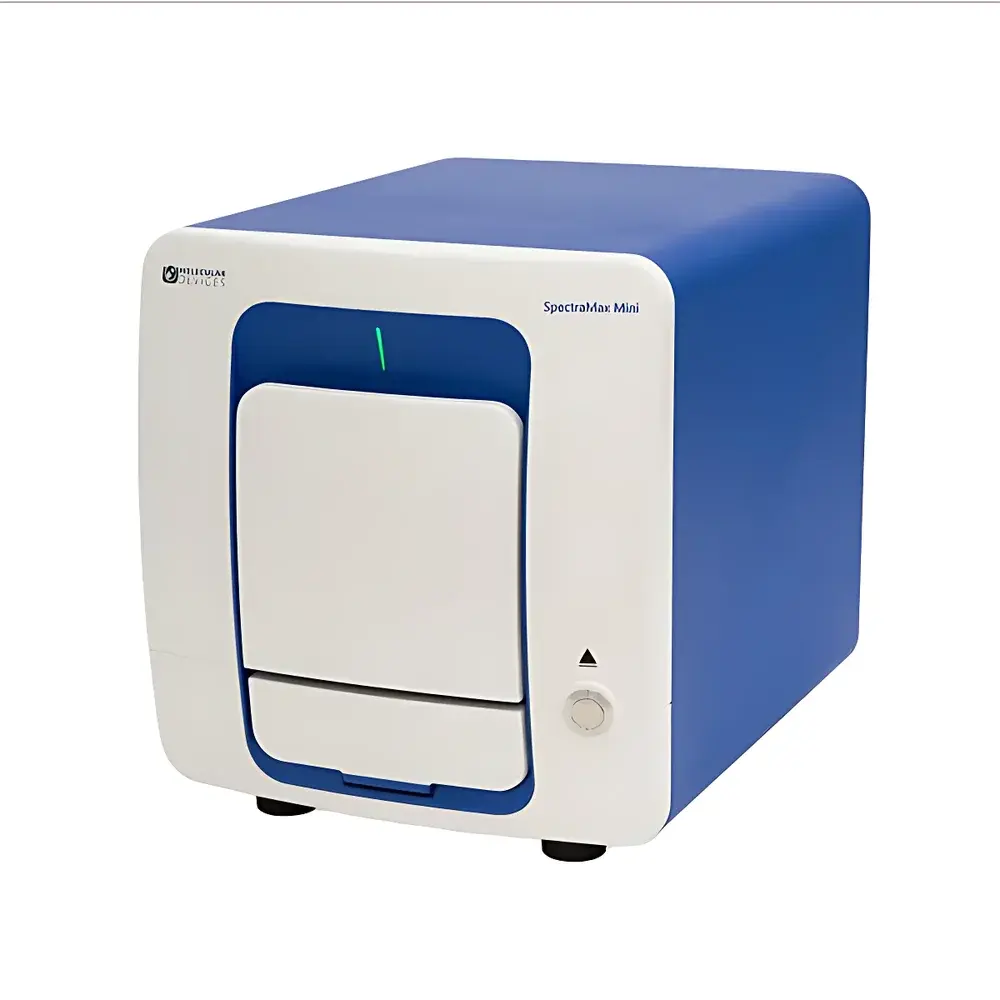
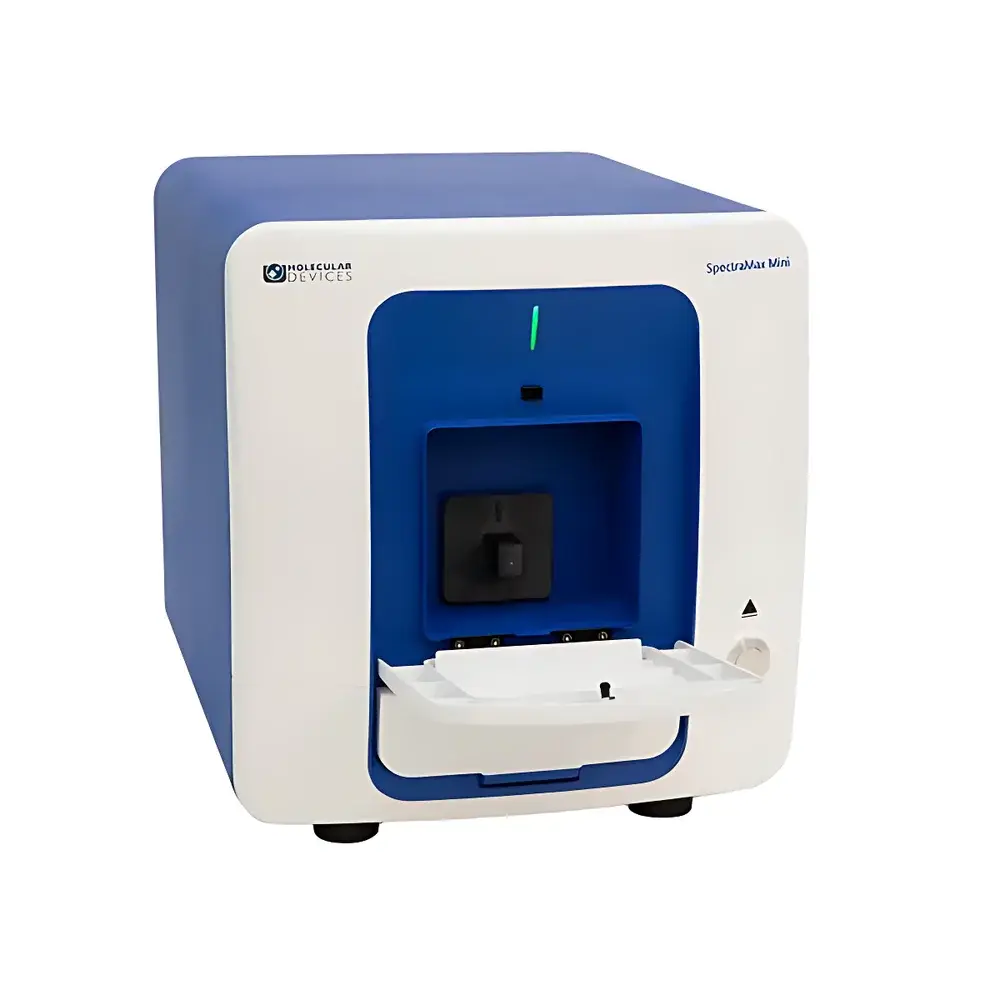
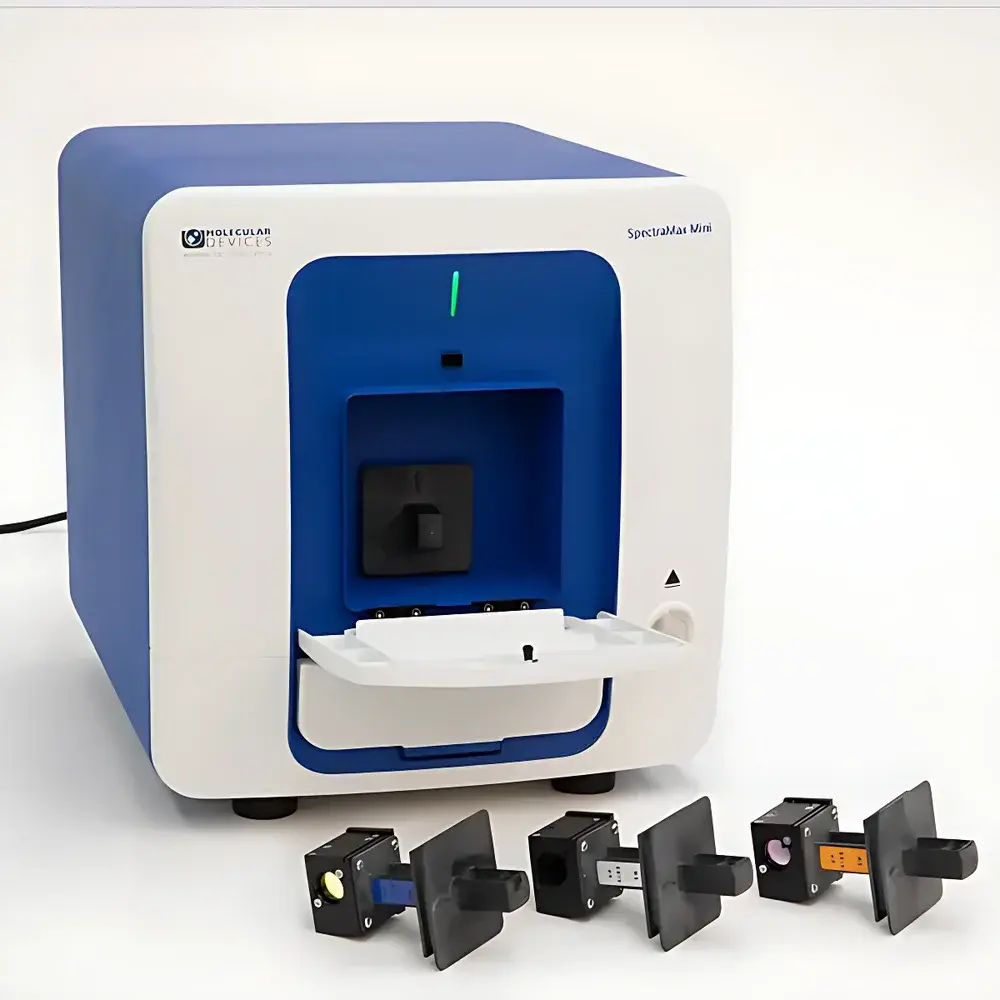
Molecular Devices SpectraMax Mini Multimode Microplate Reader
| Brand | Molecular Devices |
|---|---|
| Origin | Shanghai, China |
| Manufacturer Type | Original Equipment Manufacturer (OEM) |
| Product Origin | Domestic (China) |
| Model | SpectraMax Mini |
| Functionality | Multimode |
| Automation Level | Fully Automated Microplate Reader |
| Assay Modes | Endpoint, Kinetic, Spectral Scanning |
| Curve Fitting Options | Linear, 4-Parameter Logistic (4PL), 5-Parameter Logistic (5PL) |
| Detector | Thermoelectrically Cooled Photomultiplier Tube (PMT) at –5°C and Silicon Photodiode |
| Wavelength Range | 200–1000 nm |
| Absorbance Range | 0–4 OD |
| Absorbance Linearity | ±2 nm |
| Wavelength Scan Speed | >1 well/sec |
| Absorbance Accuracy | < ±0.003 OD ±1.0% (0–3 OD) |
Overview
The Molecular Devices SpectraMax Mini Multimode Microplate Reader is an engineered solution for laboratories requiring robust, reproducible, and flexible detection capabilities across absorbance, fluorescence, and luminescence modalities — all within a compact, benchtop footprint. Built upon Molecular Devices’ legacy of precision optical design and microplate instrumentation architecture, the SpectraMax Mini employs dual-detection technology: a thermoelectrically cooled photomultiplier tube (PMT) operating at –5°C for high-sensitivity luminescence and low-level fluorescence measurements, and a silicon photodiode optimized for broad-range absorbance quantification. Its monochromator-based optical system delivers continuous wavelength selection from 200 to 1000 nm with <±2 nm wavelength accuracy, enabling spectral scanning without filter exchange. Designed for compliance-ready workflows, the instrument supports GLP- and GMP-aligned data integrity practices when used with validated SoftMax Pro software configurations.
Key Features
- Fully automated multimode detection in a single platform: absorbance (200–1000 nm), top- and bottom-read fluorescence (with optional filters), and luminescence (including flash and glow assays)
- Modular upgrade path: users may expand from 2-mode (absorbance + fluorescence) to full 3-mode (adding luminescence) via licensed software activation and hardware enablement — no physical retrofit required
- Precise temperature control (ambient to 45°C) with uniform plate heating and real-time monitoring, critical for kinetic ELISA, cell-based assays, and enzyme activity profiling
- High-fidelity absorbance performance: accuracy <±0.003 OD ±1.0% over 0–3 OD range; linearity maintained up to 4 OD
- Compact, space-efficient chassis (W × D × H: 32.5 × 44.5 × 24.5 cm) designed for shared lab environments and core facilities with limited bench space
- Integrated barcode reader support (optional) for sample traceability and LIMS interoperability
Sample Compatibility & Compliance
The SpectraMax Mini accommodates standard microplate formats from 6- to 384-well, including clear, white, black, and specialized assay plates (e.g., tissue-culture treated, low-fluorescence, UV-transparent). It meets mechanical and electrical safety requirements per IEC 61010-1 and electromagnetic compatibility standards (EN 61326-1). When deployed with SoftMax Pro 7.1 or later under documented validation protocols, the system supports regulatory compliance frameworks including FDA 21 CFR Part 11 (electronic signatures, audit trails), ISO/IEC 17025 (testing laboratories), and USP (analytical instrument qualification). Routine operation adheres to ASTM E2597 (standard practice for microplate reader performance verification) and CLSI EP17-A2 (evaluation of detection limits).
Software & Data Management
SoftMax Pro software serves as the native acquisition and analysis engine, preconfigured with validated templates for ELISA, BCA/Lowry protein assays, DNA quantification (A260/A280), MTT/XTT cell viability, luciferase reporter gene expression, and caspase activity kinetics. All data files are saved in proprietary .smx format with embedded metadata (user, timestamp, protocol ID, instrument serial number, calibration history). Export options include CSV, Excel (.xlsx), PDF reports, and XML for integration with enterprise LIMS or ELN systems. Audit trail functionality records every parameter change, data modification, and user login event — configurable to meet ALCOA+ principles (Attributable, Legible, Contemporaneous, Original, Accurate, Complete, Consistent, Enduring, Available).
Applications
- Quantitative immunoassays (ELISA, multiplexed sandwich assays) requiring high dynamic range and low intra-assay CV
- Nucleic acid and protein concentration determination using A260, A280, or dye-binding methods (e.g., Qubit, NanoDrop-compatible workflows)
- Cell health and cytotoxicity assessment via metabolic dyes (resazurin, MTT), membrane integrity markers (LDH), or ATP bioluminescence
- Kinetic enzyme characterization (e.g., kinase, phosphatase, protease activity) with programmable interval acquisition and real-time curve fitting
- Reporter gene assays (firefly, Renilla luciferase) with dual-injection capability and coelenterazine compatibility
- Spectral scanning for compound characterization, turbidity correction, or interference identification in complex biological matrices
FAQ
Is the SpectraMax Mini compliant with FDA 21 CFR Part 11?
Yes — when operated with SoftMax Pro software configured in “Compliance Mode” (requiring electronic signature setup, role-based access control, and enabled audit trail), the system satisfies electronic record and signature requirements.
Can I validate this instrument for use in a regulated QC environment?
Absolutely. The SpectraMax Mini supports IQ/OQ/PQ documentation packages aligned with ASTM E2597 and USP . Molecular Devices provides vendor-supplied test protocols, calibration certificates, and traceable reference standards.
What is the maximum plate format supported for luminescence detection?
All standard formats up to 384-well are supported; however, optimal signal-to-noise for low-light luminescence assays is achieved on white or opaque plates in 96- or 384-well configurations.
Does the system require external calibration or annual service?
No mandatory annual service contract is required, but Molecular Devices recommends biannual optical performance verification using NIST-traceable neutral density filters and luminometers. Internal self-tests run automatically at startup.
How does the –5°C PMT cooling improve detection sensitivity?
Thermoelectric cooling reduces dark current by >90% compared to ambient PMTs, lowering baseline noise and extending the lower limit of detection — particularly critical for low-abundance luciferase assays and time-resolved fluorescence.
Related Products





