
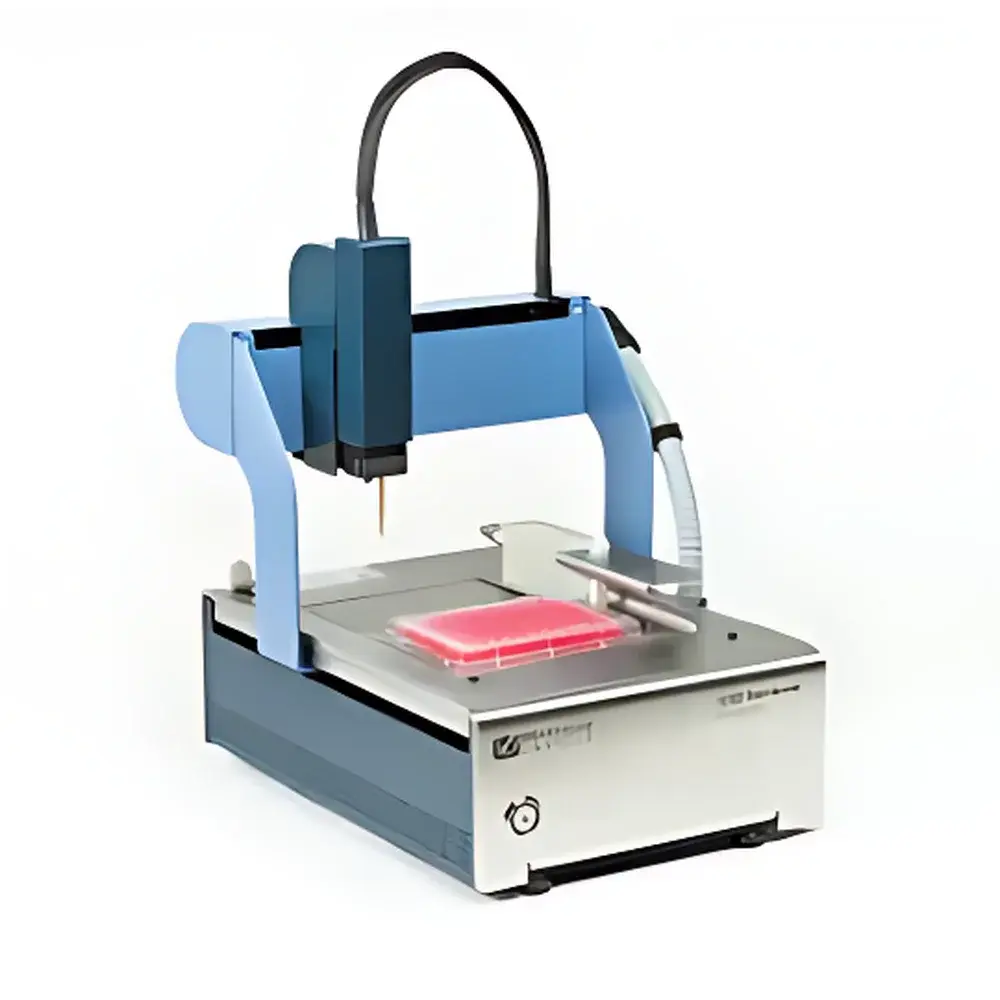
Molecular Devices DispenCell Single-Cell Dispensing System
| Brand | Molecular Devices |
|---|---|
| Origin | USA |
| Manufacturer | Molecular Devices |
| Product Type | Imported Instrument |
| Model | DispenCell |
| Separation Method | Automated Impedance-Based Dispensing |
| Certifications | Animal-Origin-Free & Cytotoxicity-Tested Disposable Tips |
| Software | DispenSoft v3.x (with Audit Trail, Electronic Signature, and 21 CFR Part 11 Compliance Support) |
Overview
The Molecular Devices DispenCell Single-Cell Dispensing System is an engineered solution for high-fidelity, automated single-cell isolation under sterile conditions. Unlike fluorescence-activated or laser-based sorting methods, DispenCell employs label-free, real-time impedance sensing to detect individual cells as they pass through a microfluidic dispensing tip—enabling gentle, non-invasive, and highly reproducible single-cell deposition into multiwell plates. The system operates at sub-0.1 psi dispensing pressure—comparable to manual pipetting—minimizing shear stress and preserving membrane integrity, metabolic activity, and proliferative capacity. Designed specifically for demanding applications in biopharmaceutical development and functional genomics, DispenCell delivers deterministic single-cell placement with traceable clonality evidence from the moment of dispensing, supporting regulatory-compliant workflows from clone selection through IND-enabling studies.
Key Features
- Impedance-based detection: Real-time, label-free cell counting and confirmation during dispensing—no dyes, antibodies, or optical perturbation required.
- Gentle dispensing dynamics: 95% post-dispensing viability across diverse mammalian cell lines (e.g., CHO, HEK293, hybridomas), validated per ISO 13485-aligned internal protocols.
- Traceable clonality assurance: DispenSoft software generates time-stamped, image-annotated dispensing maps—including well-level cell count, timestamp, tip ID, operator log, and environmental metadata—for immediate audit-ready documentation.
- Sterile workflow integration: Compact footprint (29 × 34 × 28 cm) allows full operation inside Class II biological safety cabinets; no external vacuum pumps or fluidics infrastructure needed.
- Single-use, certified consumables: Sterile, animal-origin-free, cytotoxicity-tested dispensing tips (ISO 10993-5 compliant) eliminate carryover risk and support GMP-aligned change control procedures.
- No calibration or routine maintenance: Factory-calibrated impedance sensors and plug-and-play tip recognition ensure consistent performance across shifts and operators.
Sample Compatibility & Compliance
DispenCell supports suspension-adapted mammalian cells including CHO-K1, CHO-S, HEK293, CAP-T, and hybridoma lines within size ranges of 8–25 µm diameter and concentrations of 0.5–5 × 10⁶ cells/mL. It is compatible with standard 96-well and 384-well plates (U/V-bottom, flat-bottom, and low-evaporation formats). All disposable components are manufactured under ISO 13485-certified conditions and tested per USP and for cytotoxicity. The system architecture and software design incorporate foundational controls aligned with FDA 21 CFR Part 11 (electronic records/signatures), ICH GCP, and EU Annex 11 requirements—supporting ALCOA+ data integrity principles (Attributable, Legible, Contemporaneous, Original, Accurate, Complete, Consistent, Enduring, Available).
Software & Data Management
DispenSoft v3.x provides a secure, role-based interface for method setup, run execution, and post-run analysis. Each dispensing event logs a unique digital fingerprint: plate barcode, tip serial number, ambient temperature/humidity (via optional sensor integration), user ID, timestamp (UTC-synced), and raw impedance waveform data. Export options include CSV (for LIMS integration), PDF clonality reports (with embedded thumbnails), and encrypted SQLite databases for long-term archival. Audit trail functionality captures all user actions—including parameter edits, file exports, and login/logout events—with immutable timestamps and operator attribution. Optional integration with CloneSelect Imager FL enables synchronized acquisition of Day-0 fluorescent validation images directly linked to DispenCell’s dispensing map via shared plate barcode.
Applications
- Monoclonal antibody cell line development: High-confidence single-cell seeding into 96-well plates with Day-0 clonality verification for regulatory submissions (ICH Q5D, USP <1043>).
- CRISPR/Cas9-edited clone isolation: Coupled with CloneSelect Imager FL’s confluence-based editing efficiency scoring and GFP/RFP reporter validation.
- Rare cell enrichment: Isolation of antigen-specific T cells or circulating tumor cells (CTCs) without surface marker bias or activation artifacts.
- Single-cell multi-omics preparation: Viable, unmodified single cells for downstream scRNA-seq, ATAC-seq, or paired transcriptome-epigenome profiling.
- Stem cell cloning and differentiation assays: Preservation of pluripotency markers (e.g., OCT4, NANOG) post-dispensing, confirmed by qPCR and immunocytochemistry.
FAQ
How does DispenCell differ from FACS-based single-cell sorters?
DispenCell uses impedance sensing—not optical scattering or fluorescence—to detect cells, eliminating photo-toxicity, dye requirements, and nozzle clogging risks associated with hydrodynamic focusing systems.
Is DispenSoft compliant with 21 CFR Part 11?
Yes—DispenSoft v3.x includes electronic signature workflows, audit trail logging, and role-based access control; full validation documentation (IQ/OQ/PQ templates) is available upon request.
Can DispenCell be integrated into automated liquid handling platforms?
Yes—via standardized RS-232 and Ethernet interfaces, supporting coordination with third-party robotic arms and plate handlers using Modbus TCP or custom API scripting.
What validation data is provided for clonality claims?
Each run generates a timestamped, digitally signed dispensing map with impedance-triggered event logs; this serves as primary evidence for clonality per ICH Q5D and EMA CHMP/BWP/33256/2012 guidance.
Are tips compatible with high-throughput screening (HTS) plate formats?
Yes—tips are validated for accurate single-cell deposition into 96-, 384-, and 1536-well plates, including low-volume and ultra-low-binding surfaces.



