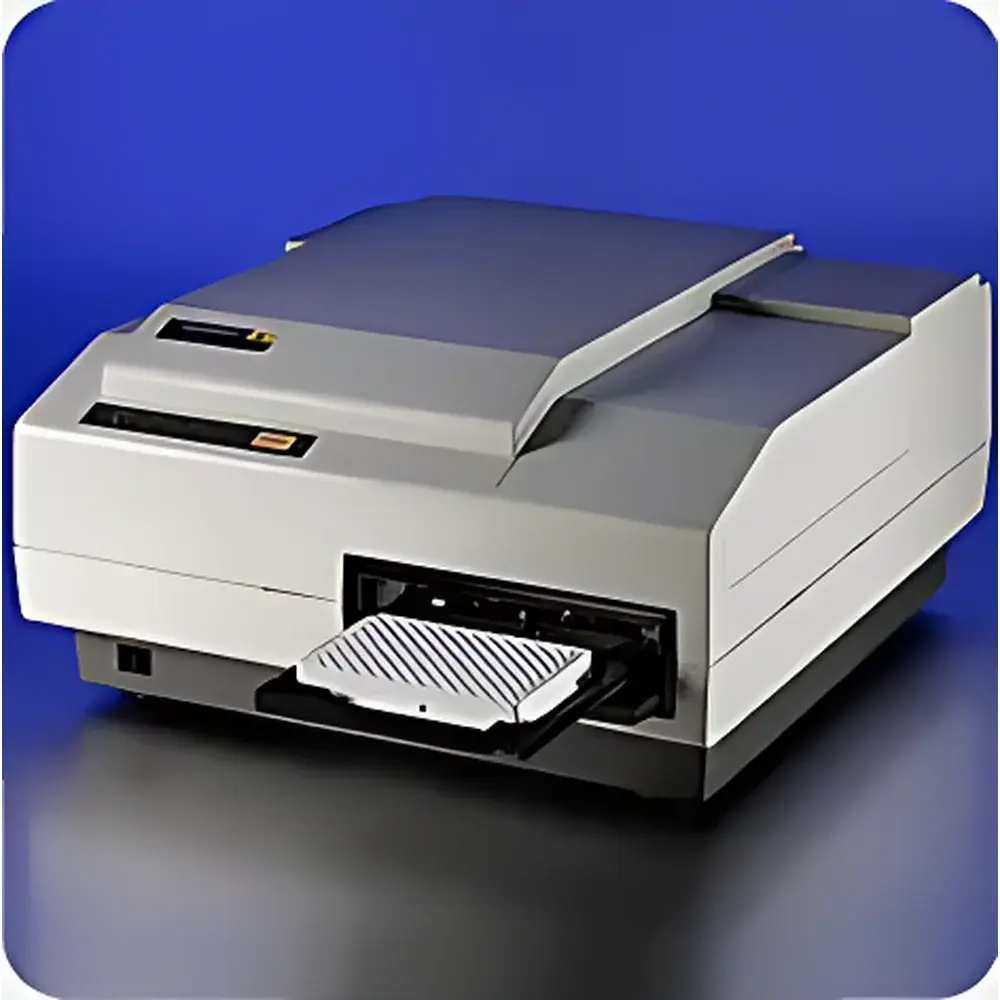
Molecular Devices SpectraMax L Chemiluminescence Microplate Reader
| Brand | Molecular Devices |
|---|---|
| Origin | Shanghai, China |
| Manufacturer Type | Original Equipment Manufacturer (OEM) |
| Regional Classification | Domestic (China-manufactured) |
| Model | SpectraMax L |
| Functionality | Dedicated Chemiluminescence Detection |
| Automation Level | Fully Automated Microplate Reader |
| Assay Modes | Endpoint, Kinetic, Fast Kinetic, Dual-Color Luminescence |
| Curve Fitting | SoftMax Pro Software (supports 4PL, 5PL, linear, log-log, spline, and custom equation models) |
| Detector | Low-Noise Photomultiplier Tube (PMT) with Synchronous Ultra-Fast Photon Counting |
| Wavelength Range | 380–630 nm |
| Absorbance Range | Not applicable (chemiluminescence-only instrument) |
| Linearity Range | 380–630 nm (luminescence spectral response) |
| Read Time per Plate | ≤10 seconds (96-well, single-channel) |
| Precision (CV) | <0.001 (R² for calibration curves), typical inter-well CV <2.5% across dynamic range |
Overview
The Molecular Devices SpectraMax L Chemiluminescence Microplate Reader is a dedicated, high-sensitivity luminometer engineered for quantitative detection of chemiluminescent and bioluminescent signals in 96- and 384-well microplates. Unlike multimode readers, the SpectraMax L employs a purpose-built optical architecture optimized exclusively for luminescence—eliminating spectral crosstalk, stray light interference, and detector saturation artifacts common in hybrid platforms. Its core measurement principle relies on photon counting via a low-noise photomultiplier tube (PMT) operating in synchronous analog and digital photon-counting modes. This dual-mode acquisition enables a dynamic detection range exceeding nine orders of magnitude (from sub-attomole to micromolar signal intensities), supporting both ultra-slow luciferase assays (e.g., firefly luciferase with 0.2 fg detection limit) and ultra-fast reactions (e.g., acridinium ester kinetics with 20 amol ATP sensitivity). The system complies with fundamental design requirements for regulated environments, including electromagnetic compatibility (IEC 61326-1), electrical safety (IEC 61010-1), and mechanical stability for continuous operation in shared laboratory infrastructure.
Key Features
- Ultra-low background detection: Optimized light-tight chamber design with thermally stabilized PMT housing reduces dark current and thermal noise, achieving signal-to-noise ratios >10⁶ under standard assay conditions.
- Configurable multi-channel architecture: Supports 1-, 2-, or 6-channel PMT configurations; 6-channel upgrade increases throughput sixfold without compromising kinetic resolution or well-to-well precision.
- Integrated, programmable reagent injectors: Up to four independently controlled injectors with bidirectional fluidics enable precise timing (±10 ms) and automated post-run line flushing—preventing precipitate accumulation and carryover between plates.
- Hardware-level PMT calibration: Internal LED-based calibration at 395 nm, 470 nm, 527 nm, and 570 nm ensures consistent spectral responsivity across channels and over time; manual 4-point well-based calibration available for assay-specific normalization.
- GxP-ready firmware architecture: Built-in audit trail logging, electronic signature support, and user-access control hierarchy aligned with FDA 21 CFR Part 11 Annex 11 and EU GMP Annex 11 expectations.
- Thermal management system: Active air cooling maintains PMT gain stability across ambient temperatures from 15–30°C, minimizing drift during extended kinetic runs (>2 hr).
Sample Compatibility & Compliance
The SpectraMax L is validated for use with standard polystyrene, white opaque, and black clear-bottom microplates (96- and 384-well formats). It supports all major chemiluminescent reporter systems—including firefly and Renilla luciferase, Gaussia princeps luciferase, Aequorin, NanoLuc, and acridinium ester–based assays—without optical filters or wavelength selection hardware. Regulatory compliance includes full IQ/OQ documentation packages, vendor-supplied installation and operational qualification protocols, and software validation kits for SoftMax Pro GxP Edition. The instrument meets ISO/IEC 17025:2017 general requirements for competence of testing and calibration laboratories when operated within specified environmental and maintenance parameters. All firmware revisions are traceable via embedded version stamps and SHA-256 checksums stored in non-volatile memory.
Software & Data Management
SoftMax Pro Software v7.1+ serves as the integrated control, acquisition, and analysis environment. It provides real-time plate mapping, kinetic trace overlay, and automatic RLU-to-concentration conversion using preloaded or user-defined curve-fitting algorithms (4-parameter logistic, 5-parameter logistic, log-log, spline interpolation). Data export options include CSV, XML, and SDMX-compliant formats compatible with LIMS and ELN systems. SoftMax Pro GxP Edition adds role-based access control, electronic signatures with reason-for-change fields, full audit trail export (including parameter edits, plate re-reads, and calibration events), and PDF report generation with embedded metadata (instrument ID, operator, timestamp, environmental logs). All software modules undergo annual verification per vendor’s Software Lifecycle Management Plan (SLCMP), with documented change control records archived for regulatory inspection.
Applications
The SpectraMax L is routinely deployed in secondary screening workflows for GPCR agonist/antagonist profiling (e.g., histamine H1 receptor activation in AqueoZen H1 cells), dual-luciferase reporter assays for transcriptional regulation studies, BRET/FRET-based protein-protein interaction quantification, and high-stringency ATP-based cell viability assays. Its fast kinetic capability supports millisecond-scale reaction monitoring in calcium flux assays using Aequorin, while its low-noise floor enables detection of endogenous bioluminescence in primary neuronal cultures or rare-event immune cell activation assays. In QC/QA settings, it validates lot-to-lot consistency of luciferase reagents per USP guidelines and supports stability-indicating methods for luminescent biomarkers under ICH Q5C.
FAQ
Is the SpectraMax L capable of absorbance or fluorescence measurements?
No. The SpectraMax L is a dedicated chemiluminescence/bioluminescence reader. It does not include excitation sources, emission filters, or absorbance optics.
What validation documentation is included with the system?
Standard delivery includes Factory Acceptance Test (FAT) report, IQ/OQ protocol templates, SoftMax Pro GxP certification package (including 21 CFR Part 11 compliance matrix), and PMT calibration certificate traceable to NIST standards.
Can the instrument be integrated into robotic liquid handling workcells?
Yes. The SpectraMax L features RS-232, USB 2.0, and Ethernet interfaces with ASCII command protocol support. It is fully compatible with StakMax Microplate Stackers and third-party automation platforms via standard plate-handling APIs.
How often must the PMT be recalibrated?
Internal LED calibration is recommended before each assay batch or daily in high-throughput labs; manual well-based calibration is required only when switching between vastly different luminescent substrates or after PMT voltage adjustment.
Does the system support time-resolved luminescence (TRF)?
No. TRF requires pulsed excitation and gated detection electronics not present in the SpectraMax L architecture.