
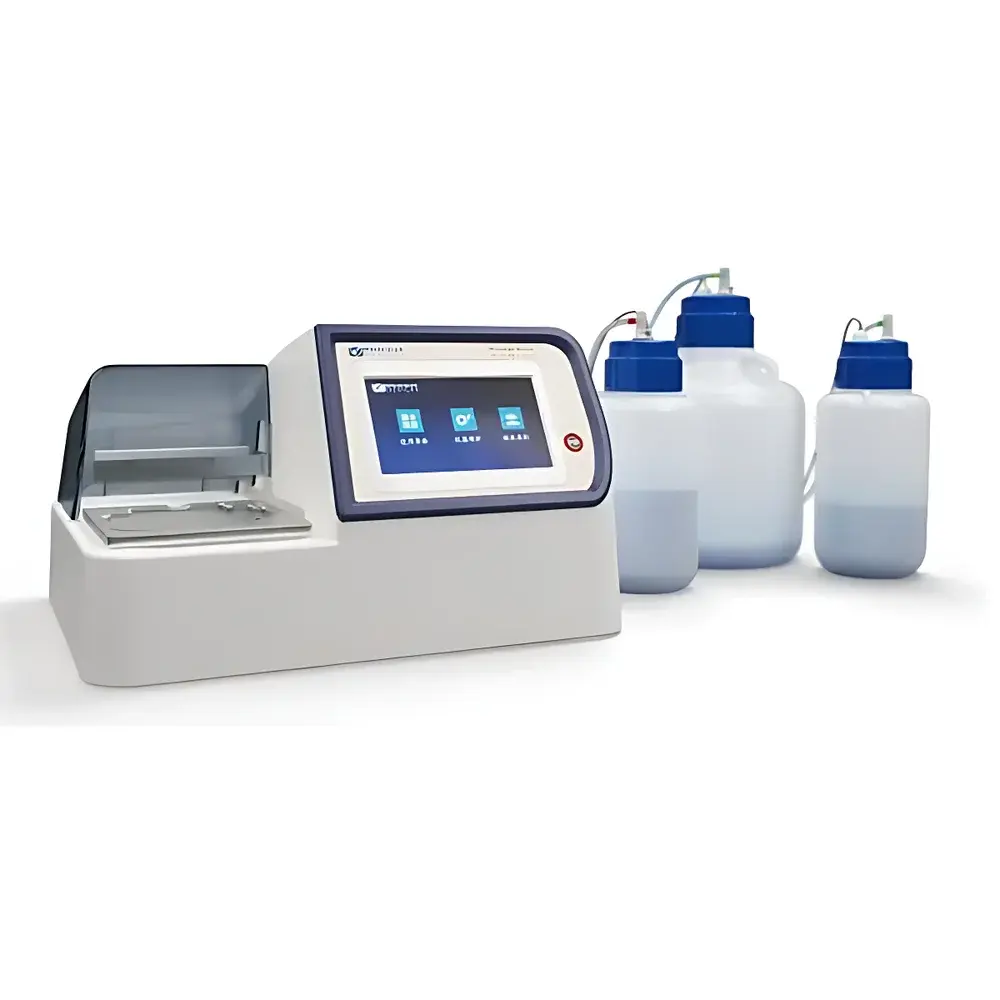
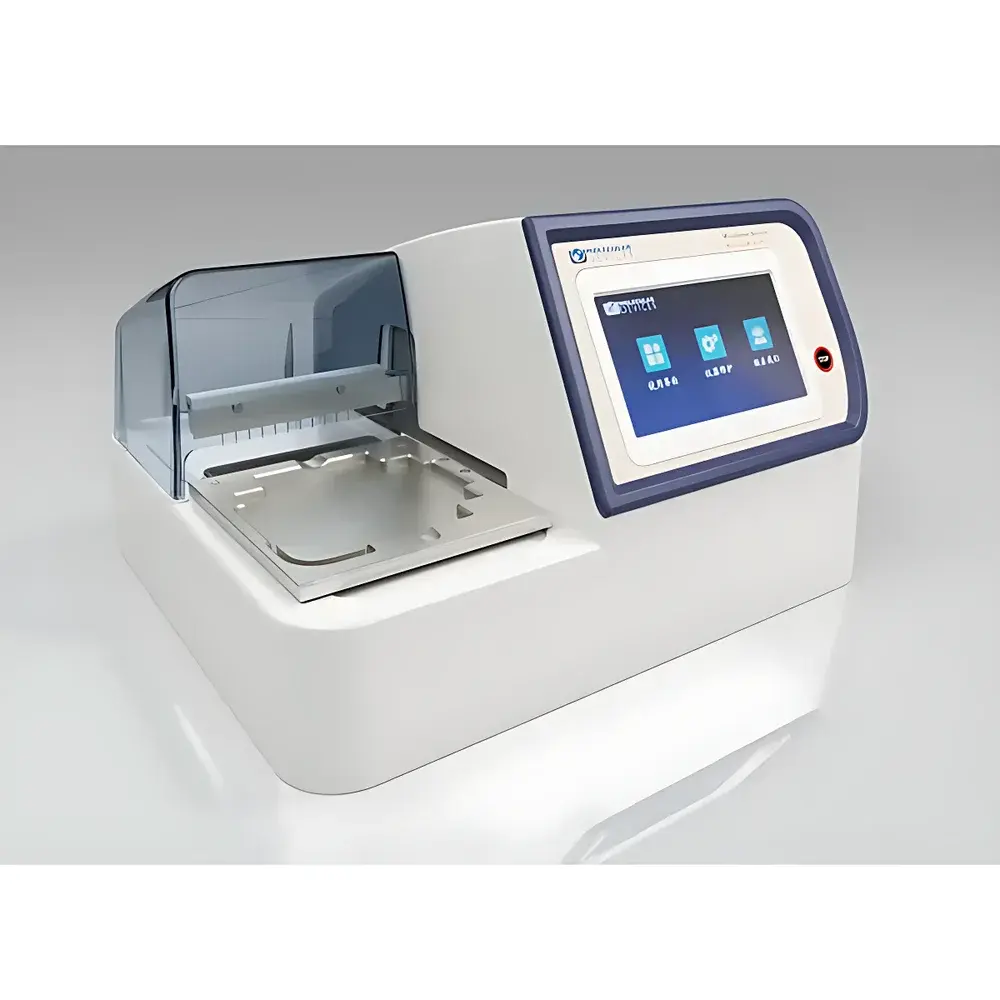
Molecular Devices MultiWash–C Automated Microplate Washer
| Brand | Molecular Devices |
|---|---|
| Origin | Shanghai, China |
| Manufacturer | Molecular Devices (Shanghai) Co., Ltd. |
| Instrument Type | Multichannel Plate Washer |
| Wash Head Configuration | 8-channel or 12-channel selectable |
| Wash Fluid Channels | 8 or 12 independent channels |
| Wash Cycle Time | <90 sec (12-channel head, 3 cycles, 3000 µL/well) |
| Residual Volume | ≤1 µL/well |
| Orbital Shaking | 3 adjustable frequency levels |
| Dispense Volume Range | 50–3000 µL (50 µL increments) |
| Dispense Accuracy & Precision | ≤3% CV at 300 µL |
| Compatible Plate Formats | Standard 96-well plates (flat-bottom, U-bottom, V-bottom |
| Integrated Fluid Management | Dual 4 L wash solution bottles + one 10 L waste bottle, all equipped with level sensors |
| Onboard Memory | 100 user-programmable protocols, up to 99 steps per protocol |
| Power Supply | 100–240 V AC, 50–60 Hz |
| Dimensions (W×H×D) | 46 × 30 × 40 cm |
| Net Weight | 13 kg |
Overview
The Molecular Devices MultiWash–C is a compact, fully automated microplate washer engineered for high-reproducibility ELISA and immunoassay workflows in regulated and research laboratories. It operates on a positive-pressure fluid delivery and vacuum-assisted aspiration principle, utilizing precisely synchronized multichannel dispensing and cross-pattern aspiration to maximize removal efficiency while minimizing well-to-well carryover. Unlike legacy washers requiring external vacuum pumps or PC-based control, the MultiWash–C integrates an internal peristaltic pump system and sealed fluid path architecture—eliminating the need for auxiliary hardware and reducing acoustic noise to <55 dB(A) during operation. Its design prioritizes operational autonomy, intuitive usability, and compatibility with standard 96-well microplates across material types (polystyrene, polypropylene) and well geometries (flat, U-bottom, V-bottom), ensuring consistent performance across diverse assay formats including sandwich ELISA, competitive binding assays, and cell-based wash steps.
Key Features
- Integrated 7-inch full-color touchscreen interface with graphical workflow navigation—no external computer or software installation required
- Selectable 8-channel or 12-channel wash heads, enabling optimization for throughput versus precision in different assay contexts
- Three-step programmable orbital shaking with adjustable frequency (low/medium/high), enhancing removal of loosely bound reagents without plate displacement
- Independent three-speed control for dispense, aspirate, and wash cycle phases—enabling fine-tuned adaptation to viscous buffers or low-volume washing protocols
- Onboard memory supporting up to 100 user-defined protocols, each configurable with up to 99 discrete steps (e.g., pre-wash, soak, dispense, incubate, aspirate, post-wash)
- Self-maintaining fluidics: automatic tubing flush sequence triggered after protocol completion or scheduled maintenance intervals
- Real-time liquid-level monitoring via capacitive sensors in both wash solution reservoirs (2 × 4 L) and waste container (10 L), with visual alerts and protocol suspension upon low-fluid or full-waste conditions
Sample Compatibility & Compliance
The MultiWash–C is validated for use with ANSI/SBS-compliant 96-well microplates, including non-standard geometries such as V-bottom and U-bottom configurations commonly used in sample concentration or bead-based assays. Its mechanical deck accommodates plates with skirted, semi-skirted, and unskirted footprints, and its adjustable plate clamp ensures stable positioning during high-frequency shaking. From a regulatory standpoint, the instrument supports audit-ready operation through timestamped protocol execution logs, user-access-level authentication (via optional password protection), and deterministic step-by-step execution—facilitating alignment with GLP, ISO 13485, and FDA 21 CFR Part 11 requirements when integrated into validated laboratory workflows. While the device itself does not carry CE IVD or FDA 510(k) clearance, it is routinely deployed as ancillary equipment in CLIA-certified labs performing ELISA under established SOPs.
Software & Data Management
All configuration, execution, and diagnostics are managed locally via the embedded Linux-based firmware and touch interface. Protocols are stored in non-volatile memory with automatic version timestamping and user attribution. No proprietary desktop software is required; however, protocol export/import via USB flash drive enables standardized method transfer between instruments within multi-site organizations. Audit trail functionality records operator ID (if enabled), start/end timestamps, protocol name, and any deviation-triggered alerts (e.g., sensor fault, aspiration failure). The system does not transmit data externally by default—ensuring compliance with institutional data governance policies—and supports manual log extraction for QA review without network connectivity.
Applications
- Routine ELISA plate washing in clinical diagnostics, biopharmaceutical QC, and academic immunology labs
- Post-incubation wash steps in multiplex cytokine assays and phospho-protein detection workflows
- Cell-based assay preparation—including adherent and suspension cultures—prior to lysis or staining
- High-sensitivity lateral flow assay development requiring precise buffer exchange and low-residue removal
- Automated support for HTS-compatible workflows when paired with Molecular Devices SpectraMax® or Spark™ microplate readers
FAQ
Does the MultiWash–C require connection to a PC or external software to operate?
No. All functions—including protocol creation, editing, execution, and maintenance—are fully self-contained on the onboard touchscreen interface.
Can the instrument be validated for GxP environments?
Yes. With appropriate IQ/OQ documentation, user access controls, and procedural SOPs, the MultiWash–C supports GLP and GMP-aligned operations; its deterministic behavior and local audit logging meet foundational requirements for regulated use.
What is the maximum residual volume achievable per well, and how is it verified?
Residual volume is ≤1 µL/well under standard 3-cycle washing conditions (3000 µL/well), as confirmed per ASTM E2797-11 using gravimetric validation methods with calibrated analytical balances.
Is the wash head compatible with deep-well or 384-well plates?
No. The MultiWash–C is designed exclusively for 96-well format plates. Deep-well and 384-well plates require dedicated wash systems with altered head geometry and fluid dynamics.
How frequently should the tubing and wash head be cleaned or replaced?
The built-in auto-flush routine mitigates salt crystallization and biofilm formation; quarterly inspection and manual cleaning with 70% ethanol are recommended. Wash head gaskets should be inspected every 6 months and replaced if compression loss or leakage is observed.




