
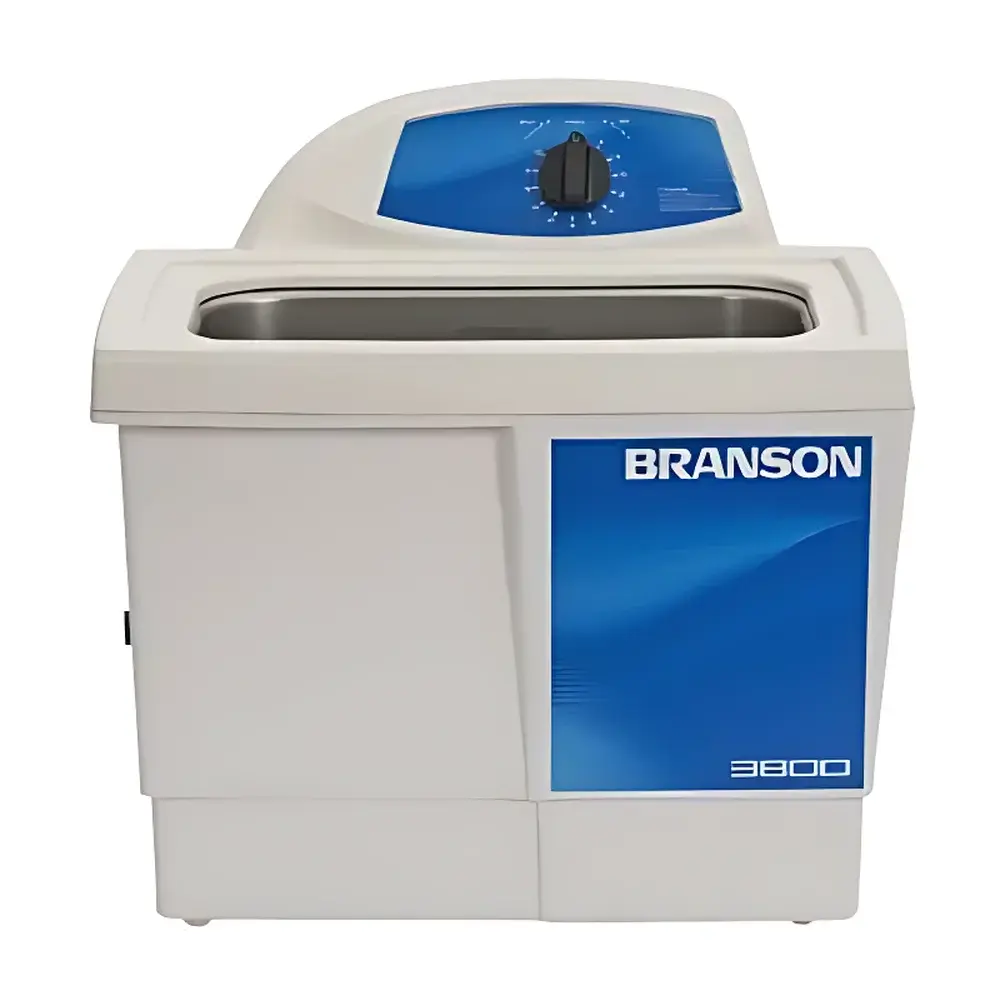
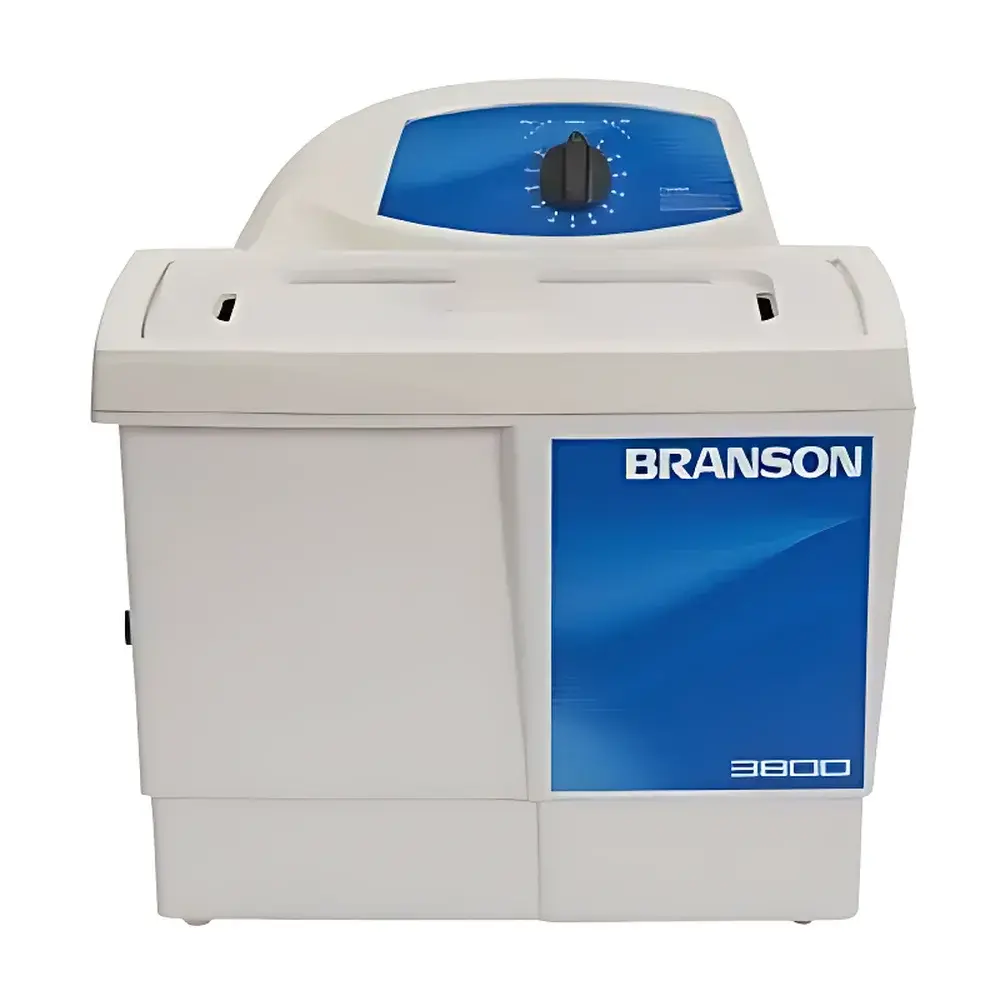
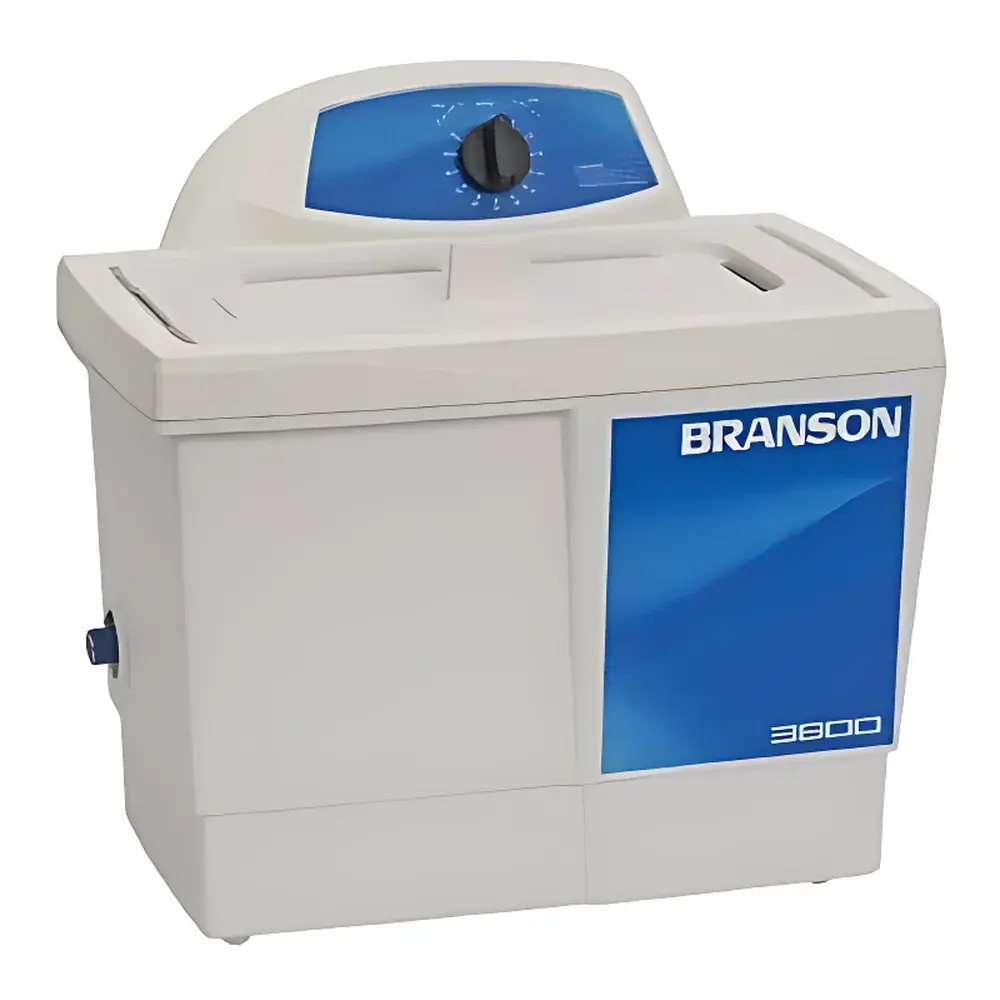
Branson M3800-C Benchtop Ultrasonic Cleaner
| Brand | Branson |
|---|---|
| Origin | USA |
| Model | M3800-C |
| Tank Capacity | 5.7 L |
| Internal Dimensions (L×W×D) | 290 × 150 × 150 mm |
| External Dimensions (L×W×D) | 397 × 317 × 377 mm |
| Weight | 5.4 kg |
| Construction | PP outer housing / 304 stainless steel tank |
| Frequency | 40 kHz |
| Power Output | 130 W |
| Timer Range | 0–60 min or continuous mode |
| Drain Port | Yes |
| Certifications | CE, UL, CSA, FCC, TÜV |
Overview
The Branson M3800-C Benchtop Ultrasonic Cleaner is an engineered solution for precision cleaning of delicate laboratory components, analytical instruments, optical parts, and small-volume samples in research, quality control, and manufacturing environments. It operates on the principle of high-frequency acoustic cavitation—generating controlled micro-bubbles in a liquid medium (typically aqueous or solvent-based cleaning solutions) that collapse with localized energy release, dislodging particulate contaminants, organic residues, and biofilms from surfaces without mechanical abrasion. With a fixed operating frequency of 40 kHz and a nominal power output of 130 W, the M3800-C delivers consistent ultrasonic energy across its 5.7-liter tank volume, optimized for reproducible cleaning performance in regulated workflows. Its design adheres to internationally recognized electromagnetic compatibility (EMC) and electrical safety standards—including UL 61010-1, CSA C22.2 No. 61010-1, EN 61000-6-3, and EN 61000-6-2—ensuring safe integration into ISO/IEC 17025-accredited laboratories and GxP-compliant facilities.
Key Features
- Automatic power tracking circuitry maintains stable ultrasonic output regardless of load variation, temperature drift, or solution composition changes—critical for inter-laboratory method transfer and long-term process validation.
- Proprietary sweep-frequency technology modulates the drive signal within a narrow band around 40 kHz to prevent standing wave formation and ensure uniform cavitation distribution throughout the tank volume.
- Langevin-type transducer assembly featuring a metal-ceramic composite stack, mounted via advanced adhesive bonding to the 304 stainless steel tank bottom—eliminating mechanical fasteners and minimizing delamination risk over extended operational life.
- Vertically oriented internal PCB architecture with conformal coating provides enhanced resistance to condensation, splashing, and ambient humidity—supporting reliable operation in high-moisture lab environments.
- Ergonomic control panel positioned above the tank rim prevents liquid ingress during routine use; mechanical timer dial offers tactile feedback and unambiguous setting visibility without reliance on digital displays.
- Optimized water-level indicator line ensures maximum energy coupling efficiency between transducers and cleaning solution—validated per ASTM D2603-20 for ultrasonic cleaning system calibration protocols.
- Integrated drain valve and hinged acoustic lid (doubles as drip tray) enable rapid solution exchange and containment of aerosols during draining—reducing operator exposure and improving workflow hygiene.
Sample Compatibility & Compliance
The M3800-C accommodates a broad range of sample types including glassware (vials, cuvettes, pipette tips), metal components (surgical tools, calibration standards), ceramic substrates, and polymer-based microfluidic devices. Its 304 stainless steel tank and polypropylene housing resist corrosion from common alkaline, acidic, and neutral cleaning formulations—including those compliant with ASTM F312-22 and ISO 15883-5 for reprocessing of medical devices. All units are supplied with full Declaration of Conformity documentation supporting CE marking under the EU Machinery Directive 2006/42/EC and Low Voltage Directive 2014/35/EU. TÜV Rheinland certification confirms compliance with IEC 61010-1:2010 + A1:2019 for laboratory equipment safety, including dielectric strength, creepage distance, and protective earth continuity testing.
Software & Data Management
As a stand-alone analog-controlled instrument, the M3800-C does not incorporate embedded software or network connectivity. Its mechanical timer and fixed-frequency operation support fully documented, non-software-dependent SOP execution—aligning with FDA 21 CFR Part 11 requirements for manual systems where electronic records are not generated. For laboratories implementing electronic batch records, the device may be integrated into validated cleaning processes using external time-stamped logbooks or supervisory control systems (e.g., LabVantage, STARLIMS) that capture operator entries, cycle parameters, and maintenance history. Calibration verification can be performed using standardized aluminum foil erosion tests per ASTM E1755-00 or hydrophone-based intensity mapping per IEC 61847.
Applications
- Cleaning of HPLC and GC autosampler vials, syringe filters, and column frits prior to analysis.
- Removal of flux residues and solder paste from printed circuit boards (PCBs) in electronics R&D labs.
- Preparation of TEM grids and SEM stubs for nanomaterial characterization.
- Decontamination of reusable surgical instruments and dental handpieces in clinical research settings.
- Routine maintenance of viscometers, density meters, and refractometers requiring residue-free sensor surfaces.
- Supporting ASTM D1298, ISO 3675, and IP 125 density measurement protocols through standardized glassware cleaning.
FAQ
What is the recommended cleaning solution for the M3800-C?
Aqueous alkaline detergents (e.g., Alconox® Liquinox®) are preferred for general labware cleaning; solvent-based solutions (e.g., isopropanol or acetone) may be used only if compatible with tank seals and verified for flash point safety.
Can the M3800-C be used for sterilization?
No—it is a cleaning device only. Sterilization requires validated thermal, chemical, or radiation methods meeting ISO 17665 or AAMI ST34 standards.
Is the unit suitable for use with deionized water alone?
Yes, though efficacy is significantly reduced; ultrasonic cavitation in pure DI water lacks surfactant-assisted particle suspension and may accelerate tank pitting over time.
How often should the transducer bond integrity be verified?
Annual visual inspection and impedance testing per Branson Service Bulletin SB-M-2023-04 are recommended for GMP-regulated environments.
Does the M3800-C support external trigger or remote start functionality?
No—operation is exclusively local via the front-panel mechanical timer; no RS-232, USB, or Ethernet interfaces are provided.



