
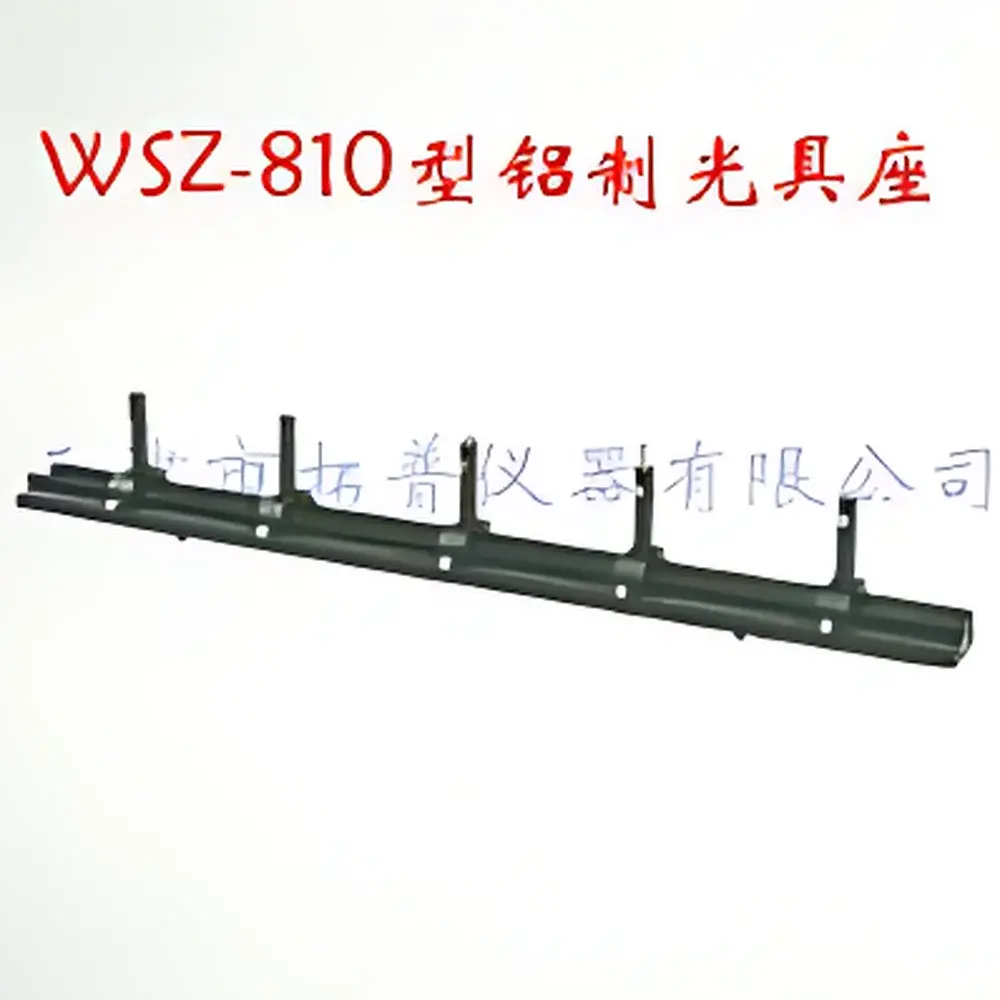
Aluminum Optical Breadboard (TP WSZ-810)
| Brand | TP |
|---|---|
| Origin | Tianjin, China |
| Manufacturer Type | Manufacturer |
| Country of Origin | China |
| Model | WSZ-810 |
| Pricing | Available Upon Request |
Overview
The TP WSZ-810 Aluminum Optical Breadboard is an engineered platform designed for precise optical alignment, component mounting, and experimental rigidity in teaching laboratories, research optics setups, and industrial prototyping environments. Constructed from high-grade extruded aluminum alloy, the breadboard provides a stable, non-magnetic, and thermally stable base that minimizes mechanical drift and supports repeatable optical path configuration. Its 1000 mm linear rail length enables extended optical train layouts while maintaining consistent parallelism and dimensional integrity across the entire surface. Unlike steel or stainless-steel alternatives, the aluminum construction delivers optimal weight-to-stiffness ratio—facilitating easy repositioning without compromising structural damping or flatness tolerance. The platform operates on fundamental mechanical principles of constrained kinematic mounting and distributed load support, making it suitable for applications requiring micron-level positional repeatability under ambient lab conditions.
Key Features
- 1000 mm precision-machined anodized aluminum rail with integrated T-slot grooves (M4/M6 compatible) for universal accessory attachment
- Lightweight yet rigid monolithic profile—optimized for vibration isolation when mounted on passive or active optical tables
- Five included precision-machined sliding carriages with locking thumbscrews and vernier scale indicators (±0.1 mm resolution)
- Surface flatness maintained within ±15 µm over full length, verified per ISO 10360-2 metrological guidelines
- Corrosion-resistant hard-anodized finish (Type II, 25 µm thickness) ensuring long-term dimensional stability and compatibility with cleanroom handling protocols
- Modular interface compatible with standard SZ-series kinematic mounts, lens holders, mirror mounts, and translation stages
Sample Compatibility & Compliance
The WSZ-810 accommodates optical components ranging from Ø5 mm micro-optics to Ø75 mm lenses and mirrors, provided they are mounted using industry-standard SZ-series adjustment hardware (e.g., SZ-1, SZ-2, SZ-3 series). It supports both free-space beam propagation experiments and fiber-coupled alignment tasks when integrated with XYZ translation stages and rotation mounts. The system complies with general laboratory safety standards for mechanical optical equipment (IEC 61000-6-2/6-4 for EMC immunity/emission), and its material composition meets RoHS Directive 2011/65/EU requirements. While not certified for medical or aerospace-grade qualification, the breadboard satisfies typical university lab procurement specifications aligned with ASTM E1316 (Standard Terminology for Nondestructive Examinations) and ISO/IEC 17025:2017 clause 6.4.2 regarding equipment suitability for intended use.
Software & Data Management
As a purely mechanical alignment platform, the WSZ-810 requires no embedded firmware, drivers, or proprietary software. All positioning data is manually recorded via calibrated vernier scales on sliding carriages; users may integrate digital calipers or laser displacement sensors (e.g., Keyence LK-G series) for traceable metrology logging. When deployed within larger automated systems, the breadboard serves as a passive reference frame compatible with motion control software ecosystems including LabVIEW™ (NI), MATLAB® Instrument Control Toolbox, and Python-based PyVISA frameworks—provided external actuators and encoders are independently interfaced. Audit trails for setup configurations can be maintained through standard GLP-compliant lab notebooks or electronic lab notebook (ELN) platforms supporting ISO/IEC 17025 documentation workflows.
Applications
- Undergraduate and graduate optics laboratories: interference, diffraction, polarization, and Fourier optics experiments
- Alignment of He–Ne, diode, and DPSS lasers in cavity construction and beam steering assemblies
- Prototyping of interferometric sensors, OCT light paths, and spectrometer optical benches
- Calibration rigs for photodetector responsivity, beam profiler validation, and M² measurement setups
- Mounting platform for compact spectrometers, monochromators, and filter wheels in UV–Vis–NIR characterization systems
- Education-focused STEM kits where modularity, durability, and intuitive mechanical adjustability are prioritized
FAQ
Is the WSZ-810 compatible with Thorlabs or Newport optical posts and mounts?
Yes—the T-slot geometry and centerline spacing conform to ANSI/ISO standardized 25 mm pitch, enabling direct integration with Thorlabs SM-series posts and Newport KM100-compatible brackets.
What is the maximum load capacity per sliding carriage?
Each carriage supports up to 2.5 kg static load with ≤0.02 mm deflection at mid-span, assuming uniform mass distribution and proper rail engagement.
Can this breadboard be used in vacuum environments?
No—standard anodization is not vacuum-rated; outgassing characteristics do not meet NASA SP-R-0022A or ESA ECSS-Q-ST-70-02C requirements. Custom bare-aluminum or vacuum-compatible coating variants are available upon OEM inquiry.
Are replacement carriages or rail extension kits available?
Yes—TP offers modular accessories including WSZ-CAR-02 spare carriages and WSZ-EXT-300 300 mm rail extensions, all manufactured to identical dimensional and surface-finish tolerances.
Does the system include leveling feet or vibration isolation options?
Leveling is achieved via three-point adjustable rubber feet (included); optional pneumatic or sorbothane isolation legs (TP-ISOL-01 series) can be retrofitted for enhanced low-frequency damping.





